Reptile Heating: Heat Mats, Bulbs & Thermostats
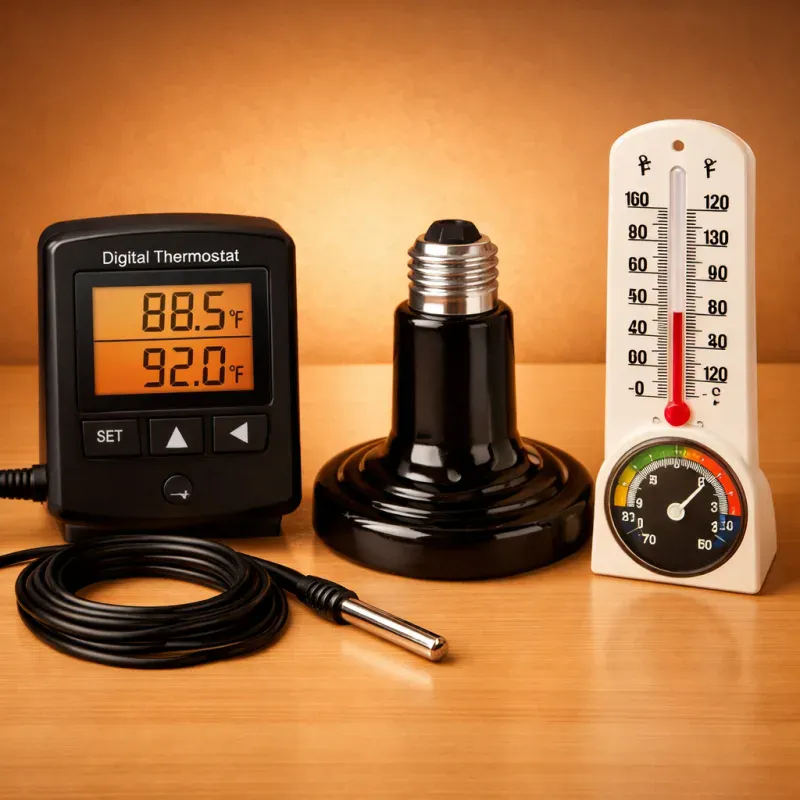
Reptile Heating Guide: Heat Mats, Bulbs, Ceramics & Thermostats
Reptiles are ectotherms — they rely entirely on their environment to regulate body temperature. Getting heating right is the single most important factor in reptile husbandry. Here is how the four main heating methods compare.
| Method | What it heats | Day / night | Best for | Watch out for |
|---|---|---|---|---|
| Heat mat | Contact surface (belly heat) | Either, on a thermostat | Terrestrial snakes and geckos that need a warm hide | Does almost nothing for ambient air in a tall enclosure; can crack glass if unregulated |
| Basking bulb (halogen or incandescent) | Surface + air, with visible light | Day only | Desert and diurnal species that bask | Needs a dimming thermostat; never use at night |
| Ceramic heat emitter (CHE) | Air and nearby surfaces, no light | Either, 24/7 on a thermostat | Night heat and ambient support | Dries the air; needs an on/off or pulse thermostat |
| Radiant heat panel (RHP) | Surfaces and objects, low air temperature | Either, 24/7 on a thermostat | Large, tall, or well-ventilated enclosures | Slow to respond; must be mounted with clearance |
No single method covers every need. Most good enclosures combine two: a light-emitting basking bulb for the day, plus a CHE, DHP, or RHP on a thermostat for ambient temperature and night heat.
Heat Mats
A heat mat provides contact heat, not room heat. It belongs under roughly one third of the floor, under a hide, with a thermostat probe on the mat itself. In a glass tank the mat goes on the outside of the bottom pane; never inside where the animal can sit on the wiring.
- Always use a thermostat. An unregulated mat can exceed 110°F (43°C) against the glass.
- Leave an escape route. Cover one third of the floor at most, so the animal can move off the warm patch.
- Keep substrate shallow over the mat. A 10 cm layer of dry substrate insulates the mat and defeats it.
- Not for arboreal species. Crested geckos, chameleons, and tree frogs need air temperature, not belly heat.
Basking Bulbs
A halogen flood or incandescent bulb produces light and heat together, which is what diurnal baskers evolved for. Fit a dimming thermostat, aim the beam at a flat stone or slate, and measure the surface temperature rather than the air beside it.
- Flood, not spot. A flood spreads the heat over a basking area; a narrow spot creates a hot pinpoint.
- Overlap UVB with the basking zone. The UVB tube and the heat lamp should illuminate the same area, or the animal has to choose between light and heat.
- Replace on schedule. Halogens lose output and UVB tubes lose UV even while still glowing; log the install date.
- Off at night. Use a CHE, DHP, or RHP for night heat so the photoperiod stays intact.
Ceramic Heat Emitters
A CHE is a ceramic element that radiates heat with no visible light, which makes it the default night-heat source. It heats the air and nearby surfaces, dries the enclosure, and must run on a thermostat — on/off or pulse proportional, never a standard dimmer.
Sizing is a function of enclosure volume and the temperature rise you need: a 40-gallon enclosure needing a 20°F rise is roughly an 80W CHE, then fine-tune with the thermostat. Full wattage tables and mounting distances are in the ceramic heat emitter guide.
Radiant Heat Panels
An RHP is a flat panel mounted on or near the ceiling. It warms surfaces and objects rather than the air, so it holds a basking area without drying the enclosure as aggressively as a CHE. It is the usual choice for large wooden vivaria and for keepers who need ambient heat without a visible bulb.
- Mount with clearance. Follow the panel's minimum distance from the ceiling and from the animal's highest perch.
- Run it on a thermostat. RHPs are slow to respond, so pair them with a pulse or dimming controller rather than an on/off unit if you can.
- Do not expect a hot spot. An RHP gives a broad warm zone; a basking species still needs a lamp for a true basking surface.
Thermostat Selection
| Type | Holds temperature to | Use with | Notes |
|---|---|---|---|
| On/off | ±2–4°F | Heat mats, CHEs | Cheapest; audible click; fine for ambient heat |
| Pulse proportional | ±1°F | CHEs, DHPs, RHPs | Best all-round choice for non-dimming loads |
| Dimming | <1°F | Halogen and incandescent bulbs | Required for basking bulbs; not for CHEs |
Put the probe where the animal basks, secure it so it cannot be dragged, and cross-check with a separate digital thermometer. A thermostat reading the wrong spot is worse than no thermostat. For a full comparison, see the thermostat controller guide.
Combining Heat Sources
The reliable pattern is one light-emitting basking source for the day plus one non-light source for ambient and night heat. Set the basking bulb to hold the hot spot, and set the CHE/DHP/RHP a few degrees lower so it only lifts ambient temperature when the room falls.
- Two controllers, two probes. Do not run a bulb and a CHE off one thermostat; they respond at different speeds.
- Watch humidity when you add heat. Every additional heat source lowers relative humidity; add a larger water bowl or a humid hide rather than misting more often.
- Build the gradient, then the microclimate. The floor plan comes first: hot end, cool end, hides at both, water in the middle or cool end.
Troubleshooting
| Problem | Likely cause | Fix |
|---|---|---|
| Enclosure will not reach temperature | Room too cold, wattage too low, or heat escaping through a mesh top | Insulate the sides and top, raise wattage, or move the enclosure out of the draught |
| Hot spot is too hot | Bulb too close or too high wattage; no dimming control | Raise the lamp, fit a dimming thermostat, or drop to a lower wattage |
| Temperature swings overnight | Only light-emitting heat, switched off at night | Add a CHE/DHP on a thermostat for ambient and night heat |
| Animal avoids the warm side | No usable cool end, or the hot spot is a pinpoint | Widen the gradient and spread the basking area over a flat stone |
| Humidity collapses when the lamp is on | Heat drying the air faster than the water bowl replaces it | Bigger water bowl, humid hide, or a switch to a radiant source |
| Thermostat reads fine, animal still cold | Probe is in the wrong place (wall, buried, or above the lamp) | Move the probe to the basking surface and cross-check with an IR gun |
Temperature Targets by Species
These are the working ranges the individual guides use. Follow the linked guide for the full gradient, humidity, and measurement method.
| Species | Basking surface | Warm side | Cool side | Night | Guide |
|---|---|---|---|---|---|
| Ball python | 88–92°F (31–33°C) | 80–86°F (27–30°C) | 76–80°F (24–27°C) | 75–78°F (24–26°C) | Ball python temperatures |
| Corn snake | 88–92°F (31–33°C) | 78–82°F (25–28°C) | 75–80°F (24–27°C) | 70–75°F (21–24°C) | Corn snake temperatures |
| King snake | 88–92°F (31–33°C) | 80–85°F (27–29°C) | 70–75°F (21–24°C) | 65–70°F (18–21°C) | King snake temperatures |
| Bearded dragon | 100–110°F (38–43°C) | 85–95°F (29–35°C) | 75–85°F (24–29°C) | 65–75°F (18–24°C) | Bearded dragon care |
| Leopard gecko | 88–92°F (31–33°C) | 85–90°F (29–32°C) | 75–80°F (24–27°C) | 65–75°F (18–24°C) | Leopard gecko care |
| Crested gecko | — (ambient species) | 75–79°F (24–26°C) | 70–75°F (21–24°C) | 65–72°F (18–22°C) | Crested gecko temperatures |
| Uromastyx | 120–130°F (49–54°C) | 95–100°F (35–38°C) | 80–85°F (27–29°C) | 65–75°F (18–24°C) | Uromastyx temperatures |
| Pacman frog | 82–85°F (28–29°C) surface | 75–82°F (24–28°C) | 72–75°F (22–24°C) | 65–72°F (18–22°C) | Pacman frog temperatures |
Two habits prevent most heating problems: put every heat source on a thermostat, and measure the surface the animal touches rather than the air at the back of the enclosure. The temperature and humidity tool converts between °F and °C and logs a gradient plan.
Frequently Asked Questions
What is the best heat source for a reptile?
It depends on the species and the enclosure. Diurnal baskers need a light-emitting basking bulb; nocturnal and arboreal species usually do better with a CHE, DHP, or RHP. Almost every setup needs a thermostat regardless of the source.
Can I use a heat mat and a lamp together?
Yes, if each has its own thermostat and each covers a different job: the mat for contact heat under a hide, the lamp for the basking surface. Do not stack them on the same patch of floor.
Do I need night heat?
Only if the room drops below the species' tolerance. A natural night drop of 5–10°F is healthy; a drop into the 60s for a tropical species is not. Use a non-light source when you do need it.
Why does my enclosure lose heat at night?
Glass and mesh tops radiate heat quickly, and a lamp that switches off takes its heat with it. Insulating the back and sides and adding a thermostat-controlled CHE or RHP is the usual fix.
Not a timer — it reads the actual humidity and stops when it hits your target. Two temperature probes, failsafes, no cloud account. We don't know yet whether it's worth making, so we're asking keepers first. Two-minute survey →
One email when there's news — including if we decide not to build it. No newsletter.
Check optimal temps, calculate feeding, and find your perfect species match.
References
- A. B. (2020). Reptile Heating Fundamentals. Herpetological Review.
- C. D. (2019). Thermal Regulation in Captive Reptiles. Journal of Zoo and Wildlife Medicine.
🐾 Join the Community
See how other keepers set up their enclosures, ask questions, and share your experience.
🛠️ Apply What You Learned
Check optimal temps, calculate feeding schedules, and get calcium dosage — all personalized for your species.
Comments
No account needed — corrections, updates and questions are all welcome. For a full question with photos, the community Q&A is the better place.