Crested Gecko Care Guide: Setup, Diet & Handling
Species Overview
\nCrested geckos thrive on powdered meal replacement (CGD) — no live insects required. Pangea and Repashy make balanced formulas. Get the diet right and you've solved 80% of care. Jump to Diet →
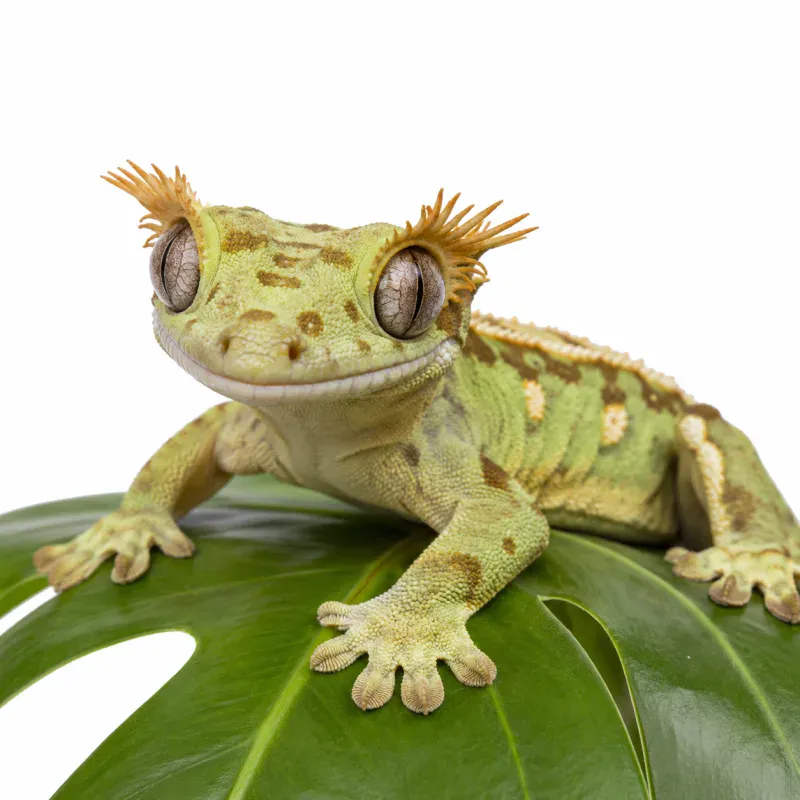
\nThe crested gecko (Correlophus ciliatus) was believed extinct until its rediscovery on the Isle of Pines, New Caledonia, in 1994. Since then, it has become one of the most popular pet geckos — and for good reason: they don't require live insects, thrive at room temperature, and display stunning color changes ("firing up").
\nNative to the humid forests of New Caledonia, these arboreal geckos are nocturnal and spend their days hidden in foliage. They are known for their distinctive crests running from their eyes to their tail base, and their ability to "fire up" — brightening their colors when excited or stressed. With proper care, they can live 15–20 years, making them a long-term companion.
\n\nEnclosure Setup
\n\n Crested geckos are arboreal. Vertical space matters more than floor space. In the wild, they rarely descend to the ground, preferring the canopy. Your enclosure should mimic this vertical habitat.
\n| Life Stage | Minimum Enclosure |
|---|---|
| Hatchling (<15g) | 12"×12"×18" or large Kritter Keeper |
| Sub-adult (15–30g) | 18"×18"×24" |
| Adult (30g+) | 18"×18"×24" or larger |
While these are minimums, bigger is always better. A 24"×18"×36" or larger enclosure provides more climbing space and allows for a more naturalistic layout. For a single adult, a 20-gallon tall aquarium with a screen top can also work, but front-opening enclosures are easier to access and maintain.
\nEssential Equipment
\n- \n
- Enclosure: Glass terrarium with front doors or a large Kritter Keeper for hatchlings. \n
- Substrate: Paper towel for quarantine or simple setups; coconut fiber, sphagnum moss, or ABG mix for bioactive. \n
- Climbing structures: Branches, cork bark, bamboo poles, and vines. Ensure they are sturdy and securely placed. \n
- Foliage: Live or artificial plants covering 70–80% of the space. This provides hiding spots and helps maintain humidity. \n
- Feeding ledge: A magnetic or suction-cup ledge at mid-to-upper height for food and water dishes. \n
- Hide: At least one hide near the top, such as a cork tube or coconut hide. \n
- Water dish: Small, shallow dish with fresh water, placed on the ledge or floor. \n
- Thermometer and hygrometer: Digital units placed at mid-height to monitor conditions. \n
Step-by-Step Setup
\n- \n
- Clean the enclosure with a reptile-safe disinfectant and rinse thoroughly. \n
- Add substrate: 2–3 inches for simple setups; for bioactive, add drainage layer (clay balls) and ABG mix. \n
- Place hardscape: branches, cork bark, and vines. Create multiple vertical and horizontal pathways. \n
- Add plants: live or artificial. Ensure they are non-toxic and secure. \n
- Install feeding ledge and water dish at upper levels. \n
- Add a hide near the top. \n
- Set up lighting and heating (if needed). \n
- Mist the enclosure thoroughly and let it cycle for 24–48 hours before adding the gecko. \n
Common Mistakes
\n- \n
- Too small enclosure: Hatchlings can be in a small container, but adults need the 18"×18"×24" minimum. \n
- No vertical space: A long, low tank is unsuitable for an arboreal species. \n
- Overcrowding: House only one gecko per enclosure; they are solitary and may fight. \n
- Insufficient foliage: A bare tank causes stress and makes the gecko feel exposed. \n
Temperature & Heating
\nThis is where crested geckos differ dramatically from desert species: they are heat-sensitive. They are adapted to the mild, subtropical climate of New Caledonia, where temperatures rarely exceed 80°F (27°C).
\n| Period | Temperature (°F) | Temperature (°C) |
|---|---|---|
| Day | 72–78°F | 22–26°C |
| Night | 65–72°F | 18–22°C |
Critical: Sustained temperatures above 80°F (27°C) cause heat stress, neurological damage, and death. If your home stays above 80°F in summer, you need air conditioning — not a fan, which doesn't cool reptiles.\n
Most homes need no supplemental heating for crested geckos. If your room dips below 65°F, use a low-wattage ceramic heat emitter on a thermostat. Never use heat rocks or heat mats under the enclosure, as they can cause burns.
\nHow to Heat Safely
\n- \n
- If temperatures fall below 65°F at night, use a ceramic heat emitter (CHE) rated for the enclosure size, connected to a thermostat set to 70°F. \n
- Place the CHE on one side to create a temperature gradient, allowing the gecko to thermoregulate. \n
- Monitor with a digital thermometer at both the warm and cool ends. \n
- Never use heat lamps that emit light at night; they can disrupt the gecko's circadian rhythm. \n
What to Do in Summer Heat
\n- \n
- Move the enclosure to the coolest room in the house. \n
- Use air conditioning to keep ambient temperatures below 80°F. \n
- Provide a ceramic tile or stone slab in the enclosure; you can freeze it briefly (but not below freezing) and place it for the gecko to cool on. \n
- Increase ventilation slightly, but maintain humidity. \n
Humidity & Misting
\nHumidity is crucial for crested geckos, as they come from a tropical environment with high moisture. A proper humidity cycle mimics the natural fog and rain patterns of New Caledonia.
\n- \n
- Daytime: Let the enclosure dry to 50–60%. \n
- Night: Mist heavily to raise to 80–90%. \n
- This cycle mimics New Caledonia's nighttime fog → daytime sun. \n
- Use a digital hygrometer. Never keep the enclosure constantly wet — this causes bacterial/fungal infections. \n
How to Mist
\nMisting can be done manually with a spray bottle or automatically with a misting system. For most keepers, manual misting once or twice daily is sufficient.
\n- \n
- Use distilled or reverse-osmosis water to avoid mineral spots on glass. \n
- Mist the foliage and sides of the enclosure thoroughly in the evening, raising humidity to 80–90%. \n
- Allow the enclosure to dry during the day, but not completely — aim for 50–60%. \n
- If your home is very dry, you may need to mist again in the morning or use a humidifier in the room. \n
Monitoring and Troubleshooting
\n- \n
- Place the hygrometer at mid-height, away from the direct mist spray. \n
- If humidity stays too high (above 90% constantly), increase ventilation and reduce misting. \n
- If humidity drops below 40%, the gecko may have difficulty shedding. Increase misting frequency. \n
- Signs of low humidity: stuck shed, dry skin, lethargy. \n
- Signs of high humidity: respiratory issues, mold growth, skin infections. \n
Water Dish
\nAlways provide a small, shallow water dish with fresh water. Even though they may not drink from it often, it's essential for hydration and can also contribute to humidity.
\n\nComplete Gecko Diet (CGD)
\nThe single biggest advantage of crested geckos: they thrive on a powdered complete diet mixed with water. No live insects required. This makes feeding simple and eliminates the need for insect husbandry.
\n- \n
- Recommended brands: Pangea Gecko Diet (Fruit Mix with Insects or Watermelon are favorites), Repashy Crested Gecko Diet. \n
- Mixing: 1 part powder to 2 parts water. Change every 24–48 hours. \n
- Live insects (optional): Dubia roaches or crickets, dusted with calcium, 1–2×/week. Never more than the width between the gecko's eyes. \n
Detailed Feeding Instructions
\n- \n
- Mix the CGD powder with water to a ketchup-like consistency. Use warm water to mix more easily. \n
- Place a small amount (about a teaspoon for adults, less for juveniles) on the feeding ledge. \n
- Offer food every other day for adults; hatchlings and juveniles can be fed daily. \n
- Remove and replace the food after 24–48 hours, even if it looks uneaten, to prevent spoilage. \n
- Clean the feeding ledge with warm water after each feeding. \n
Nutritional Considerations
\nCGD formulas are balanced with calcium, vitamins, and protein, so no additional supplements are needed when feeding CGD exclusively. If you offer live insects, dust them with a calcium supplement (without D3 if using a UVB light, or with D3 if no UVB).
\nTroubleshooting Feeding Issues
\n- \n
- Gecko not eating: This can be due to stress, temperature, or illness. Ensure temperatures are in the correct range and the enclosure is not too bright. New geckos may take a few days to settle. \n
- Gecko losing weight: Check for parasites or other health issues. Weigh your gecko regularly with a digital scale. \n
- Gecko eating substrate: This is dangerous. Ensure food is always on the ledge, not on the ground. \n
Live Insects: Pros and Cons
\n| Pros | Cons |
|---|---|
| Provides variety and mental stimulation | Requires insect husbandry |
| Can boost protein for breeding or growth | Risk of impaction if insects are too large |
| Encourages natural hunting behavior | May cause overfeeding and obesity |
If you choose to offer insects, do so sparingly and always dust them with calcium. Never offer insects larger than the space between the gecko's eyes.
\n\nBioactive vs. Simple Setup
\nCrested geckos are the most popular species for bioactive enclosures — and for good reason. They thrive in a naturalistic environment with live plants and a self-cleaning ecosystem.
\n- \n
- Simple: Paper towel substrate (easy to monitor droppings) + plastic plants + feeding ledge. \n
- Bioactive: Drainage layer + ABG mix substrate + springtails + isopods + live plants (pothos, bromeliads, snake plants). Self-cleaning ecosystem — reduce maintenance to occasional glass wiping. \n
How to Set Up a Bioactive Enclosure
\n- \n
- Drainage layer: Add 2–3 inches of clay balls or lava rock at the bottom to prevent waterlogging. \n
- Substrate: Add a layer of ABG mix (a blend of peat, bark, and charcoal) or a similar tropical mix, 3–4 inches deep. \n
- Clean-up crew: Introduce springtails and isopods (like dwarf white or powder orange) to break down waste. \n
- Live plants: Choose tropical plants that tolerate high humidity: pothos, bromeliads, snake plants, ferns, and philodendrons. Ensure they are pesticide-free. \n
- Hardscape: Add branches, cork bark, and leaf litter for hiding spots and climbing. \n
- Lighting: Provide low-level UVB or bright LED for plant growth, but ensure the gecko has shaded areas. \n
- Cycle the enclosure: Let the plants and clean-up crew establish for 2–4 weeks before adding the gecko. \n
Maintenance Differences
\n| Aspect | Simple | Bioactive |
|---|---|---|
| Substrate change | Weekly or bi-weekly | Rarely needed; spot clean |
| Cleaning | Full disinfecting monthly | Occasional glass wiping |
| Odor | Potential if not cleaned | Minimal |
| Cost | Lower initial | Higher initial, but lower long-term |
| Aesthetic | Functional | Naturalistic |
Common Bioactive Mistakes
\n- \n
- No drainage layer: Causes waterlogged substrate and root rot. \n
- Too few clean-up crew: The system can't keep up with waste; add more springtails and isopods. \n
- Using toxic plants: Some plants are harmful if ingested. Stick to known safe species. \n
- Overwatering: Leads to mold growth. Ensure proper drainage and allow the top layer to dry slightly between mistings. \n
Handling & Temperament
\nCrested geckos are generally docile and can be handled, but they are also skittish and can drop their tails as a defense mechanism. Tail loss is permanent — they do not regenerate.
\nHow to Handle Safely
\n- \n
- Wait 2–4 weeks after bringing your gecko home before handling to allow it to settle. \n
- Start with short sessions (2–5 minutes) and gradually increase. \n
- Handle in a low-stress environment: dim light, quiet room, and no sudden movements. \n
- Support the gecko's body with both hands or let it walk from hand to hand. \n
- Never grab the tail — if the gecko jumps, let it go and retrieve it gently. \n
Signs of Stress
\n- \n
- Dark coloration ("firing down") \n
- Tail waving or curling \n
- Jumping or trying to escape \n
- Loss of appetite \n
If you notice these signs, give your gecko a break from handling and ensure its environment is optimal.
\n\nHealth & Common Issues
\nCrested geckos are hardy, but they can suffer from a few health problems, mostly related to incorrect husbandry.
\nFloppy Tail Syndrome (FTS)
\nFloppy tail syndrome is caused by sleeping upside-down on glass without adequate horizontal perches. To prevent it, provide cork bark or bamboo ledges at multiple heights in the enclosure.
\nMetabolic Bone Disease (MBD)
\nMBD is caused by calcium deficiency, often due to lack of supplementation or inadequate UVB. Symptoms include weak limbs, tremors, and deformities. Prevent by feeding a balanced CGD and dusting insects with calcium.
\nShedding Problems
\nInsufficient humidity can cause stuck shed, especially on toes and tail. Soak the gecko in shallow warm water and gently remove with a cotton swab.
\nTail Loss
\nAs mentioned, crested geckos drop their tails when stressed or grabbed. The tail does not regenerate. Keep the stub clean and watch for infection. The gecko can live a normal life without a tail.
\nRespiratory Infections
\nConstant high humidity and poor ventilation can lead to respiratory issues. Symptoms include wheezing, open-mouth breathing, and mucus. Improve ventilation and reduce humidity; consult a vet if symptoms persist.
\nParasites
\nIntestinal parasites can cause weight loss and lethargy. A fecal exam by a reptile vet is recommended annually.
\n\nLessons From Experienced Keepers
\n- \n
- Overheating: Adding a heat lamp "just in case." Crested geckos die at temperatures that feel comfortable to humans. \n
- Too-dry enclosure: Without adequate misting, they become dehydrated and suffer shedding problems. \n
- Handling too soon: Wait 2–4 weeks after bringing a new gecko home before handling. They need time to settle. \n
- Tail loss: Crested geckos do not regenerate tails. Handle gently and never grab the tail. \n
- Floppy tail syndrome (FTS): Caused by sleeping upside-down on glass without adequate horizontal perches. Provide cork bark or bamboo ledges at multiple heights. \n
- Incorrect diet: Feeding only fruits or insects without CGD leads to nutritional deficiencies. Always use a balanced CGD as the staple. \n
- Ignoring humidity: Some keepers focus only on temperature and forget humidity, leading to shedding issues and dehydration. \n
- Using harsh chemicals: Never use household cleaners in the enclosure; they can be toxic. Use reptile-safe disinfectants. \n
Frequently Asked Questions
\nWhat is the minimum enclosure size for an adult crested gecko?
\nThe minimum enclosure size for an adult crested gecko (30g+) is 18"×18"×24" or larger. Hatchlings under 15g can start in a 12"×12"×18" or large Kritter Keeper, and sub-adults (15–30g) need an 18"×18"×24".
\nWhat are the recommended daytime and nighttime temperatures for crested geckos?
\nDaytime temperatures should be 72–78°F (22–26°C), and nighttime temperatures should be 65–72°F (18–22°C). Sustained temperatures above 80°F (27°C) cause heat stress, neurological damage, and death, so most homes need no supplemental heating.
\nHow should I mix and feed Complete Gecko Diet (CGD) to my crested gecko?
\nMix 1 part powder to 2 parts water, and change the food every 24–48 hours. Recommended brands include Pangea Gecko Diet and Repashy Crested Gecko Diet. Live insects like dubia roaches or crickets are optional and should be dusted with calcium, offered 1–2 times per week, and never larger than the width between the gecko's eyes.
\nWhat causes floppy tail syndrome (FTS) in crested geckos and how can it be prevented?
\nFloppy tail syndrome is caused by sleeping upside-down on glass without adequate horizontal perches. To prevent it, provide cork bark or bamboo ledges at multiple heights in the enclosure.
\n\nRelated Reading
\n- \n
- Gargoyle Gecko Care Guide — The crested gecko's chunkier cousin with identical CGD diet. \n
- How to Set Up a Bioactive Reptile Enclosure — Crested geckos are perfect for bioactive tropical vivariums. \n
- Crested Gecko Not Sticking to Glass? Causes & Fixes — Troubleshoot shedding and humidity issues. \n
Still deciding on a species? Take our which reptile is right for you quiz — 8 questions scored against your space, schedule and experience before you commit to a setup.
Check optimal temps, calculate feeding, and find your perfect species match.
References
- de Vosjoli, P. (2003). The Herpetoculture of the Crested Gecko. Advanced Vivarium Systems.
- Repashy, A. (2009). Crested Gecko Nutrition. Repashy Ventures.
- Pangea Reptile. (2020). Crested Gecko Care Sheet. Pangea Reptile LLC.
🐾 Join the Community
See how other keepers set up their enclosures, ask questions, and share your experience.
🛠️ Apply What You Learned
Check optimal temps, calculate feeding schedules, and get calcium dosage — all personalized for your species.
Comments