Ball Python Care Guide: Setup, Feeding & Shedding
Species Overview
\\nBall pythons come from tropical West Africa where humidity rarely drops below 60%. A glass tank with a screen top is their #1 enemy. Get humidity right and 90% of problems disappear. Jump to Humidity →
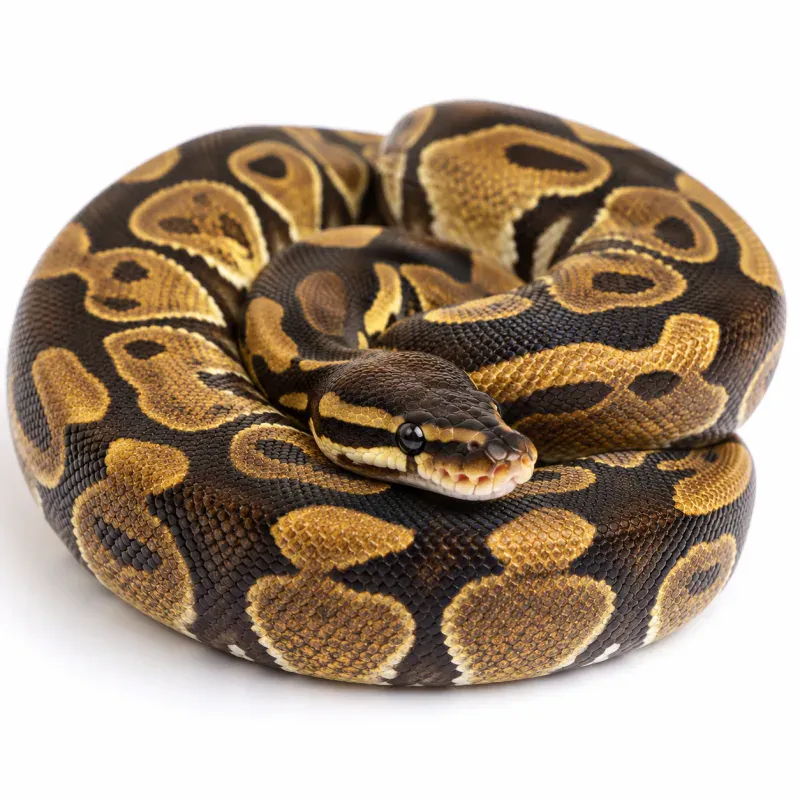
\\nThe ball python (Python regius) is the most popular pet snake in the world, and for good reason: they are docile, manageable in size, and available in thousands of morph color combinations. Native to the grasslands and savannas of West and Central Africa, they are named for their defensive behavior of coiling into a tight ball with the head protected in the center.
\\nI've rescued more ball pythons than I can count, and the #1 issue I see is chronic dehydration from low humidity. Glass tanks with screen tops look nice but they're humidity killers. If your ball python has stuck shed or wrinkled skin, don't just mist more — switch to a PVC enclosure or cover 80% of that screen top with foil. Humidity should sit at 60-70%, not 40%. Your snake will eat better, shed cleaner, and live longer.
\\nBut they are not bulletproof: humidity management is the #1 challenge that separates healthy snakes from chronically dehydrated ones. In this guide, we'll walk through every aspect of ball python care—from enclosure setup and heating to feeding, health, and morphs—so you can provide the best possible life for your scaly friend.
\\n\\nEnclosure Setup
\\n\\n | Life Stage | Minimum Enclosure |
|---|---|
| Hatchling | 10–20 gallon (with plenty of clutter) |
| Juvenile | 20–40 gallon |
| Adult male | 40-gallon breeder or 3'×2'×2' PVC |
| Adult female | 4'×2'×2' PVC (120 gallon equivalent) |
PVC enclosures are strongly recommended over glass tanks for ball pythons. They hold humidity and heat far more efficiently and reduce stress by providing opaque walls. Glass tanks with screen tops are the most common cause of low humidity, leading to dehydration, stuck shed, and respiratory issues.
\\n\\nChoosing the Right Enclosure Type
\\nWhen selecting an enclosure, consider the following options:
\\n- \\n
- PVC enclosures: Best overall. They insulate well, hold humidity, and are easy to clean. Brands like Animal Plastics, Reptile Basics, and Custom Reptile Habitats are popular. \\n
- Glass tanks with screen tops: Only recommended if you're willing to modify them (cover 80% of the screen with foil or HVAC tape). They lose heat and humidity quickly. \\n
- Wooden vivariums: Good for humidity but require a waterproof sealant to prevent rot. \\n
- Tub setups: Often used by breeders. Plastic tubs with heat tape can work but lack visibility and enrichment opportunities. \\n
Essential Enclosure Furnishings
\\nBeyond the enclosure itself, you'll need:
\\n- \\n
- At least two identical hides (one warm, one cool) that are snug — the snake should touch all sides when coiled. A half-log is not a hide; it's decor. Use enclosed cave-style hides. \\n
- Water bowl: Large enough for the snake to soak in, placed on the warm side to increase humidity. \\n
- Clutter: Fake plants, branches, and cork bark to make the snake feel secure. An open space terrifies ball pythons. \\n
- Thermometer and hygrometer: Digital ones are more accurate. Place one on each side to monitor the gradient. \\n
- Substrate: See the Substrate section below. \\n
Common Enclosure Mistakes
\\n- \\n
- Too-large enclosure without enough clutter: An open space terrifies ball pythons. Fill empty space with plants, branches, and hides. \\n
- Using a half-log as a hide: Half-logs are open on both ends and don't make the snake feel secure. Use enclosed hides. \\n
- Not providing a temperature gradient: Ball pythons need a warm side and a cool side to regulate their body temperature. \\n
Heating & Temperature
\\n| Zone | Temperature (°F) | Temperature (°C) |
|---|---|---|
| Basking surface | 90–95°F | 32–35°C |
| Warm side ambient | 88–92°F | 31–33°C |
| Cool side | 78–82°F | 26–28°C |
| Night | 72–78°F | 22–26°C |
Want the full zone-by-zone reference? See the ball python temperature guide for basking/cool-side targets and thermostat troubleshooting.
\nUse one of these heating configurations:
\\n- \\n
- Overhead: Halogen flood (day) + CHE or DHP on thermostat. Most natural. \\n
- Radiant heat panel (RHP): Best for PVC enclosures. Mounts to ceiling, provides gentle ambient heat. \\n
- Heat tape/UTH: Acceptable as supplementary belly heat, but must be on a thermostat. \\n
Setting Up a Thermostat
\\nA thermostat is non-negotiable. Without it, heat sources can overheat and burn your snake. Here's how to set one up:
\\n- \\n
- Place the thermostat probe in the warm hide or on the basking surface, depending on the type of heat source. \\n
- Set the thermostat to the desired temperature (e.g., 90°F for a basking surface). \\n
- Plug the heat source into the thermostat's outlet. \\n
- Verify the temperature with a separate digital thermometer after 24 hours. \\n
Nighttime Temperature Management
\\nIf your home drops below 72°F at night, use a CHE or RHP set to maintain minimum night temps. Avoid colored bulbs (red/blue) as they can disrupt the snake's day/night cycle.
\\n\\nCommon Heating Mistakes
\\n- \\n
- Using unregulated heat sources: Always use a thermostat to prevent burns and overheating. \\n
- Placing heat tape under a thick substrate: This can block heat and create hot spots. Use a thin layer or a heat mat with a thermostat. \\n
- Not measuring temperatures at the snake's level: Temperatures at the top of the enclosure can be misleading. Measure at the substrate surface. \\n
Humidity Management
\\nThis is the most common failure point. Ball pythons need 50–60% ambient humidity (70–80% during shed).
\\n\\nTo maintain humidity:
\\n- \\n
- Use 3–4 inches of humidity-retaining substrate (cypress mulch, coco husk, ReptiChip). \\n
- Pour water directly into the corners of the substrate (not misting, which only wets the surface). \\n
- Cover 80% of a screen top with HVAC tape, foil, or a PVC sheet. \\n
- Use a large water bowl on the warm side. \\n
- Provide a humid hide with damp sphagnum moss at all times. \\n
A ball python with stuck shed, wrinkled skin, or dented eye caps is dehydrated. This is a husbandry failure, not a "bad shedder."\\n\\n
How to Create a Humid Hide
\\n- \\n
- Take a plastic container with a lid (e.g., a deli cup or Tupperware). \\n
- Cut a hole in the lid or side large enough for the snake to enter. \\n
- Fill it with damp sphagnum moss (not soaking wet). \\n
- Place it in the middle of the enclosure, between the warm and cool sides. \\n
- Check the moss weekly and re-dampen as needed. \\n
Troubleshooting Humidity Issues
\\n| Problem | Cause | Solution |
|---|---|---|
| Humidity too low (<50%) | Screen top, dry substrate, small water bowl | Cover screen, pour water into corners, use larger bowl |
| Humidity too high (>70% constantly) | Over-misting, poor ventilation | Increase ventilation, reduce misting, ensure substrate isn't soaked |
| Condensation on walls | Too much moisture, poor airflow | Increase ventilation, reduce water added |
Substrate
\\nRecommended: Cypress mulch, ReptiChip (coconut husk), coco coir, organic topsoil + play sand mix.
\\nAvoid: Aspen (molds in humidity), pine/cedar (toxic oils), pure sand, newspaper (too dry, no enrichment).
\\n\\nSubstrate Depth and Maintenance
\\nUse 3–4 inches of substrate to help retain humidity. Spot-clean daily by removing feces and urates. Replace the entire substrate every 1–2 months, or sooner if it becomes soiled or moldy.
\\n\\nDIY Substrate Mix
\\nFor a budget-friendly option, mix 40% organic topsoil (no fertilizers) with 40% play sand and 20% coconut coir. This mix holds humidity well and allows burrowing.
\\n\\nFeeding Guide
\\n| Age | Prey | Frequency |
|---|---|---|
| Hatchling | Pinky rat or large mouse hopper | Every 5–7 days |
| Juvenile (200–500g) | Rat pup or small weaned rat | Every 7 days |
| Sub-adult (500–1000g) | Small rat (40–70g) | Every 7–10 days |
| Adult (1000g+) | Small-medium rat (50–90g) | Every 10–14 days |
Prey size: Slightly wider than the snake's widest point. After swallowing, there should be a visible — but not extreme — lump.
\\nFrozen-thawed only: Never feed live prey. It's unethical and dangerous — a live rat can severely injure or kill a snake that refuses to eat.
\\n\\nHow to Feed Frozen-Thawed Prey
\\n- \\n
- Remove the prey from the freezer and place it in a sealed plastic bag. \\n
- Thaw in warm water (not boiling) for 20–30 minutes until the prey is warm to the touch. \\n
- Use tongs to offer the prey to your snake, wiggling it gently to simulate live prey. \\n
- If your snake doesn't strike immediately, leave the prey in the enclosure overnight (but remove it if it's not eaten by morning). \\n
Handling Hunger Strikes
\\nHealthy ball pythons can go months without eating. If weight is stable, don't stress. Vet visit if weight loss exceeds 10%. Common causes of hunger strikes include:
\\n- \\n
- Temperature or humidity issues \\n
- Stress from handling or enclosure changes \\n
- Seasonal fasting (especially males during breeding season) \\n
- Prey size too large or too small \\n
Feeding Mistakes to Avoid
\\n- \\n
- Feeding live prey: Dangerous and unethical. Always use frozen-thawed. \\n
- Handling too soon after feeding: Wait at least 48 hours to avoid regurgitation. \\n
- Feeding too frequently: Overfeeding can lead to obesity and shorter lifespan. \\n
Ball Python Morphs
\\nBall pythons are available in thousands of morphs—genetic mutations that affect color and pattern. Here are some popular ones:
\\n| Morph | Description | Price Range (USD) |
|---|---|---|
| Normal (Wild-type) | Brown with dark blotches | $30–$50 |
| Albino | White or yellow with orange/red blotches | $100–$300 |
| Pied | White with patches of normal color | $150–$500 |
| Banana | Yellow with black speckles | $150–$400 |
| Mojave | High contrast with a golden sheen | $100–$200 |
| Clown | Reduced pattern with an orange/red head | $200–$600 |
Recessive vs. Dominant vs. Co-Dominant Morphs
\\n- \\n
- Recessive: Both parents must carry the gene for the morph to show (e.g., albino, pied, clown). \\n
- Dominant: Only one parent needs the gene (e.g., pinstripe, spider). \\n
- Co-dominant: One gene copy produces a morph, two copies produce a "super" form (e.g., pastel, mojave). \\n
Choosing a Morph
\\nWhen selecting a morph, consider:
\\n- \\n
- Health: Some morphs (e.g., spider) are linked to neurological issues like wobble. Research before buying. \\n
- Budget: Prices vary widely from $30 to thousands for rare combos. \\n
- Personal preference: Pick a morph you love, but always prioritize health and temperament. \\n
Common Health Issues
\\n- \\n
- Respiratory Infection: Wheezing, bubbles from nostrils, open-mouth breathing. Caused by low temperature + high humidity or vice versa. Requires vet treatment. \\n
- Scale Rot: Brown/discolored belly scales. Caused by sitting on wet substrate. Clean enclosure and keep substrate dry on the surface. \\n
- Mites: Tiny black dots moving on the snake, especially around eyes and heat pits. Treat with Provent-A-Mite (follow instructions precisely) and disinfect the entire enclosure. \\n
Preventing Health Issues
\\n- \\n
- Maintain proper temperature and humidity gradients. \\n
- Clean the enclosure regularly and remove waste promptly. \\n
- Quarantine new snakes for at least 30 days before introducing them to your collection. \\n
- Monitor your snake's weight and appetite regularly. \\n
When to See a Vet
\\n- \\n
- Weight loss exceeding 10% of body weight \\n
- Refusal to eat for more than 2 months (if weight is dropping) \\n
- Difficulty shedding or retained eye caps \\n
- Any signs of respiratory distress \\n
- Lethargy or unusual behavior \\n
Handling & Temperament
\\nBall pythons are known for their docile nature, but they need time to acclimate to their new home.
\\n\\nFirst Two Weeks
\\nNo handling for the first 2 weeks, and not until they've taken 2–3 consecutive meals. This allows them to settle in and reduces stress.
\\n\\nHow to Handle Safely
\\n- \\n
- Wash your hands and approach the enclosure calmly. \\n
- Gently lift the snake from below, supporting its body. \\n
- Keep handling sessions to 10–15 minutes, gradually increasing as the snake gets comfortable. \\n
- Never grab or restrain the snake tightly; let it move freely. \\n
Signs of Stress
\\n- \\n
- Hissing or striking \\n
- Musking (releasing a foul-smelling odor) \\n
- Refusing food \\n
- Excessive hiding or restlessness \\n
What Beginners Often Get Wrong
\\n- \\n
- Dry enclosure: The single most common problem. If humidity is below 50%, the snake is chronically dehydrated even if it's eating. \\n
- Over-handling a new snake: No handling for the first 2 weeks, and not until they've taken 2–3 consecutive meals. \\n
- Panic-fixing hunger strikes: Healthy ball pythons can go months without eating. If weight is stable, don't stress. Vet visit if weight loss exceeds 10%. \\n
- Too-large enclosure without enough clutter: An open space terrifies ball pythons. Fill empty space with plants, branches, and hides. \\n
- Inadequate heating at night: If your home drops below 72°F, use a CHE or RHP set to maintain minimum night temps. \\n
Frequently Asked Questions
\\nWhat is the ideal ambient humidity range for a ball python, and what should it be during shedding?
\\nBall pythons need 50–60% ambient humidity, and 70–80% during shed. The article emphasizes that humidity management is the most common failure point, and that chronic dehydration from low humidity is the #1 issue seen in rescued ball pythons.
\\nWhy are PVC enclosures recommended over glass tanks for ball pythons?
\\nPVC enclosures are strongly recommended because they hold humidity and heat far more efficiently than glass tanks with screen tops. They also reduce stress by providing opaque walls, whereas a glass tank with a screen top is described as a humidity killer.
\\nWhat are the recommended temperatures for the basking surface, warm side, cool side, and night?
\\nThe basking surface should be 90–95°F (32–35°C), the warm side ambient should be 88–92°F (31–33°C), the cool side should be 78–82°F (26–28°C), and night temperatures should be 72–78°F (22–26°C).
\\nWhy should you never feed live prey to a ball python?
\\nThe article states that frozen-thawed prey should be used exclusively, and live prey should never be fed. It explains that feeding live is unethical and dangerous because a live rat can severely injure or kill a snake that refuses to eat.
\\n\\nRelated Reading
\\n- \\n
- Corn Snake Care Guide — A more forgiving first snake with bulletproof husbandry. \\n
- Ball Python Humidity Guide: Optimal Ranges & Setup — Master the #1 challenge in ball python care. \\n
- 10 Common Reptile Health Issues & How to Prevent Them — Identify respiratory infections and scale rot. \\n
Still deciding on a species? Take our which reptile is right for you quiz — 8 questions scored against your space, schedule and experience before you commit to a setup.
Check optimal temps, calculate feeding, and find your perfect species match.
References
- McCurley, K. (2015). The Complete Ball Python. Eco Publishing.
- Barker, D. G., & Barker, T. M. (2006). Ball Pythons in Captivity. VPI Library.
- de Vosjoli, P. (2004). The Ball Python Manual. Advanced Vivarium Systems.
🐾 Join the Community
See how other keepers set up their enclosures, ask questions, and share your experience.
🛠️ Apply What You Learned
Check optimal temps, calculate feeding schedules, and get calcium dosage — all personalized for your species.
Comments