Corn Snake Care Guide: The Best First Snake
Species Overview
\nCorn snakes are escape artists. If there's a gap the width of your pinky, they'll find it. Invest in a locking, escape-proof enclosure before anything else. Jump to Enclosure Setup →
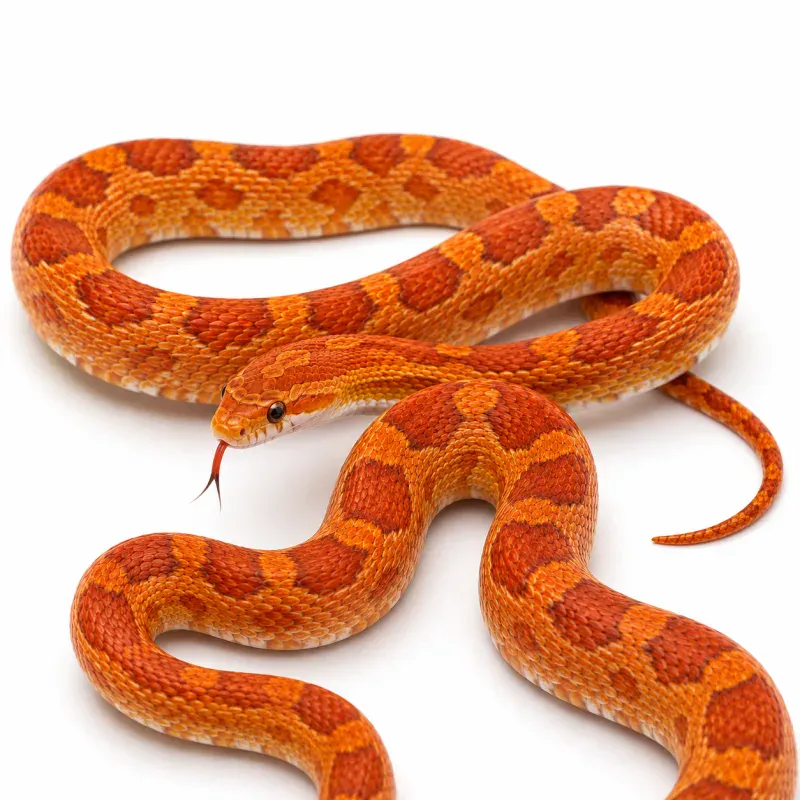
\nThe corn snake (Pantherophis guttatus) is arguably the best first snake for any new keeper. Native to the southeastern United States, they are diurnal, excellent feeders, tolerant of handling, and forgiving of minor husbandry mistakes that would seriously harm more sensitive species.
\n\nNatural History & Why They Make Great Pets
\nCorn snakes are found in forests, fields, and abandoned buildings throughout the southeastern U.S. They are semi-arboreal, often climbing low branches in search of prey or basking spots. Their name comes from their habit of hunting rodents in corn cribs and from the maize-like pattern on their belly.
\nIn the wild, they are diurnal (active during the day), which makes them fun to watch. They are also relatively long-lived, with a lifespan of 15–20 years in captivity. This is a long-term commitment, so be prepared to care for your snake for many years.
\n\nEnclosure Setup
\n\n | Life Stage | Minimum Enclosure |
|---|---|
| Hatchling | 10-gallon (with secure, escape-proof lid) |
| Juvenile | 20-gallon long |
| Adult | 40-gallon breeder (36"×18") or 4'×2'×2' PVC |
Escape-proofing is critical. Corn snakes are notorious escape artists — they can push through gaps you'd never think possible. Use cage clips or a locking lid on glass tanks. For PVC enclosures, ensure sliding doors have a tight seal and a lock.
\n\nStep-by-Step Enclosure Setup
\n- \n
- Choose the right size: Start with a 10-gallon for a hatchling, upgrade to a 20-gallon long for a juvenile, and move to a 40-gallon breeder or 4'×2'×2' PVC for an adult. Bigger is always better for adults. \n
- Secure the lid: Use cage clips or a locking mechanism. Test by gently prying with your finger—if you can open it, so can the snake. \n
- Add substrate: Spread 2–3 inches of aspen shavings, cypress mulch, coco coir, or ReptiChip. Aspen is ideal because it holds burrows. \n
- Place hides: Provide at least two identical hides—one on the warm side, one on the cool side. Identical hides prevent the snake from choosing one side just because it feels safer. \n
- Add climbing branches: Corn snakes are semi-arboreal, so include sturdy branches for climbing. Ensure they are secure and cannot fall. \n
- Include plants: Fake or live plants provide cover and make the snake feel secure. Avoid plants with sharp edges. \n
- Add a water bowl: Choose a bowl large enough for the snake to soak in, and place it on the cool side to maintain humidity. \n
- Set up heating: Install a UTH or overhead heat source with a thermostat. Place the probe on the warm side hide's floor. \n
- Acclimate and test: Run the enclosure for 24–48 hours before introducing the snake. Verify temperatures with a digital thermometer. \n
Enclosure Type Comparison
\n| Type | Pros | Cons |
|---|---|---|
| Glass aquarium with screen lid | Inexpensive, easy to find, good visibility | Poor heat retention, needs extra clips, heavy |
| PVC enclosure | Excellent heat retention, lightweight, escape-proof | More expensive, can be heavy to ship |
| Plastic tub (for hatchlings) | Cheap, easy to clean, holds humidity | Poor visibility, may need extra ventilation |
Common Mistakes in Enclosure Setup
\n- \n
- Using a lid without clips: Even a secure-fitting lid can be pushed open by a determined corn snake. Always use cage clips or a locking mechanism. \n
- Placing the enclosure in direct sunlight: This can cause dangerous temperature spikes. Keep the enclosure in a room with stable temperatures. \n
- Not providing a temperature gradient: Without a warm side and a cool side, the snake cannot regulate its body temperature, leading to stress and health issues. \n
- Using too many hides: While hides are essential, too many can make it hard for the snake to find the warmest spot. Stick to two identical hides plus a humid hide during shed. \n
Heating & Temperature
\n| Zone | Temperature (°F) | Temperature (°C) |
|---|---|---|
| Basking surface | 88–92°F | 31–33°C |
| Warm side | 85–88°F | 29–31°C |
| Cool side | 72–78°F | 22–26°C |
| Night | 68–75°F | 20–24°C |
Corn snakes don't need intense basking like bearded dragons. A UTH on a thermostat (with a warm hide above it) or a low-wattage overhead halogen/CHE is sufficient. Allow a natural nighttime temperature drop.
\n\nChoosing the Right Heat Source
\n- \n
- Under-Tank Heater (UTH): Best for belly heat. Attach to the underside of the enclosure and always use a thermostat. UTHs do not emit light, so they are ideal for 24/7 use. \n
- Ceramic Heat Emitter (CHE): Screws into a ceramic fixture. Provides overhead heat without light. Good for cold nights. \n
- Halogen bulb: Emits light and heat, great for a daytime basking spot. Use a dimming thermostat to prevent overheating. \n
- Heat tape: Common in racks. Must be on a thermostat and carefully installed to avoid burns. \n
Thermostat Setup
\n- \n
- Place the thermostat probe directly on the substrate above the UTH or under the heat lamp where the snake will bask. \n
- Set the thermostat to the desired basking temperature (88–92°F). \n
- Wait 24 hours and verify with a separate digital thermometer with a probe. \n
- Adjust the thermostat as needed. Check weekly. \n
Troubleshooting Temperature Issues
\n- \n
- Enclosure too hot: Check thermostat settings, move heat source farther away, or reduce wattage. \n
- Enclosure too cold: Add a second heat source, insulate the enclosure (e.g., foam panels on the back), or increase room temperature. \n
- No temperature gradient: Make sure the heat source is only on one side. Use a divider if necessary. \n
Seasonal Temperature Adjustments
\nIn the wild, corn snakes experience seasonal temperature changes. While captive snakes don't need a full brumation, you can mimic slight seasonal shifts to promote natural behaviors:
\n- \n
- Winter: Allow nighttime temperatures to drop to the lower end of the range (68–70°F). You may reduce the basking temperature by 2–3°F, but keep it within the recommended range. \n
- Summer: Ensure the warm side stays at the higher end (85–88°F). If your room gets very warm, monitor to prevent overheating. \n
- Brumation (optional): If you plan to breed, a controlled brumation period of 8–10 weeks with temperatures around 55–65°F is sometimes used. This is advanced and not recommended for beginners. \n
Substrate & Decor
\nGood options: Aspen shavings (classic, holds burrows), cypress mulch, coco coir, ReptiChip.
\nAvoid: Pine and cedar (contain toxic phenols), sand (doesn't hold burrows, abrasive), corn cob (impaction risk).
\nInclude branches for climbing, a humid hide with damp sphagnum moss (especially during shed), and a water bowl large enough for soaking.
\n\nSubstrate Comparison
\n| Substrate | Pros | Cons |
|---|---|---|
| Aspen shavings | Holds burrows, absorbent, inexpensive | Can mold if wet, not ideal for high humidity |
| Cypress mulch | Retains humidity, natural look | Can be dusty, may contain sharp pieces |
| Coco coir | Retains humidity, eco-friendly | Can be messy when dry, holds burrows poorly |
| ReptiChip | Holds burrows, low dust | More expensive than aspen |
How to Set Up a Humid Hide
\n- \n
- Choose a small plastic container with a lid. \n
- Cut an entrance hole large enough for the snake. \n
- Fill with damp sphagnum moss (not soaking wet). \n
- Place it on the warm side of the enclosure. \n
- Monitor humidity with a hygrometer; keep the moss moist but not dripping. \n
Decor Ideas for Enrichment
\n- \n
- Climbing branches: Corn snakes are semi-arboreal, so provide sturdy branches of varying thickness. Secure them firmly. \n
- Fake plants: Silk or plastic plants add cover and make the snake feel secure. Avoid plants with sharp edges. \n
- Rock piles: Smooth, secure rocks can create additional hiding spots and basking surfaces. Ensure they cannot shift and crush the snake. \n
- Cardboard tubes: Empty paper towel or toilet paper rolls make great cheap hides and tunnels. Replace when soiled. \n
Feeding Schedule
\n| Age | Prey | Frequency |
|---|---|---|
| Hatchling (4–15g) | Pinky mouse | Every 5–6 days |
| Juvenile (15–100g) | Fuzzy to hopper mouse | Every 6–7 days |
| Sub-adult (100–300g) | Weaned to small adult mouse | Every 7–10 days |
| Adult (300g+) | Adult mouse or small rat | Every 10–14 days |
Frozen-thawed only. Thaw in the refrigerator overnight, warm to ~100°F in a sealed bag in warm water before offering. Feed with tongs — never your fingers.
\n\nStep-by-Step Feeding Guide
\n- \n
- Remove a frozen mouse from the freezer and place it in a sealed plastic bag. \n
- Refrigerate overnight to thaw slowly. \n
- Before feeding, place the sealed bag in warm water (not boiling) for 10–15 minutes until the mouse is warmed to ~100°F. \n
- Dry the mouse with a paper towel to remove excess water. \n
- Use long tongs to offer the mouse to your snake. Wiggle it gently to trigger a feeding response. \n
- Once the snake strikes and begins swallowing, let it do so without disturbance. \n
- Do not handle for 48 hours after feeding. \n
Troubleshooting Feeding Refusals
\n- \n
- Check temperatures: If the enclosure is too cold, the snake may not digest properly and may refuse food. \n
- Check for shedding: Snakes often refuse food before a shed. Wait until after the shed. \n
- Offer smaller prey: Sometimes the prey is too large. Try one size down. \n
- Try braining: If the snake is reluctant, make a small cut in the mouse's head to release scent. \n
- Do not over-handle: Stress can cause refusals. Give the snake a week without handling. \n
Prey Size Guide
\nChoosing the right prey size is crucial for your corn snake's health. A good rule of thumb is to offer prey that is about the same width as the snake's widest point. Here's a quick reference:
\n| Snake Weight | Prey Size | Approximate Prey Weight |
|---|---|---|
| 4–15g | Pinky mouse | 1–2g |
| 15–30g | Double pinky or small fuzzy | 2–4g |
| 30–50g | Fuzzy mouse | 4–6g |
| 50–100g | Hopper mouse | 6–12g |
| 100–200g | Weaned mouse | 12–20g |
| 200–300g | Small adult mouse | 20–30g |
| 300g+ | Adult mouse or small rat | 30–50g |
Remember, these are guidelines. Adjust based on your snake's body condition — you should see a slight bulge after feeding, but not a huge lump.
\n\nHandling & Temperament
\nCorn snakes are among the most tolerant of handling. Start slow:
\n- \n
- Wait 2 weeks after bringing the snake home before the first handling session. \n
- Wait until it has taken 2–3 consecutive meals. \n
- Start with 5–10 minute sessions, gradually increasing. \n
- Support the snake's body — don't let it dangle. \n
- Avoid handling for 48 hours after feeding (regurgitation risk). \n
Building Trust
\n- \n
- Move slowly and deliberately. Sudden movements can startle the snake. \n
- Let the snake come to you rather than grabbing it. \n
- Keep handling sessions short and positive. \n
- Never handle when the snake is in shed—it will be more defensive. \n
Signs of Stress in Corn Snakes
\n- \n
- Musking (releasing a foul-smelling liquid) \n
- Tail rattling \n
- Striking (defensive) \n
- Hiding constantly \n
- Refusing food \n
If you see these signs, reduce handling and check your husbandry.
\n\nHealth & Shedding
\nCommon Health Issues
\n- \n
- Respiratory infections: Symptoms include wheezing, open-mouth breathing, and mucus. Caused by cold, damp conditions. Vet care required. \n
- Mites: Tiny black dots on the snake and in the water bowl. Treat with reptile-safe mite spray and clean the enclosure thoroughly. \n
- Stuck shed: Often due to low humidity. Provide a humid hide and ensure proper hydration. \n
- Regurgitation: Caused by handling too soon after feeding, too-large prey, or cold temperatures. If it happens, wait 2 weeks before feeding again. \n
Shedding Process
\n- \n
- Signs: dull skin, blue-ish eyes, hiding more. \n
- Maintain humidity by misting the enclosure and providing a humid hide. \n
- The snake will rub its nose to start the shed. Do not pull the skin off. \n
- After shedding, check for retained skin on the tail tip and eyecaps. If present, soak the snake in lukewarm water for 15 minutes and gently remove. \n
When to See a Vet
\n- \n
- Persistent wheezing or open-mouth breathing: These are signs of respiratory infection and require veterinary treatment. \n
- Lumps or bumps under the skin: Could be abscesses or tumors. \n
- Prolonged regurgitation: If your snake regurgitates more than once, seek vet advice. \n
- Mites or ticks: While treatable at home, a vet can recommend the safest products. \n
- Difficulty shedding: If retained shed persists despite humid hide, a vet may need to assist. \n
Cost Breakdown
\nUnderstanding the initial and ongoing costs of corn snake ownership helps you prepare financially. Here's an approximate breakdown:
\n| Item | Initial Cost | Notes |
|---|---|---|
| Enclosure (40-gallon breeder or PVC) | $80–$300 | PVC is more expensive but better heat retention |
| Heat source (UTH or lamp) | $20–$60 | Includes fixture if needed |
| Thermostat | $30–$80 | Essential for safety |
| Substrate (initial) | $15–$30 | Enough for 2–3 changes |
| Hides and decor | $20–$50 | Two identical hides, branches, plants |
| Water bowl | $5–$15 | Large enough for soaking |
| Thermometer/hygrometer | $10–$20 | Digital with probe |
| Feeding tongs | $5–$15 | Long, for safety |
| Total initial | $185–$570 |
Ongoing costs:
\n| Item | Monthly Cost | Notes |
|---|---|---|
| Substrate | $10–$20 | Replace every 2–4 weeks |
| Food (frozen mice) | $5–$15 | For an adult, 2–3 mice per month |
| Electricity | $5–$10 | Heat source running |
| Miscellaneous (cleaning supplies, etc.) | $5–$10 | Reptile-safe disinfectant |
| Total monthly | $25–$55 |
Pitfalls to Avoid
\n- \n
- Inadequate lid security: If there's a gap the width of the snake's snout, it can escape. Use locking clips. \n
- Feeding in a separate container: An outdated myth. Feeding in the enclosure does not cause aggression. Moving the snake causes stress and regurgitation risk. \n
- Handling too soon after feeding: Wait 48 hours minimum. Regurgitation is dangerous and resets the clock on their digestive health. \n
- No heat gradient: If the whole enclosure is the same temperature, the snake can't thermoregulate. One side must be cool. \n
- Forgetting the humid hide: Provide one during shed to prevent stuck eyecaps and retained shed on the tail tip, which can cause necrosis. \n
Frequently Asked Questions
\nWhat is the minimum enclosure size for an adult corn snake?
\nThe minimum enclosure for an adult corn snake is a 40-gallon breeder (36"×18") or a 4'×2'×2' PVC enclosure. Hatchlings require a 10-gallon tank, and juveniles need a 20-gallon long, all with secure, escape-proof lids.
\nWhat temperatures should be provided for a corn snake?
\nThe basking surface should be 88–92°F (31–33°C), the warm side 85–88°F (29–31°C), the cool side 72–78°F (22–26°C), and nighttime temperatures 68–75°F (20–24°C). A natural nighttime temperature drop is recommended.
\nHow often should I feed an adult corn snake?
\nAdult corn snakes weighing 300g or more should be fed an adult mouse or small rat every 10–14 days. Hatchlings are fed pinky mice every 5–6 days, juveniles every 6–7 days, and sub-adults every 7–10 days.
\nWhy should I avoid handling a corn snake after feeding?
\nYou should avoid handling a corn snake for 48 hours after feeding because it risks regurgitation, which is dangerous and resets the clock on their digestive health. Handling too soon after feeding is listed as a pitfall to avoid in the care guide.
\nWhat are the signs of a respiratory infection in corn snakes?
\nSigns of a respiratory infection include wheezing, open-mouth breathing, and mucus. These are caused by cold, damp conditions and require veterinary care.
\nHow can I prevent stuck shed in my corn snake?
\nTo prevent stuck shed, maintain proper humidity by misting the enclosure and providing a humid hide with damp sphagnum moss, especially during the shedding process. Check for retained skin on the tail tip and eyecaps after shedding.
\nWhat should I do if my corn snake regurgitates its meal?
\nIf regurgitation occurs, wait at least 2 weeks before feeding again. Regurgitation can be caused by handling too soon after feeding, prey that is too large, or cold temperatures. If it happens repeatedly, consult a veterinarian.
\n\nRelated Reading
\n- \n
- King Snake Care Guide — A bolder colubrid with an equally enthusiastic feeding response. \n
- Corn Snake Morph Guide: Colors, Patterns & Genetics — Explore the incredible variety of corn snake morphs. \n
- Milk Snake Care Guide — Stunning tricolor bands with near-identical husbandry. \n
Still deciding on a species? Take our which reptile is right for you quiz — 8 questions scored against your space, schedule and experience before you commit to a setup.
Check optimal temps, calculate feeding, and find your perfect species match.
References
- Bartlett, R. D., & Bartlett, P. (2006). Corn Snakes and Other Rat Snakes. Barron's Educational Series.
- Vosjoli, P. de (2004). The Art of Keeping Snakes. Advanced Vivarium Systems.
- McCurley, K. (2015). The Complete Corn Snake Care Guide. Reptile Apartment.
🐾 Join the Community
See how other keepers set up their enclosures, ask questions, and share your experience.
🛠️ Apply What You Learned
Check optimal temps, calculate feeding schedules, and get calcium dosage — all personalized for your species.
Comments