Ceramic Heat Emitter Guide: Setup & Safety
What Is a Ceramic Heat Emitter?
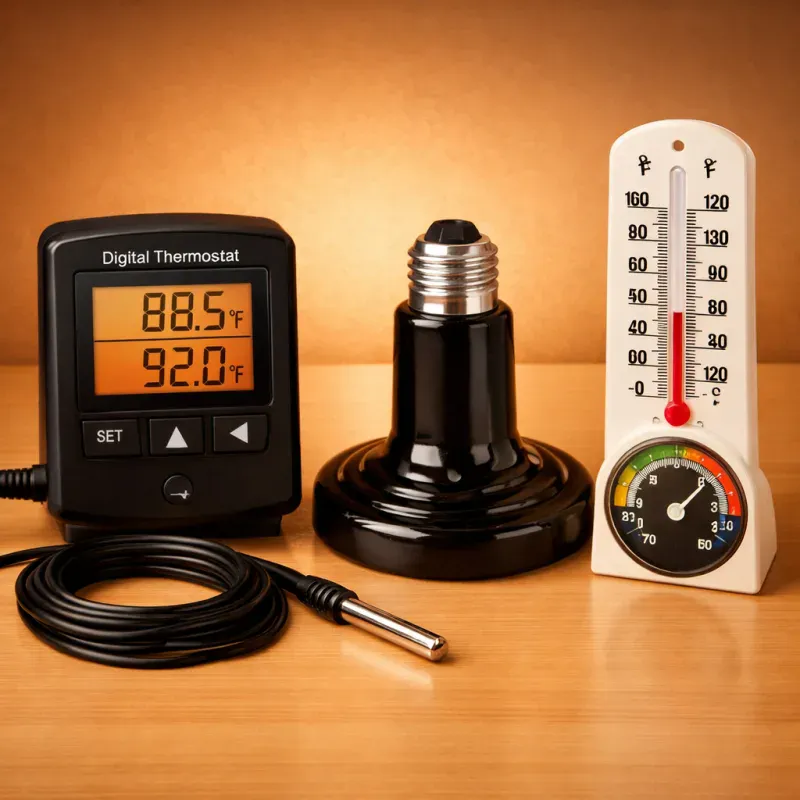
A ceramic heat emitter (CHE) is a screw-in bulb that produces infrared heat without visible light. Made from a high-density ceramic body with an internal heating element, CHEs are designed to emit heat only, making them ideal for nocturnal reptiles, species requiring a temperature drop at night, or as a supplemental heat source in multi-light setups. Unlike incandescent bulbs, CHEs do not emit light, so they won't disrupt your reptile's day/night cycle.
Benefits and Drawbacks
| Aspect | Benefits | Drawbacks |
|---|---|---|
| Light output | None – perfect for 24-hour heating | Not suitable as sole light source |
| Heat penetration | Deep-penetrating infrared heat | Heats ceramic surface – can cause burns |
| Lifespan | Up to 10,000+ hours | Requires ceramic socket |
| Humidity impact | Minimal (dry heat) | Can dry out enclosure quickly |
| Compatibility | Works with pulse/on-off thermostats | Not dimmable with standard dimmers |
Wattage Calculator: How to Choose the Right CHE
Selecting the correct wattage is critical for achieving safe basking and ambient temperatures. Use the following guidelines based on enclosure volume and target temperature rise above room temperature.
General Wattage Guidelines
- Small enclosures (10–20 gallons / 38–76 L): 50–75 watts
- Medium enclosures (20–40 gallons / 76–151 L): 75–100 watts
- Large enclosures (40–75 gallons / 151–284 L): 100–150 watts
- Extra-large enclosures (75+ gallons / 284+ L): 150–200+ watts (may need multiple CHEs)
Temperature Rise Formula
To calculate approximate wattage needed: Wattage = (Desired temperature rise in °F × enclosure volume in gallons) ÷ 10. For example, a 40-gallon enclosure needing a 20°F rise would require roughly 80 watts (20 × 40 ÷ 10 = 80). Always use a thermostat to fine-tune.
Setup and Installation
Mounting the CHE
CHEs must be mounted in a ceramic socket rated for high heat (at least 250°F / 121°C). Plastic or standard sockets will melt. Use a dome fixture with a porcelain base or a wire cage fixture. Position the CHE above the enclosure, either on the screen lid (if metal mesh) or inside using a guard to prevent direct contact.
Distance from Substrate
- Screen top: 6–12 inches (15–30 cm) from the basking surface
- Inside enclosure: 12–18 inches (30–46 cm) with a protective cage
Measure basking surface temperature with an infrared thermometer to ensure it reaches the target (e.g., 90–100°F / 32–38°C for most desert species).
Thermostat Pairing: Essential for Safety
CHEs can reach surface temperatures exceeding 400°F (204°C) and must always be used with a thermostat. Two types are compatible:
On/Off Thermostat
Simplest option: powers the CHE fully on until the set temperature is reached, then shuts it off. Acceptable for many setups but can cause temperature swings of 2–5°F.
Pulse Proportional Thermostat
Recommended for CHEs: sends rapid pulses of power to maintain a steady temperature. Reduces wear on the bulb and keeps temperatures within ±1°F. Do not use dimming thermostats (designed for incandescent bulbs) – they can damage CHEs.
Installation Steps
- Place the thermostat probe directly under the CHE at the basking spot, secured to avoid shifting.
- Set the desired temperature (e.g., 95°F / 35°C for a bearded dragon basking area).
- Plug the CHE into the thermostat's output socket, then plug the thermostat into the wall.
- Test with a separate thermometer to confirm accuracy.
Safety Best Practices
- Never use CHEs without a thermostat. Overheating can cause burns, fires, or enclosure damage.
- Use a ceramic socket. Plastic sockets melt at high temperatures.
- Add a protective wire cage if the CHE is inside the enclosure to prevent burns.
- Check for hot spots with an infrared thermometer weekly.
- Ensure proper ventilation – CHEs heat the air, so enclosures need airflow to avoid stagnant heat buildup.
- Never cover the CHE with decorations or substrate.
Pitfalls and How to Avoid Them
- Using too high wattage: Leads to overheating. Always start with lower wattage and adjust.
- Skipping thermostat: The #1 cause of CHE-related accidents.
- Placing CHE too close: Can cause thermal burns. Maintain recommended distances.
- Using CHE as sole heat source for diurnal species: They need both basking light and UVB. CHE is supplemental or for nighttime use.
- Ignoring humidity: CHEs dry out air. Monitor humidity and mist or use a humidifier as needed.
Species-Specific Recommendations
CHEs are ideal for:
- Nocturnal reptiles (leopard geckos, crested geckos, ball pythons) – provide nighttime heat without light.
- Desert species (bearded dragons, uromastyx) – supplemental heat for basking or cool nights.
- Arboreal species (green tree pythons, chameleons) – mounted above perches for gradient heat.
Avoid using CHEs as the primary heat source for species that require bright basking lights (e.g., many lizards) because they lack UVB and visible light. Always pair with appropriate UVB and daylight bulbs.
Frequently Asked Questions
Can I use a CHE with a dimmer switch?
No – standard dimmers can damage CHEs. Use a pulse proportional thermostat instead.
How long do CHEs last?
Typically 10,000–20,000 hours, but lifespan shortens if used without a thermostat or in dusty enclosures.
Can I use a CHE for a snake that needs high humidity?
Yes, but you'll need to compensate with frequent misting, a larger water bowl, or a humidifier to maintain 60–80% humidity.
What if my CHE breaks?
Dispose of it in a sealed bag (ceramic dust can be harmful). Replace immediately with a new bulb.
Conclusion
Ceramic heat emitters are a versatile, safe heating solution when used correctly. Always pair with a pulse proportional thermostat, use a ceramic socket, and monitor temperatures and humidity regularly. With the right wattage and setup, your reptile will enjoy consistent, gentle heat without light disruption. For more reptile heating guides, visit ScalyPal.com.
Related Reading
- Reptile Heating Guide: Heat Mats, Bulbs, Ceramics & ...
- Best Thermostats for Reptiles 2026: On/Off vs Propor...
- Heat Mat vs Overhead Heating Guide: UTH, Ceramic Hea...
Check optimal temps, calculate feeding, and find your perfect species match.
References
- Adkins, J. (2020). Reptile Heating Essentials. Herpetological Press.
- Miller, S. (2022). Thermostat Guide for Reptile Keepers. Reptile Care Publishing.
- National Reptile Association. (2023). Safe Heating Practices. NRA Technical Bulletin 45.
🐾 Join the Community
See how other keepers set up their enclosures, ask questions, and share your experience.
🛠️ Apply What You Learned
Check optimal temps, calculate feeding schedules, and get calcium dosage — all personalized for your species.
Comments