Best Reptile Thermostats 2026: On/Off vs Dimming
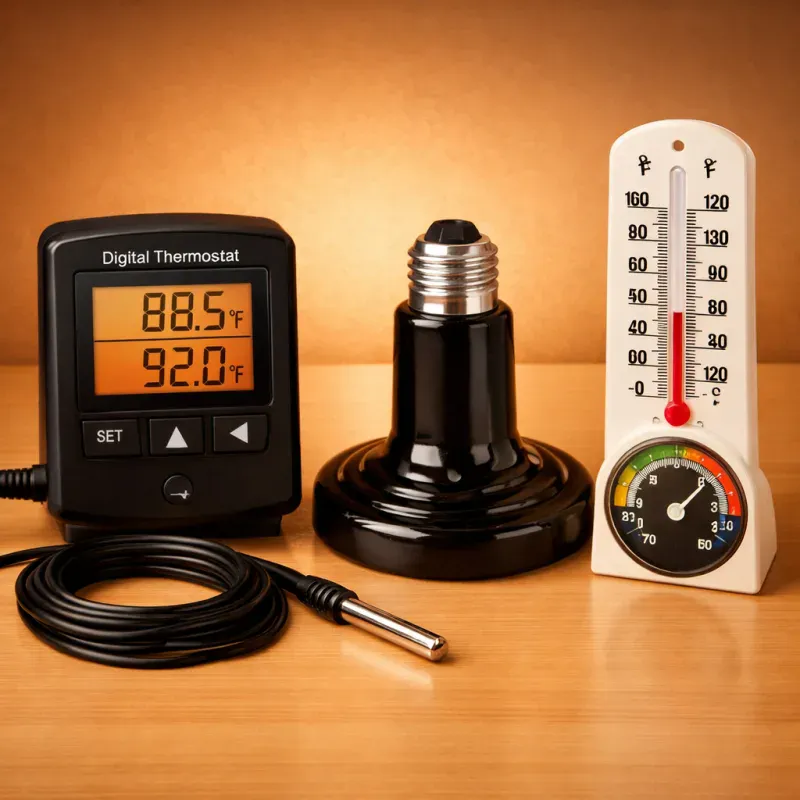
Why a Thermostat Is Non-Negotiable for Reptile Health
Reptiles are ectothermic — they rely on external heat sources to regulate their body temperature, digestion, metabolism, and immune function. Without a thermostat, a heat bulb or mat can easily overheat, causing burns, dehydration, or even fatal heat stroke. Conversely, inadequate temperatures can lead to respiratory infections, poor digestion, and lethargy. A thermostat maintains a stable, safe temperature gradient, mimicking the reptile’s natural environment and preventing dangerous fluctuations. Every responsible reptile keeper must use a thermostat with any heat source.
In the wild, reptiles bask in the sun and retreat to cooler areas to regulate their body temperature precisely. In captivity, we must replicate that gradient. A thermostat ensures the basking spot stays at the correct temperature while the cool side remains within a safe range. Without it, even a 'low-wattage' bulb can push temperatures past 120°F (49°C), which is lethal for most species. The investment in a thermostat is minor compared to the cost of a vet visit — or the loss of a beloved pet.
Moreover, thermostats protect your equipment. Heat sources that run uncontrolled experience more stress, burn out faster, and can pose fire hazards. By cycling or dimming power, thermostats extend the lifespan of bulbs and mats, saving you money in the long run. This guide will walk you through the three main types, help you choose the right one for your setup, and show you how to install and troubleshoot it like a pro.
How Thermostats Work: The Three Main Types
On/Off Thermostats
On/off thermostats (also called pulse or cycle thermostats) simply switch the heat source on when the temperature drops below the set point, and off when it exceeds it. They are the most basic and affordable option. However, they cause temperature swings of 2–5°F (1–3°C) and can reduce bulb life due to frequent cycling. Best for: budget setups, ceramic heat emitters (CHEs), or heat mats.
How they work: A mechanical or digital sensor reads the temperature at the probe. When the temp falls below your set point, the thermostat sends full power to the heat source. Once the temp rises above the set point (plus a small hysteresis), it cuts power completely. This on/off cycle repeats, maintaining an average temperature but with noticeable fluctuations.
Pros: Cheap, simple, works with any heat source that doesn't mind being turned on and off. Cons: Temperature swings can stress sensitive reptiles; bulbs may flicker and burn out faster; some models emit a clicking sound when switching.
Ideal use cases: Heat mats under tanks, CHEs in ceramic sockets, and setups where slight temperature variation is acceptable (e.g., for hardy species like leopard geckos).
Proportional (Pulse Proportional) Thermostats
Proportional thermostats send rapid pulses of power to the heat source, gradually increasing or decreasing the pulse width to maintain a steady temperature. They are more precise than on/off models, with swings of only 0.5–1°F (0.3–0.5°C). They also extend bulb life. Best for: heat mats, CHEs, and deep heat projectors (DHPs).
How they work: Instead of full on/off, the thermostat adjusts the duty cycle — the percentage of time power is flowing. When the temperature is close to the set point, it sends short pulses (e.g., 10% power). If the temp drops further, the pulse width increases. This constant adjustment keeps the temperature remarkably stable, without the harsh cycling of on/off units.
Pros: High precision, silent operation (some models have a faint hum), extends bulb life, works with most heat sources except incandescent bulbs that need dimming. Cons: Slightly more expensive; not ideal for basking bulbs that need gradual dimming to simulate sunrise/sunset.
Ideal use cases: CHEs, DHPs, heat mats, and any setup where stable temperatures are critical (e.g., for breeding or sensitive species).
Dimming Thermostats
Dimming thermostats continuously adjust the voltage to the heat source, smoothly ramping up or down to maintain the set temperature. They produce no clicking or pulsing and are the most precise, with swings under 0.5°F (0.3°C). They are ideal for incandescent bulbs and basking lamps because they simulate natural daylight dimming. Best for: basking bulbs, mercury vapor bulbs, and high-wattage setups.
How they work: A dimming thermostat uses a triac or similar electronic component to reduce the voltage (RMS) supplied to the bulb. When the probe reads below the set point, it increases voltage; when above, it decreases. This creates a seamless, continuous adjustment, much like a home dimmer switch. As a result, the bulb's brightness and heat output slowly rise and fall, mimicking natural sunlight patterns.
Pros: Ultimate precision, silent, extends bulb life significantly, perfect for basking species that need a gradual warm-up. Cons: Most expensive; not suitable for heat mats or CHEs (they may not dim properly and could overheat); requires a bulb that can handle dimming (incandescent, halogen, mercury vapor).
Ideal use cases: Basking lamps for bearded dragons, tortoises, and other sun-loving reptiles; high-wattage setups; multi-zone enclosures with multiple dimming channels.
Comparison Table: On/Off vs Proportional vs Dimming Thermostats
| Feature | On/Off | Proportional | Dimming |
|---|---|---|---|
| Temperature swing | 2–5°F (1–3°C) | 0.5–1°F (0.3–0.5°C) | <0.5°F (0.3°C) |
| Bulb life | Shortened | Extended | Extended |
| Best for | Heat mats, CHEs | CHEs, DHPs, heat mats | Basking bulbs, mercury vapor |
| Noise | Clicking | Silent or faint hum | Silent |
| Price range | $15–$40 | $40–$80 | $60–$120+ |
| Precision | Low | Medium–High | High |
| Compatible heat sources | Mats, CHEs, DHPs | Mats, CHEs, DHPs, some bulbs | Incandescent, halogen, mercury vapor |
| Simulates sunrise/sunset | No | No | Yes (with dimming) |
Top Thermostat Recommendations for 2026 by Budget
Budget Picks (Under $40)
- BN-LINK Digital Heat Mat Thermostat — Simple on/off, works well for heat mats. Not ideal for bulbs. ~$20.
- Inkbird ITC-308 — Dual outlet on/off, good for mats and CHEs. Reliable and widely used. ~$35.
These budget options are perfect for beginners or keepers with a single heat source. The BN-LINK is a no-frills controller with a digital display and a probe. The Inkbird adds a second outlet, allowing you to control two devices (e.g., a heat mat and a CHE) independently. Both have a temperature range of 32–140°F (0–60°C) and a resolution of 0.1°F, which is adequate for most reptiles.
Mid-Range Options ($40–$80)
- Vivarium Electronics VE-100 — Proportional thermostat, great for CHEs and DHPs. Silent and precise. ~$60.
- Spyder Robotics Herpstat 1 — Proportional with dimming mode. Excellent build quality, supports up to 600W. ~$75.
The VE-100 is a workhorse for those who need stable temps for nocturnal heat sources. It features a bright LCD, a simple interface, and a 100W capacity (expandable with a relay). The Herpstat 1 is a favorite among serious keepers because it offers both proportional and dimming modes, so you can use it with any heat source. Its 600W capacity handles most setups, and the built-in night drop feature lets you program cooler nighttime temps.
Premium/Professional ($80–$150+)
- Spyder Robotics Herpstat 4 — Four-channel proportional/dimming thermostat. Ideal for multi-zone setups. ~$150.
- Habistat Dimming Thermostat — High-precision dimming, perfect for basking lamps. Used in zoos. ~$100.
For large enclosures or breeding racks, the Herpstat 4 allows independent control of four heat sources, each with its own probe and settings. It also logs temperature history and has safety alarms. The Habistat dimming thermostat is a classic choice for basking bulbs; it's built like a tank and provides smooth, silent dimming. Both are investments, but they offer the reliability and precision that professional herpetologists demand.
Setting Up Your Thermostat Correctly
Place the thermostat probe at the reptile’s basking spot — not on the glass or substrate. Secure the probe with a cable tie or suction cup to prevent the animal from moving it. Set the thermostat to the desired basking temperature (e.g., 95°F for a bearded dragon). Always use a separate digital thermometer with a probe to double-check temperatures. Never place the probe directly under a heat lamp (it will read falsely high). For multi-zone enclosures, use multiple thermostats or a multi-channel model.
Step-by-Step Setup Guide
- Read the manual — Each model has specific instructions for wiring and calibration.
- Position the probe — Place it exactly where your reptile will bask. For most species, this is on a branch or rock about 2-4 inches below the heat source. Use a suction cup or hot glue to secure it in place.
- Connect the heat source — Plug the thermostat into the wall, then plug your heat source into the thermostat's outlet. Ensure the wattage does not exceed the thermostat's rating.
- Set the temperature — Turn the thermostat to your target basking temp. Start low and adjust gradually, monitoring with a separate thermometer.
- Wait and verify — Let the system run for 24 hours, checking temps at multiple times of day. Adjust as needed.
- Calibrate if necessary — Some thermostats allow offset adjustment. If your thermometer reads 2°F higher than the thermostat, set the offset to -2°F.
Probe Placement Tips
- Never bury the probe in substrate; it will read the substrate temp, not the air temp.
- Avoid placing the probe in direct line of sight of the heat source — it will absorb radiant heat and read too high.
- Use a cable tie with a small zip tie to attach the probe to a branch or rock, leaving the tip exposed.
- For heat mats, place the probe between the mat and the glass, but outside the enclosure if the mat is under the tank. For inside mats, place the probe on the substrate surface.
Errors to Avoid
- Not using a thermostat at all — Most heat sources can exceed 120°F, causing burns or fire.
- Using an on/off thermostat for basking bulbs — The frequent cycling reduces bulb life and causes light flickering.
- Placing the probe incorrectly — Results in inaccurate readings and dangerous temperatures.
- Using a dimming thermostat for heat mats — Dimming thermostats are not designed for non-light-emitting heat sources.
- Overlooking ambient temperature — A thermostat controls one heat source; you still need a gradient.
Additional common mistakes:
- Choosing the wrong probe type — Some thermostats come with a soil probe vs. an air probe. Use the right one for your application.
- Not accounting for room temperature swings — If your house gets cold at night, the thermostat will work harder. Consider a night drop feature.
- Using extension cords improperly — Plug the thermostat directly into the wall; avoid daisy-chaining power strips.
- Ignoring humidity — High humidity can affect probe readings. Use a waterproof probe if needed.
- Skipping regular checks — Even the best thermostat can fail. Check temps weekly with a separate thermometer.
Troubleshooting Common Thermostat Issues
Temperature Too High or Low
- Check probe placement — Move it to the actual basking spot.
- Verify with a second thermometer — If the thermostat reads correctly but the enclosure is off, the probe may be shielded.
- Calibrate the thermostat — Use the offset function if available.
Thermostat Not Turning On/Off
- Check power — Ensure the outlet works and the thermostat is plugged in.
- Test the heat source — Plug the heat source directly into the wall to see if it works.
- Inspect the probe — A damaged probe can cause erratic readings.
Light Flickering with On/Off Thermostat
- Switch to a dimming thermostat — On/off is not suitable for bulbs.
- Use a CHE instead — CHEs don't emit light, so flickering is not an issue.
Thermostat Trips Breaker
- Check wattage — The heat source may exceed the thermostat's rating.
- Use a dedicated circuit — Avoid overloading the circuit with other devices.
Maintenance and Calibration Schedule
| Task | Frequency |
|---|---|
| Check temperature accuracy with a separate thermometer | Monthly |
| Clean the probe and sensor | Every 2-3 months |
| Inspect cords and connections for wear | Every 3 months |
| Test the thermostat's safety shutoff (if applicable) | Every 6 months |
| Replace the thermostat if readings are off by more than 2°F (1°C) after calibration | As needed |
Species-Specific Thermostat Recommendations
Bearded Dragons
Bearded dragons need a basking spot of 95–105°F (35–40°C) and a cool side of 75–85°F (24–29°C). A dimming thermostat with a basking bulb is ideal to simulate the sun. Use a separate on/off thermostat for a CHE if you need nighttime heat (though temps can drop to 65°F).
Leopard Geckos
Leopard geckos are nocturnal and need a warm hide of 88–92°F (31–33°C). A heat mat with an on/off or proportional thermostat works perfectly. Avoid dimming thermostats for mats. Keep the cool side at 75°F (24°C).
Ball Pythons
Ball pythons require a warm spot of 88–92°F (31–33°C) and ambient temps of 78–80°F (26–27°C). Use a proportional thermostat with a CHE or DHP for stable temps. A dimming thermostat can be used for a basking bulb if you provide a light cycle, but be careful with humidity.
Red-Eared Sliders (Aquatic Turtles)
Aquatic turtles need a basking area of 85–95°F (29–35°C) and water temps of 75–80°F (24–27°C). Use a dimming thermostat for the basking bulb and a separate waterproof thermostat for the water heater. Ensure probes are waterproof.
Energy Efficiency and Cost Analysis
Thermostats not only protect your reptile but also save energy. On/off thermostats may consume more power because they overshoot and undershoot, wasting energy. Proportional and dimming thermostats maintain a steady temperature with less energy, potentially cutting your electric bill by 10-20%.
For example, a 100W basking bulb running 12 hours a day costs about $4.38/month at $0.12/kWh. With a dimming thermostat, the bulb may run at an average of 60% power, reducing cost to $2.63/month — a savings of $1.75/month. Over a year, that's $21, which can offset the thermostat's price.
Additionally, longer bulb life means fewer replacements. A $10 bulb that lasts 6 months without a thermostat might last 12 months with a dimming thermostat, saving you $10/year.
Final Thoughts: Invest in a Quality Thermostat
A thermostat is the single most important safety device in a reptile enclosure. While on/off models work for basic setups, proportional and dimming thermostats offer far better precision, bulb longevity, and safety. For most keepers, a mid-range proportional thermostat like the Herpstat 1 or VE-100 is the best value. Remember: a thermostat is not an accessory — it’s a necessity.
In 2026, the market offers more options than ever, from budget-friendly controllers to professional multi-channel systems. No matter your budget, there is a thermostat that fits your needs. Prioritize safety, precision, and reliability. Your reptile will thank you with better health, brighter colors, and a longer life.
Frequently Asked Questions
Can I use a dimming thermostat with a ceramic heat emitter?
No — dimming thermostats are designed for incandescent bulbs. CHEs require on/off or proportional control. Dimming a CHE can cause it to overheat or malfunction, as they are not designed to be dimmed. Use a proportional thermostat for CHEs to ensure safe, stable temperatures.
Do I need a thermostat for a heat mat under a tank?
Absolutely. Heat mats can reach 130°F+ without regulation, causing burns. A thermostat is essential to keep the mat at a safe temperature (typically 90-95°F for most species). Even if your heat mat has a built-in thermostat, it's often inaccurate; use a separate one for safety.
How often should I replace my thermostat?
High-quality thermostats last 5–10 years. Check accuracy yearly with a thermometer. If the readings deviate by more than 2°F (1°C) after calibration, it's time to replace it. Also, replace immediately if the probe is damaged or the display malfunctions.
Can I use one thermostat for multiple heat sources?
Yes, but only if they are in the same zone and you use a multi-channel thermostat. For example, a Herpstat 4 can control four separate heat sources independently. Otherwise, you risk overheating one area while underheating another. Always use a separate probe for each heat source.
Related Reading
- Reptile Heating Guide — Heat mats, bulbs, ceramics compared.
- Reptile UVB Lighting Guide — Ferguson Zones and bulb selection.
- Bearded Dragon UVB Setup — Species-specific lighting example.
Check optimal temps, calculate feeding, and find your perfect species match.
References
- Spyder Robotics Herpstat Manual (2025)
- Vivarium Electronics VE-100 Product Guide
- Habistat Thermostat Instructions
- Inkbird ITC-308 User Manual
- Reptile Temperature Guide (2026 Edition)
🐾 Join the Community
See how other keepers set up their enclosures, ask questions, and share your experience.
🛠️ Apply What You Learned
Check optimal temps, calculate feeding schedules, and get calcium dosage — all personalized for your species.
Comments
No account needed — corrections, updates and questions are all welcome. For a full question with photos, the community Q&A is the better place.