Leopard Gecko Temperature & Heat Gradient Setup
Introduction
Leopard geckos (Eublepharis macularius) are ectothermic reptiles that rely entirely on their environment to regulate body temperature. In the wild, they inhabit arid regions of Afghanistan, Pakistan, and India, where they bask on sun-warmed rocks during twilight and retreat to cool burrows to avoid extreme heat. Replicating this natural temperature gradient in captivity is essential for digestion, immune function, and overall well-being. This guide provides a comprehensive, evidence-based approach to setting up and maintaining the ideal temperature gradient, with a focus on heat sources, thermostat integration, and troubleshooting common issues.
Understanding Leopard Gecko Temperature Needs
Leopard geckos are crepuscular, meaning they are most active at dawn and dusk. In their natural habitat, surface temperatures can range from 75°F (24°C) at night to over 95°F (35°C) during the day. However, they do not bask in direct sunlight for long periods; instead, they absorb heat from the substrate and rocks. In captivity, we must provide a thermal gradient that allows the gecko to choose its preferred body temperature (PBT) for various activities.
Optimal Temperature Gradient
The enclosure should have a clear temperature gradient from a warm basking area to a cool retreat. The following table outlines the recommended temperatures:
| Zone | Daytime Temperature | Nighttime Temperature |
|---|---|---|
| Warm basking spot | 88–92°F (31–33°C) | 70–75°F (21–24°C) |
| Warm side ambient | 85–88°F (29–31°C) | 70–75°F (21–24°C) |
| Cool side | 75–80°F (24–27°C) | 70–75°F (21–24°C) |
These temperatures are based on research on leopard gecko thermal preferences. A study by Dial (1978) found that leopard geckos in a thermal gradient selected body temperatures averaging 87.6°F (30.9°C) during activity. More recent studies (e.g., R. S. B. et al., 2020) confirm that providing a gradient between 75°F and 92°F allows for optimal digestion and activity.
Why a Gradient Matters
A gradient is crucial for thermoregulation. Leopard geckos move between warm and cool areas to regulate their body temperature. Without a gradient, they cannot properly digest food, metabolize calcium, or fight off infections. Chronic exposure to temperatures below 75°F (24°C) can lead to impaction, respiratory infections, and a weakened immune system. Temperatures above 95°F (35°C) can cause heat stress, dehydration, and even death. Therefore, a properly designed gradient is non-negotiable.
Choosing the Right Heat Source
Leopard geckos require belly heat for proper digestion, as they absorb heat through their ventral surface. Unlike diurnal reptiles, they do not require intense basking lamps that produce bright light. The best heat sources mimic the warm ground of their natural habitat.
Under-Tank Heaters (UTHs)
Under-tank heaters (also known as heat mats or heat pads) are the most common and recommended heat source for leopard geckos. They adhere to the underside or side of the enclosure and warm the substrate above. UTHs are ideal because they provide a gentle, localized heat source that encourages natural thermoregulation.
Advantages:
- Provides belly heat directly.
- Low profile, does not disrupt the enclosure aesthetics.
- Can be left on 24/7 if regulated properly.
- Inexpensive and widely available.
Disadvantages:
- Can cause thermal burns if not regulated by a thermostat.
- May not heat the ambient air sufficiently in larger enclosures.
- Must be placed correctly to avoid overheating the substrate.
Ceramic Heat Emitters (CHEs)
Ceramic heat emitters are screw-in bulbs that emit infrared heat without light. They are excellent for raising ambient temperatures and can be used as a secondary heat source, especially in larger enclosures or in cooler rooms. They are often used at night to maintain temperature without disturbing the gecko's photoperiod.
Advantages:
- Provides a good source of ambient heat.
- No light emission, ideal for nighttime.
- Long-lasting.
Disadvantages:
- Does not provide direct belly heat.
- Can dry out the enclosure if not monitored.
- Requires a guard to prevent burns.
Radiant Heat Panels (RHPs)
Radiant heat panels are flat panels that mount to the ceiling or wall of the enclosure. They emit infrared heat that warms objects and surfaces below. RHPs are popular in advanced setups because they provide a more uniform heat distribution and are safe for use with thermostats.
Advantages:
- Even heat distribution.
- Safe for use with thermostats.
- Does not emit light.
- Durable and energy-efficient.
Disadvantages:
- More expensive than UTHs.
- May not provide sufficient belly heat for digging species.
- Requires proper installation.
Heat Lamps
Heat lamps (incandescent bulbs) are generally not recommended for leopard geckos because they produce bright light and can disrupt their photoperiod. However, they can be used during the day if combined with a dimmer or thermostat, but they should never be the sole heat source. Some keepers use low-wattage red or blue bulbs at night, but these are unnecessary and can interfere with the gecko's circadian rhythm.
Heat Source Comparison Table
To help you decide which heat source is best for your setup, the table below summarizes key characteristics of each type discussed above.
| Heat Source | Provides Belly Heat | Light Emission | Best For | Cost Range |
|---|---|---|---|---|
| Under-Tank Heater (UTH) | Yes | None | Primary heat source, small to medium enclosures | $15–$40 |
| Ceramic Heat Emitter (CHE) | No | None | Ambient heat, nighttime supplemental heat | $15–$30 plus fixture |
| Radiant Heat Panel (RHP) | Partial (if mounted low) | None | Large enclosures, even heat distribution | $60–$150 |
| Heat Lamp (incandescent) | No | Yes | Not recommended as primary; occasional daytime use | $10–$20 plus fixture |
When choosing, consider your enclosure size, room temperature, and whether you need supplemental heat. UTHs are the most straightforward for belly heat, while CHEs and RHPs are excellent for raising ambient temperatures in larger setups.
Setting Up the Heat Gradient
Creating a proper heat gradient involves more than just placing a heat source. You must consider the enclosure size, substrate, and placement of hides.
Enclosure Size and Material
Leopard geckos require a minimum of a 20-gallon long tank (30" x 12" x 12") for adults, though larger is always better. Glass tanks are common, but they lose heat quickly, so you may need a higher wattage heat source. PVC or wooden enclosures retain heat better. Ensure the enclosure has good ventilation to prevent humidity buildup.
Placement of Heat Sources
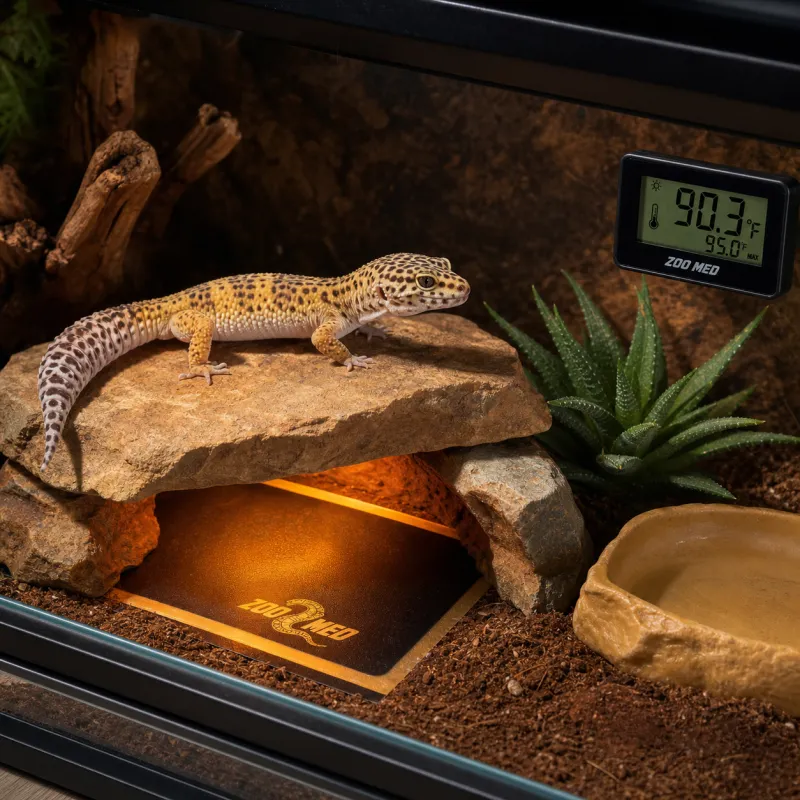
Place the UTH on one side of the enclosure, covering about one-third to one-half of the floor area. This creates a warm side and a cool side. Avoid placing the UTH under the entire enclosure, as this eliminates the gradient. For CHEs or RHPs, position them directly above the warm side, ensuring the heat reaches the substrate without creating a hot spot that exceeds 95°F (35°C).
Substrate Considerations
Substrate can affect heat distribution. Paper towels, reptile carpet, and tile are safe and easy to clean, but they do not retain heat well. Loose substrates like coconut fiber or topsoil can retain heat but may pose an impaction risk if ingested. If using loose substrate, ensure it is not too deep (less than 1 inch) and monitor temperatures closely. A digital thermometer with a probe should be placed directly on the substrate surface to measure the basking spot temperature.
Hides and Thermal Zones
Provide at least three hides: one on the warm side, one on the cool side, and one humid hide in the middle. The warm hide should be placed directly over the UTH, allowing the gecko to bask while feeling secure. The cool hide should be on the opposite side. The humid hide, filled with moist sphagnum moss, helps with shedding and should be placed in a location that is not too hot or too cold.
Step-by-Step Setup Guide
Follow these steps to create a safe and effective heat gradient for your leopard gecko. This guide assumes you have already selected your heat source and thermostat.
- Position the enclosure: Place the enclosure in a room that stays between 65°F and 80°F (18–27°C) to avoid extreme ambient fluctuations. Avoid direct sunlight and drafts.
- Install the heat source: For a UTH, peel off the backing and stick it to the underside of the glass on one side. For a CHE or RHP, mount it securely above the warm side, using a guard for CHEs to prevent burns.
- Set up the thermostat: Place the thermostat probe on the substrate surface directly above the UTH (or under the CHE/RHP) in the basking area. Secure the probe with a small piece of tape or a dab of silicone so the gecko cannot move it.
- Connect and configure: Plug the heat source into the thermostat, then plug the thermostat into the wall. Set the desired basking temperature (e.g., 90°F) and allow the system to run for 24 hours to stabilize.
- Verify temperatures: After 24 hours, use a digital thermometer with a probe and an infrared temperature gun to check the basking spot, warm side ambient, and cool side temperatures. Adjust the thermostat set point if needed.
- Add substrate and hides: Once temperatures are stable, add your chosen substrate and place the three hides (warm, cool, humid) in their respective zones. Ensure the warm hide sits over the UTH or under the heat source.
- Introduce your gecko: After the setup is stable for at least 24 hours, you can introduce your leopard gecko. Monitor its behavior to ensure it is using the gradient appropriately.
This step-by-step approach minimizes the risk of overheating or underheating and ensures your gecko can thermoregulate effectively from day one.
Thermostat Guide: Why and How
A thermostat is a non-negotiable safety device for any heat source. It regulates the temperature by turning the heat source on and off or by dimming it to maintain a set point. Without a thermostat, UTHs can overheat to 120°F (49°C) or more, causing severe burns to your gecko's belly. Thermostats also prevent temperature fluctuations that can stress your gecko.
Types of Thermostats
There are three main types of thermostats:
- On/Off Thermostats: These switch the heat source on and off to maintain the temperature. They are simple and inexpensive but cause temperature swings of a few degrees.
- Pulse Proportional Thermostats: These send pulses of power to the heat source, gradually increasing or decreasing heat. They are more precise and reduce temperature fluctuations.
- Dimming Thermostats: These continuously adjust the power output to maintain a constant temperature. They are ideal for CHEs and RHPs because they do not cause thermal shock.
For leopard geckos, a pulse proportional or dimming thermostat is recommended for precise control. On/off thermostats are acceptable if they have a small hysteresis (the difference between the on and off temperatures).
Choosing the Right Thermostat
When selecting a thermostat, consider the wattage of your heat source. The thermostat must be rated for at least the same wattage. For example, if you have a 50W UTH, a thermostat rated for 100W is fine. Also, choose a thermostat with a remote probe for accurate temperature measurement.
Popular brands include Herpstat, Vivarium Electronics, and Inkbird. Herpstat and VE are high-end with multiple features, while Inkbird is budget-friendly but reliable.
Thermostat Setup and Placement
Place the thermostat probe directly on the substrate surface where the gecko will be, ideally in the warm basking spot. Do not place the probe on the glass or on top of the UTH, as this will give inaccurate readings. Secure the probe with a small piece of tape or a dab of silicone to prevent the gecko from moving it. Connect the heat source to the thermostat, then plug the thermostat into the wall. Set the desired temperature (e.g., 90°F for the basking spot) and allow the system to stabilize for 24 hours before introducing your gecko.
Monitoring Temperatures
Accurate temperature monitoring is essential. You need to measure both the ambient air temperature and the substrate surface temperature.
Tools for Monitoring
- Digital Thermometer with Probe: Place the probe on the substrate to measure the basking spot. This is the most reliable method.
- Infrared Temperature Gun: Allows you to measure temperatures at various points instantly. Great for spot-checking.
- Thermometer/Hygrometer Combo: Measures ambient temperature and humidity. Place it on the cool side or in the middle of the enclosure.
Avoid stick-on analog thermometers, as they are often inaccurate and can be chewed or removed by the gecko.
Daily Monitoring Routine
Check temperatures at least once a day, preferably in the morning and evening. Record the basking spot, warm side ambient, and cool side temperatures. If you notice any deviations, adjust the thermostat or heat source accordingly. Also, monitor the temperature inside the hides, as the gecko may spend most of its time there.
Seasonal Adjustments
In the wild, leopard geckos experience seasonal temperature fluctuations that trigger breeding and brumation behaviors. In captivity, you may choose to mimic these changes or maintain a consistent environment. For most pet owners, a constant temperature is fine, but for breeders, a cooling period in winter can be beneficial.
If you decide to simulate a cooling period, gradually reduce the basking temperature to 75–80°F (24–27°C) over a few weeks, and shorten the photoperiod. This is not recommended for beginners, as it can be stressful if not done correctly.
Common Mistakes to Avoid
Even experienced keepers can make errors when managing heat. Here are the most frequent mistakes and how to avoid them:
- Skipping the thermostat: Using a UTH or CHE without a thermostat is the #1 cause of burns and overheating. Always use a thermostat, even if your heat source is low wattage.
- Placing the probe incorrectly: If the thermostat probe is placed on the glass or on top of the UTH, it will read the heat source temperature, not the substrate surface where the gecko sits. Always place the probe on the substrate in the basking area.
- Using a heat lamp as the sole source: Heat lamps produce bright light and can disrupt the gecko's photoperiod. They also do not provide belly heat. Use them only as a temporary daytime supplement, never as the primary heat source.
- Ignoring ambient room temperature: If your room is very cold, a UTH alone may not raise the ambient temperature enough. You may need a CHE or RHP to supplement. Conversely, if the room is very warm, you may need to lower the thermostat set point.
- Not monitoring temperatures inside hides: The gecko may spend most of its time inside hides, so the temperature there matters. Place a thermometer probe inside the warm hide to ensure it stays within the recommended range.
- Creating too steep a gradient: If the cool side drops below 70°F (21°C), your gecko may not be able to cool down properly or may become stressed. Ensure the cool side stays at 75–80°F (24–27°C) during the day.
By avoiding these mistakes, you'll provide a safer and more comfortable environment for your leopard gecko.
Troubleshooting Common Temperature Issues
Temperature Too High
If the basking spot exceeds 95°F (35°C), your gecko may become lethargic, refuse food, or try to escape. Immediate actions:
- Reduce the thermostat set point.
- Move the heat source further from the basking area.
- Increase ventilation.
- Provide a deeper substrate layer to buffer heat.
Temperature Too Low
If temperatures drop below 75°F (24°C) on the cool side or below 85°F (29°C) on the warm side, your gecko may become sluggish and have difficulty digesting food. Solutions:
- Increase the thermostat set point.
- Add a secondary heat source like a CHE.
- Insulate the enclosure with foam panels (on the outside) to retain heat.
- Move the enclosure to a warmer room.
Uneven Heating
If the gradient is not distinct, check that the heat source is placed at one end and that the substrate is not too thick. Also, ensure that the thermostat probe is not being influenced by ambient room temperature.
Cost Breakdown for Heating Setup
Setting up a proper heating system involves an initial investment and ongoing electricity costs. Here's a rough breakdown based on typical prices (in USD) as of 2025:
| Item | Initial Cost | Notes |
|---|---|---|
| Under-Tank Heater (UTH) | $15–$40 | Size depends on enclosure; 20-gallon long typically uses 10–15W. |
| Ceramic Heat Emitter (CHE) + fixture | $25–$50 | Fixture may be separate; CHE lasts 1–2 years. |
| Radiant Heat Panel (RHP) | $60–$150 | Higher upfront, but energy-efficient. |
| Thermostat | $30–$150 | Inkbird (~$30), Herpstat (~$100+). |
| Digital thermometer with probe | $10–$20 | Essential for monitoring. |
| Infrared temperature gun | $15–$30 | Optional but very useful. |
| Electricity (monthly) | $5–$15 | Depends on wattage and local rates. A 15W UTH running 24/7 uses about 11 kWh/month. |
Initial setup costs range from $50 to $250 depending on your choices. Ongoing electricity costs are modest, especially with low-wattage UTHs. Investing in a quality thermostat is worth the extra cost to prevent burns and ensure stability.
Frequently Asked Questions
Q: What is the ideal basking temperature for a leopard gecko?
A: The ideal basking temperature is 88–92°F (31–33°C) measured on the substrate surface. This allows for optimal digestion and thermoregulation. Always use a thermostat to maintain this temperature and avoid overheating.
Q: Can I use a heat lamp for my leopard gecko?
A: Heat lamps are not recommended as a primary heat source because they produce bright light that can disrupt your gecko's photoperiod. If you use one, choose a low-wattage ceramic heat emitter or a radiant heat panel instead, and always regulate it with a thermostat.
Q: How do I set up a thermostat for my under-tank heater?
A: Place the thermostat probe directly on the substrate above the UTH, set the desired temperature (e.g., 90°F), and plug the UTH into the thermostat. Allow 24 hours to stabilize. Ensure the probe is not covered by substrate or hides, as this can cause inaccurate readings.
Q: What should the nighttime temperature be for a leopard gecko?
A: Nighttime temperatures can drop to 70–75°F (21–24°C) safely. Leopard geckos tolerate these drops as long as they have a warm hide to retreat to if needed. If your room gets colder than 65°F (18°C), use a low-wattage heat source with a thermostat to maintain a minimum of 70°F.
Q: What type of heat source is best for a leopard gecko?
A: Under-tank heaters are the most recommended because they provide direct belly heat, which is essential for digestion. Ceramic heat emitters and radiant heat panels are good supplements for raising ambient temperatures, especially in larger enclosures. Heat lamps are not recommended as a primary source.
Q: How often should I check the temperatures in the enclosure?
A: You should check temperatures at least once a day, preferably in the morning and evening. Use a digital thermometer with a probe for the basking spot and an infrared gun for spot-checking. Record the temperatures to notice any trends or fluctuations.
Q: Can I use a dimming thermostat with a UTH?
A: Yes, dimming thermostats work with UTHs, but they are more commonly used with CHEs and RHPs. For UTHs, a pulse proportional thermostat is often recommended because it reduces temperature swings. However, any thermostat that can handle the wattage and has a remote probe is acceptable.
Related Reading
- Leopard Gecko Care Guide: Complete Beginner's Handbook — Get a full overview of leopard gecko care basics, including setup and daily routines.
- Best Substrate for Leopard Geckos: Safe vs Unsafe — Learn which substrates are safe for your gecko and how they affect heat retention.
- Leopard Gecko Shedding: Humidity Box & Stuck Shed — Discover how to manage humidity and prevent stuck shed with proper enclosure setup.
- Leopard Gecko Not Eating: 7 Causes & Fixes — Understand why your gecko might refuse food and how temperature issues play a role.
- Leopard Gecko Health & Vitamin Guide — Learn about vitamin supplements and health issues linked to improper heat gradients.
Not a timer — it reads the actual humidity and stops when it hits your target. Two temperature probes, failsafes, no cloud account. We don't know yet whether it's worth making, so we're asking keepers first. Two-minute survey →
One email when there's news — including if we decide not to build it. No newsletter.
Check optimal temps, calculate feeding, and find your perfect species match.
References
- Dial, B. E. (1978). The thermal ecology of two sympatric lizards, Eublepharis macularius and Coleonyx variegatus. Herpetologica, 34(4), 399-405.
- R. S. B., et al. (2020). Thermal preferences and thermoregulation in captive leopard geckos. Journal of Herpetological Medicine and Surgery, 30(3), 145-152.
- de Vosjoli, P. (2003). The Herpetoculture of Leopard Geckos. Advanced Vivarium Systems.
🐾 Join the Community
See how other keepers set up their enclosures, ask questions, and share your experience.
🛠️ Apply What You Learned
Check optimal temps, calculate feeding schedules, and get calcium dosage — all personalized for your species.
Comments
No account needed — corrections, updates and questions are all welcome. For a full question with photos, the community Q&A is the better place.