Chinese Water Dragon Care: The Complete Advanced Guide
Species Overview
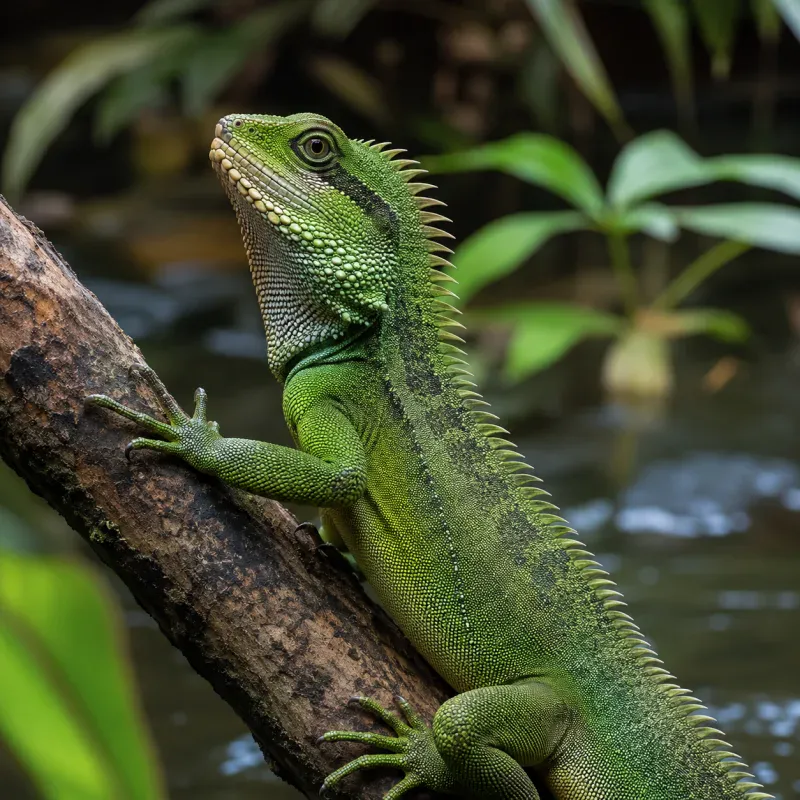
\nThe Chinese water dragon (Physignathus cocincinus) is one of the most striking lizards in the pet trade — brilliant green with turquoise accents, a prominent nuchal crest, and a tail that accounts for two-thirds of their total length. Native to the rainforests of Southeast Asia, they are semi-arboreal lizards that require a large water feature as part of their enclosure.
\nThis is an advanced species. The enclosure is expensive, humidity must be precise, and adults need a minimum 6 feet of vertical space. Chinese water dragons are not beginner reptiles. But for experienced keepers willing to invest in a proper setup, they are unparalleled display animals.
\n\nWarning: Chinese water dragons sold cheaply at pet stores are almost always wild-caught, dehydrated, and parasitized. Source from a reputable captive breeder only.\n\n
Natural History & Behavior
\nIn the wild, Physignathus cocincinus inhabits tropical rainforests near streams and rivers across Thailand, Vietnam, Cambodia, and southern China. They are semi-arboreal, spending most of their time in trees and shrubs overhanging water, and they dive into the water to escape predators. This natural history explains their captive needs: vertical climbing space, a large water area, high humidity, and a basking zone that mimics sun-dappled branches.
\nChinese water dragons are diurnal (active by day) and territorial. Males are particularly aggressive toward each other and should never be housed together; even males with females can cause stress. They are also known for their intelligence and curiosity — many keepers report that well-socialized adults recognize their owners and will come to the front of the enclosure for food.
\n\nEnclosure Requirements
\n| Life Stage | Minimum Enclosure |
|---|---|
| Juvenile | 36"×18"×36" (tall) |
| Adult | 6'×3'×6' (height is critical) |
A custom-built PVC or wood enclosure is almost always required — no commercially available glass tank is large enough for an adult. The enclosure must incorporate a water area (see below), multiple basking branches at different heights, live or artificial foliage covering 60–70% of the space, and sturdy climbing structures.
\n\nStep-by-Step: Building the Ideal Enclosure
\n- \n
- Choose the material: PVC panels are lightweight, waterproof, and easy to clean. Melamine-coated wood is cheaper but must be sealed with a waterproof paint or epoxy to prevent warping. \n
- Design the layout: Plan the water feature at one end and the basking area at the other to create a thermal gradient. The basking zone should be at the top, with climbing branches leading to it. \n
- Install the water feature: Before adding substrate, place the pond or tub. Ensure it is level and has a ramp (e.g., a piece of cork bark or slate) for easy entry and exit. \n
- Add climbing structures: Use thick branches (2–4 inches diameter) that can support the dragon's weight. Secure them with heavy-duty suction cups or screws, as falling can cause injury. \n
- Cover the substrate: Use a 3–4 inch layer of ABG mix or coco coir. Add leaf litter on top to retain moisture and encourage natural foraging behavior. \n
- Install lighting and heating: Mount the UVB tube and basking lamps above the basking branch, ensuring the dragon can get within 8–12 inches of the UVB source. \n
- Add foliage: Live plants like pothos, ferns, and bromeliads not only look natural but also boost humidity. If using artificial plants, choose ones with large leaves to provide cover. \n
Common Enclosure Mistakes
\n- \n
- Too small: Even a 4-foot-tall enclosure is too small for an adult. They need 6 feet to climb and exercise. \n
- No ventilation: Stagnant air promotes bacterial growth. Use a vent fan or partial screen top to ensure airflow. \n
- Inadequate substrate: Newspaper or paper towels are easy to clean but do not hold humidity. Use a moisture-retaining substrate like coconut coir. \n
- No visual barriers: If the dragon can see you approaching from all sides, it will feel stressed. Cover the back and sides with a background or opaque material. \n
Water Feature Setup
\nChinese water dragons are semi-aquatic and must have a water area large enough to submerge their entire body. Options:
\n- \n
- Built-in pond: A fiberglass or sealed plywood reservoir at the enclosure base, 8–12 inches deep with a ramp for easy exit. \n
- Large tub: A heavy-duty plastic tub (e.g., concrete mixing tub) embedded in the substrate. \n
- Canister filter: The water must be filtered — these lizards defecate in water. A canister filter rated for 2–3× the water volume is essential. \n
- Water changes: 50% weekly. Test water parameters (ammonia, nitrite, nitrate) like an aquarium. \n
Step-by-Step: Setting Up the Water Feature
\n- \n
- Choose the container: For an adult, a 30-gallon tub or a custom pond of at least 4 feet long, 2 feet wide, and 8–12 inches deep is ideal. \n
- Place it in the enclosure: Position it at the bottom, flush with the substrate. Ensure it is stable and does not leak. \n
- Add a ramp: Use a piece of cork bark, slate, or a reptile ramp that extends from the bottom of the tub to the edge. The dragon must be able to climb out easily. \n
- Install the filter: Submerge the canister filter intake and return hoses. Choose a filter rated for at least 2–3 times the water volume (e.g., a 100-gallon filter for a 30-gallon tub). \n
- Add an aquarium heater: Use a submersible heater rated for the water volume to maintain 75–80°F (24–27°C). \n
- Cycle the water: Run the filter for 24 hours before introducing the dragon. Test ammonia, nitrite, and nitrate weekly. \n
Water Quality Troubleshooting
\n| Problem | Cause | Solution |
|---|---|---|
| Cloudy water | Bacterial bloom or overfeeding | Reduce feeding in water, increase filter flow, perform 50% water change |
| High ammonia | Insufficient filtration or infrequent changes | Upgrade filter, change water 50% weekly, add beneficial bacteria |
| Algae growth | Excess light and nutrients | Reduce lighting hours, clean filter, scrub surfaces |
| Dragon not swimming | Water too cold or too deep | Check heater, adjust depth to 8–12 inches, ensure ramp is accessible |
Heating & UVB
\n| Zone | Temperature (°F) | Temperature (°C) |
|---|---|---|
| Basking surface | 95–105°F | 35–41°C |
| Ambient daytime | 82–88°F | 28–31°C |
| Night | 72–78°F | 22–26°C |
| Water temperature | 75–80°F | 24–27°C |
UVB: T5 HO 10.0 or 12% tube running the full length of the enclosure. Replace every 12 months. These are sun-worshipping lizards — UVB is non-negotiable. Use multiple halogen flood bulbs to create a broad basking zone, plus a ceramic heat emitter for nighttime ambient heat if needed. An aquarium heater keeps water at the correct temperature.
\n\nStep-by-Step: Setting Up Heating and UVB
\n- \n
- Mount the UVB tube: Install a T5 HO 10.0 or 12% tube spanning the full length of the enclosure. Place it at the top, ideally on the ceiling, about 8–12 inches above the basking branch. \n
- Position the basking lamps: Use two or three halogen flood bulbs (50–100 watts each) to create a broad basking zone. Place them over a large branch or platform, ensuring the surface temperature reaches 95–105°F (35–41°C). \n
- Add a ceramic heat emitter: If nighttime temperatures drop below 72°F (22°C), use a ceramic heat emitter connected to a thermostat to provide gentle ambient heat without light. \n
- Heat the water: Submerge an aquarium heater in the water feature, set to 75–80°F (24–27°C). Always use a heater with a guard to prevent burns. \n
- Use thermostats: Connect all heat sources to a thermostat to prevent overheating. Place a digital thermometer at the basking surface and ambient level to verify temperatures. \n
UVB Facts and Myths
\n- \n
- Myth: A coil UVB bulb is sufficient. Fact: Coil bulbs produce a narrow beam and are inadequate for this species. A T5 HO tube is required. \n
- Myth: UVB only matters for calcium absorption. Fact: UVB also supports immune function and overall well-being. \n
- Myth: UVB bulbs last forever. Fact: They lose output over time; replace every 12 months even if they still light up. \n
Humidity Management
\nHumidity: 70–85%. This is the hardest parameter to maintain. Strategies:
\n- \n
- Automatic misting system: MistKing or similar, running 2–3× daily for 30–60 seconds. \n
- Fogger: Ultrasonic fogger on a timer boosts humidity dramatically. \n
- Live plants: Pothos, ferns, bromeliads, and ficus contribute to ambient humidity. \n
- Deep substrate: ABG mix or coco coir with leaf litter holds moisture. \n
- Partial top coverage: Covering 70% of the screen top with acrylic or PVC traps humidity. \n
Step-by-Step: Achieving and Maintaining Humidity
\n- \n
- Install a misting system: Set up a MistKing or similar system with nozzles aimed at foliage and branches. Program it to run 2–3 times daily for 30–60 seconds, ideally in the morning and evening. \n
- Add a fogger: For extra humidity, use an ultrasonic fogger on a timer for 15–30 minutes 2–3 times a day, especially if ambient humidity drops below 70%. \n
- Use live plants: Choose tropical plants like pothos, ferns, and bromeliads. They release moisture through transpiration. \n
- Maintain substrate moisture: Mist the substrate directly until it is damp but not waterlogged. Mix in sphagnum moss to retain moisture. \n
- Cover part of the top: Use acrylic or PVC sheets to cover 70% of the screen top. This reduces evaporation while allowing some airflow. \n
- Monitor with a hygrometer: Place a digital hygrometer at mid-height to track humidity. Adjust misting frequency as needed. \n
Humidity Troubleshooting
\n| Symptom | Cause | Solution |
|---|---|---|
| Humidity below 70% | Screen top too open, insufficient misting | Cover more of the top, increase misting frequency, add a fogger |
| Condensation on glass | Humidity too high (above 85%) | Increase ventilation, reduce misting, remove some plants |
| Mold growth | Excess moisture and poor airflow | Improve ventilation, reduce misting, remove moldy substrate |
| Stuck shed | Humidity too low | Increase humidity, provide a soak in the water feature |
Diet & Supplementation
\nChinese water dragons are omnivores with an insect-heavy diet:
\n- \n
- Staples (70%): Dubia roaches, crickets, silkworms, black soldier fly larvae, earthworms. \n
- Occasional (20%): Superworms, hornworms, pinky mice (adults only, 1–2×/month). \n
- Vegetables (10%): Collard greens, dandelion, squash, bell pepper — finely chopped. \n
- Supplementation: Calcium (no D3) every feeding for juveniles, 3–4×/week for adults. Calcium with D3 1–2×/week. Multivitamin 1×/week. \n
Feeding Schedule by Life Stage
\n| Life Stage | Frequency | Portion Size |
|---|---|---|
| Juvenile (under 1 year) | Daily | As many insects as they will eat in 10 minutes |
| Sub-adult (1–2 years) | Every other day | 10–15 insects per feeding |
| Adult (over 2 years) | 3–4 times per week | 15–20 insects per feeding |
Gut-Loading and Dusting
\nGut-loading feeder insects for 24 hours before feeding ensures your dragon gets essential nutrients. Use a commercial gut-load diet or fresh vegetables like carrots, leafy greens, and sweet potatoes. Dust insects with supplements just before feeding:
\n- \n
- Calcium without D3: For juveniles at every feeding; for adults 3–4 times a week. \n
- Calcium with D3: 1–2 times a week for all ages. \n
- Multivitamin: Once a week for all ages. \n
Common Diet Mistakes
\n- \n
- Feeding only crickets: Crickets are low in calcium and high in phosphorus. Offer a variety of insects. \n
- Overfeeding pinky mice: Pinkies are high in fat and should be limited to adults, 1–2 times per month maximum. \n
- Ignoring vegetables: Some dragons are insect-picky, but you should still offer chopped greens daily. Try mixing with insects to encourage consumption. \n
- Not dusting supplements: Without calcium, dragons can develop metabolic bone disease (MBD). \n
Handling & Temperament
\nChinese water dragons can become docile with regular, gentle handling, but they are initially nervous and may drop their tail as a defense mechanism (which does not regrow). Start with short handling sessions (5–10 minutes) and gradually increase as the dragon becomes comfortable. Always support the body fully and avoid grabbing the tail. Watch for signs of stress: darkening color, hissing, tail whipping, or attempting to jump. Never handle a dragon that is shedding or has just eaten.
\n\nHealth & Common Issues
\nLike all reptiles, Chinese water dragons are prone to certain health problems, many of which are preventable with proper care.
\nMetabolic Bone Disease (MBD)
\nCaused by calcium deficiency and/or inadequate UVB. Symptoms include tremors, swollen limbs, and a rubbery jaw. Treatment requires veterinary intervention and immediate correction of UVB and supplementation.
\nRespiratory Infections
\nOften caused by low humidity and cold temperatures. Symptoms include wheezing, open-mouth breathing, and excess mucus. Increase humidity and temperature, and consult a vet.
\nSkin Issues
\nStuck shed results from low humidity. Provide a soak in shallow water and increase humidity. Rostral abrasions (snout rubbing) occur when a dragon is stressed or enclosure is too small. Provide visual barriers and more space.
\nParasites
\nWild-caught dragons are almost always parasitized. If you suspect parasites (weight loss, diarrhea), have a fecal exam done by a veterinarian. Captive-bred dragons are generally parasite-free if sourced from a reputable breeder.
\n\nWhat Not to Do
\n- \n
- Small enclosure: An adult CWD in a 40-gallon tank is animal cruelty. Minimum 6 feet tall. \n
- No water feature: A water bowl is not enough. They need to submerge and swim. \n
- Buying wild-caught: WC dragons are dehydrated, stressed, and heavily parasitized. Source captive-bred only. \n
- Low humidity: Chronic low humidity causes respiratory infections, stuck shed, and kidney damage. \n
- Improper UVB: A coil bulb in a dome fixture is nowhere near sufficient. T5 tube, full enclosure length. \n
- Rostral abrasions: Dragons rub their snouts on glass or screen when stressed. This causes permanent facial deformities. Provide visual barriers and adequate space. \n
Frequently Asked Questions
\nHow often should I clean the water feature?
\nYou should perform a 50% water change weekly and test water parameters (ammonia, nitrite, nitrate) regularly. The canister filter should be cleaned according to the manufacturer's instructions, typically every 2–4 weeks.
\nCan I keep two Chinese water dragons together?
\nNo, especially not two males, as they are territorial and will fight. Even a male and female pair can cause stress to the female from constant breeding attempts. It is best to house them singly.
\nHow long do Chinese water dragons live?
\nWith proper care, captive-bred Chinese water dragons can live 10–15 years, and some have been known to live up to 20 years. Wild-caught individuals often have shorter lifespans due to dehydration, parasites, and stress.
\nWhat is the ideal UVB bulb and how often should it be replaced?
\nUse a T5 HO 10.0 or 12% tube that runs the full length of the enclosure. Replace it every 12 months, even if it still emits light, because the UVB output decreases over time.
\n\nRelated Reading
\n- \n
- Chinese Water Dragon Water Guide — Filtration and humidity. \n
- Enclosure Size Guide — Minimum tank sizes. \n
- Bearded Dragon Care Guide — Popular agamid comparison. \n
Check optimal temps, calculate feeding, and find your perfect species match.
References
- de Vosjoli, P. (2003). The Chinese Water Dragon. Advanced Vivarium Systems.
- Kaplan, M. (2016). Reptile Care: An Atlas of Diseases and Treatments. CRC Press.
- McLeod, L. (2019). Chinese Water Dragon Care Sheet. The Spruce Pets.
🐾 Join the Community
See how other keepers set up their enclosures, ask questions, and share your experience.
🛠️ Apply What You Learned
Check optimal temps, calculate feeding schedules, and get calcium dosage — all personalized for your species.
Comments