Emerald Tree Skink Care: Complete Arboreal Gem Guide
Species Overview
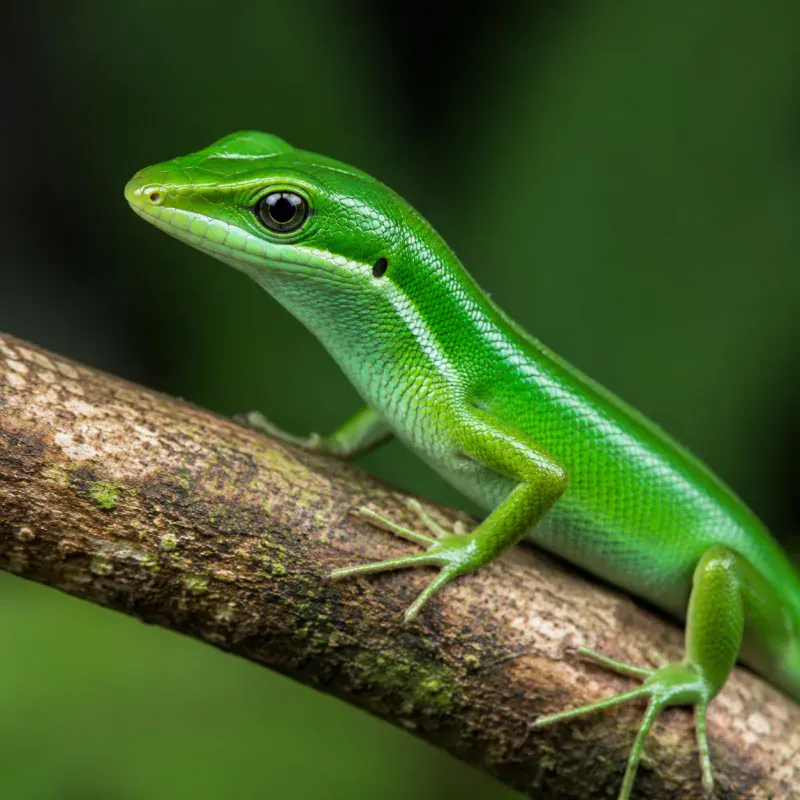
The emerald tree skink (Lamprolepis smaragdina) is a brilliant green, diurnal lizard native to Southeast Asia and the Indo-Pacific islands. What sets them apart from most lizards is their social nature — emerald tree skinks can be housed in pairs or small groups, and they exhibit fascinating communal behaviors including sleeping together in piles.
They are fast, alert, and highly active. Unlike crested geckos which hide during the day, emerald tree skinks are out and visible, making them exceptional display animals. However, their speed and arboreal lifestyle mean they are not handleable — these are display lizards, not pets to hold.
Natural History and Behavior
In the wild, emerald tree skinks are found in tropical rainforests, often on tree trunks and branches, where they bask in sunbeams and hunt small insects. They are excellent climbers, with specialized toe pads that allow them to grip smooth surfaces. Their bright green coloration provides camouflage among leaves, and they can quickly dart to safety when threatened.
These skinks are known for their curiosity and active foraging. They spend much of the day moving through the canopy, scanning for prey. Their social structure in the wild often involves loose aggregations, which translates well to captive groups.
Why Choose an Emerald Tree Skink?
- Active and visible: Unlike many reptiles that hide, these skinks are out and about during the day, making them great display animals.
- Social: They can be kept in pairs or small groups, offering a unique opportunity to observe communal behavior.
- Relatively small: Their modest size makes them suitable for medium-sized arboreal enclosures.
- Low handling needs: Since they are not handleable, they are ideal for keepers who prefer observation over interaction.
However, they are not for beginners who want a pet to hold. Their speed and fragility require a keeper who appreciates them from a distance.
Enclosure Setup
| Housing | Recommendation |
|---|---|
| Single or pair | 18"×18"×24" (minimum, arboreal) |
| Trio or group | 24"×18"×36" or larger |
Vertical space is everything. Fill the enclosure with bamboo poles, cork bark tubes, and broad-leaf plants (pothos, schefflera, ficus). Provide multiple basking spots at different heights. Substrate: ABG mix or coco coir with leaf litter. They don't burrow but appreciate a naturalistic floor.
Step-by-Step Enclosure Setup
- Choose the right size: For a pair, a 18"×18"×24" enclosure is the minimum. For a trio or group, go larger, such as 24"×18"×36" or more. The key is height, as these skinks are arboreal.
- Select a substrate: Use an ABG mix (a blend of tree fern fiber, sphagnum moss, charcoal, and orchid bark) or coco coir. Add a layer of leaf litter on top to retain humidity and provide a natural look. Avoid substrates that dry out quickly or are dusty.
- Add climbing structures: Place bamboo poles vertically and diagonally across the enclosure. Cork bark tubes can be wedged between branches to create hides and sleeping spots. Ensure everything is stable and can support the weight of the skinks.
- Incorporate live plants: Pothos, schefflera, and ficus are excellent choices. They provide cover, increase humidity, and create a natural environment. Plants should be non-toxic and able to thrive in high humidity.
- Create basking spots: Position a basking branch or platform near the heat lamp, at different heights, so the skinks can choose their preferred temperature. Use sturdy branches that won't move when climbed on.
- Provide hiding areas: Even though they are social, they need places to retreat. Cork bark tubes, dense foliage, and artificial caves can serve as hides.
- Add a water dish: While they mostly drink droplets, a shallow water dish can be provided. Ensure it is stable and cleaned regularly.
Lighting and Photoperiod
Emerald tree skinks are diurnal, so they need a day/night cycle. Provide 10-12 hours of light per day, with a basking lamp and UVB tube. At night, the lights should be off, and temperatures should drop.
Common Enclosure Mistakes
- Too small: Cramped enclosures cause stress and health issues.
- Lack of vertical space: A long, low tank is unsuitable; height is crucial.
- Insufficient climbing structures: Without branches and vines, skinks become inactive and stressed.
- Poor ventilation: Stagnant air can lead to respiratory problems. Ensure some airflow while maintaining humidity.
Heating & UVB
| Zone | Temperature (°F) | Temperature (°C) |
|---|---|---|
| Basking surface | 95–100°F | 35–38°C |
| Ambient daytime | 80–85°F | 27–29°C |
| Night | 68–72°F | 20–22°C |
UVB is essential. T5 HO 5.0 or 6% tube covering the upper third of the enclosure. Halogen flood bulb for basking. These are sun-loving, diurnal skinks that bask frequently — UVB deficiency leads to rapid MBD onset.
Setting Up Heating
To achieve the correct temperature gradient, place a basking lamp at one end of the enclosure, focused on a branch or platform. Use a thermostat to control the temperature and prevent overheating. The basking surface should be 95–100°F, while the cool end should be around 80°F. At night, allow the temperature to drop to 68–72°F, which can be achieved by turning off the basking lamp. Use a ceramic heat emitter if ambient temperatures drop too low.
Choosing UVB Lighting
UVB is critical for vitamin D3 synthesis and calcium metabolism. A T5 HO 5.0 or 6% tube is recommended, covering the upper third of the enclosure. Place it so that the skinks can bask within 6-8 inches of the bulb. Replace the bulb every 6-12 months, as UVB output diminishes over time. Avoid placing glass or plastic between the bulb and the skinks, as it filters out UVB.
Monitoring Temperatures
Use digital thermometers with probes to monitor basking and ambient temperatures. A temperature gun can measure the surface temperature of the basking spot. Check daily to ensure consistency.
Common Heating Mistakes
- Insufficient basking temperature: Below 90°F, digestion slows and activity drops.
- No UVB: As mentioned, this leads to MBD within months.
- Overheating: Temperatures above 105°F can be lethal. Always use a thermostat.
- Incorrect bulb placement: UVB must be accessible; if it's too far, it's ineffective.
Humidity & Hydration
Humidity: 60–80%. Mist 2× daily with dechlorinated water. A dripper or automatic misting system is ideal for consistent humidity. They drink droplets from leaves, though some individuals learn to use a water dish. Live plants dramatically help maintain humidity.
Maintaining Humidity
To keep humidity in the 60-80% range, mist the enclosure every morning and evening. Use dechlorinated water to avoid harmful chemicals. An automatic misting system can provide multiple bursts throughout the day, which is especially useful if you are away. A hygrometer is essential to monitor levels. If humidity is too low, increase misting frequency, add more live plants, or partially cover the screen top to reduce evaporation. If it's too high, increase ventilation.
Water Sources
Emerald tree skinks prefer drinking water droplets from leaves. After misting, you'll often see them licking the foliage. Some individuals may also drink from a shallow water dish. Ensure the dish is cleaned daily to prevent bacterial growth. A dripper can also encourage drinking and increase humidity.
Signs of Dehydration
Signs include sunken eyes, wrinkled skin, and lethargy. If you notice these, increase misting and provide a humid hide (a container with damp sphagnum moss).
Diet & Feeding
- Staples: Small crickets, dubia roach nymphs, small silkworms, flightless fruit flies (for young).
- Occasional: Small mealworms, waxworms (treat only).
- Frequency: Daily for juveniles, every other day for adults.
- Supplementation: Calcium (no D3) 3–4×/week, Calcium with D3 1×/week, Multivitamin 1×/week.
- Feeding method: Release feeders into the enclosure. Emerald tree skinks are active hunters and will chase prey across branches.
Nutritional Needs
A varied diet is essential for optimal health. Crickets and dubia roaches should be gut-loaded with nutritious foods before feeding. Silkworms are highly nutritious and can be a staple. For young skinks, flightless fruit flies are appropriate. Treats like waxworms and mealworms should be limited due to high fat content.
Supplementation Schedule
| Supplement | Frequency |
|---|---|
| Calcium (no D3) | 3–4 times per week |
| Calcium with D3 | 1 time per week |
| Multivitamin | 1 time per week |
Dust the feeders with supplements just before offering them. Avoid over-supplementing, as that can be harmful.
Feeding Tips
- Release feeders: Place crickets or roaches in the enclosure and let the skinks hunt. This encourages natural behavior.
- Observe feeding: Watch to ensure all individuals are eating. In groups, some may be more dominant; ensure everyone gets enough.
- Remove uneaten prey: After 30 minutes, remove any uneaten insects to prevent them from stressing the skinks or becoming a nuisance.
Common Diet Mistakes
- Feeding only one type of insect: Lack of variety leads to nutritional deficiencies.
- No supplementation: Without calcium, MBD develops.
- Overfeeding treats: Waxworms and mealworms can cause obesity.
- Feeding too large prey: Insects should be no larger than the space between the skink's eyes.
Social Behavior
This is the most unique aspect of emerald tree skinks. Unlike most reptiles, they are genuinely social:
- Pairs work well: Male-female or female-female pairs. Two males may fight.
- Communal sleeping: Skinks pile together in cork tubes or under leaves at night.
- Reduced stress: Solo-kept skinks are often shyer. Pairs are bolder and more visible.
- Breeding: If you keep a male-female pair, expect eggs. Provide a nest box with damp sphagnum.
Group Dynamics
In a group, there is often a hierarchy. Males may display to each other, and if two males are housed together, they may fight, leading to injuries. Female-female pairs usually coexist peacefully. A male-female pair is ideal for breeding and social interaction.
Introducing New Skinks
When introducing a new skink, quarantine it for at least 30 days to prevent disease transmission. Then, introduce them in a neutral territory or rearrange the enclosure to disrupt established territories. Monitor for aggression. If fighting occurs, separate them and try again later.
Breeding
If you have a male-female pair, breeding is likely. Provide a nest box filled with damp sphagnum moss or vermiculite. The female will lay a clutch of eggs, which should be incubated at around 80°F. After hatching, the young can be raised separately or in a group if space allows.
What Not to Do
- No UVB: Diurnal basking skinks absolutely require UVB. Without it, MBD develops within months.
- Trying to handle: These are fast. Attempting to grab one results in a dropped tail or an escaped lizard. They're display animals.
- Too-dry enclosure: Low humidity causes dehydration, stuck shed, and respiratory issues.
- Insufficient basking temperature: Below 90°F, digestion slows and activity drops.
- Keeping alone: While possible, solo skinks are shyer and less active than pairs. They genuinely benefit from conspecifics.
Additional Mistakes to Avoid
- Using loose substrate that can be ingested: While they don't burrow, they may accidentally ingest substrate while hunting. Use larger pieces or feed in a dish if necessary.
- Ignoring signs of illness: Lethargy, loss of appetite, or abnormal shedding should be addressed immediately.
- Not providing enough hiding spots: Even social skinks need privacy.
- Overcrowding: Too many skinks in a small space leads to stress and aggression.
Health & Wellness
Common Health Issues
- Metabolic Bone Disease (MBD): Caused by lack of UVB and calcium. Symptoms include soft jaw, tremors, and deformed limbs. Prevention is key.
- Dehydration: Signs include wrinkled skin and sunken eyes. Ensure proper humidity and water availability.
- Respiratory infections: Caused by low temperatures and high humidity. Symptoms include wheezing and mucus discharge.
- Stuck shed: Due to low humidity. Provide a humid hide or increase misting.
- Parasites: Can be introduced through feeder insects. Quarantine new animals and use clean feeders.
Signs of a Healthy Skink
- Bright, alert eyes.
- Smooth, glossy skin with no stuck shed.
- Active movement and foraging behavior.
- Regular eating and defecation.
- Clear nostrils and no discharge.
When to See a Vet
Find a reptile veterinarian before you need one. If you notice any signs of illness, such as lethargy, loss of appetite, or abnormal behavior, consult a vet immediately. Early treatment is crucial.
Frequently Asked Questions
Can I keep two male emerald tree skinks together?
No, two males may fight, leading to injuries and stress. It's best to keep a male-female pair or a group of females.
How often should I mist the enclosure?
Mist the enclosure twice daily to maintain humidity between 60-80%. An automatic misting system can provide consistent humidity.
What is the lifespan of an emerald tree skink?
With proper care, emerald tree skinks can live 5-10 years in captivity, though some may live longer with optimal conditions.
Do emerald tree skinks need UVB lighting?
Yes, UVB is essential for their health. Without it, they develop metabolic bone disease quickly. Use a T5 HO 5.0 or 6% tube.
Related Reading
- Emerald Tree Skink Social Guide — Group housing and compatibility.
- Crested Gecko Care Guide — Another arboreal display species.
- Bioactive Enclosure Guide — Planted tropical vivarium setup.
Check optimal temps, calculate feeding, and find your perfect species match.
References
- McLeod, L. (2021). Emerald Tree Skink Care Sheet. The Spruce Pets.
- Reptile Magazine. (2020). Emerald Tree Skink: Care and Breeding.
🐾 Join the Community
See how other keepers set up their enclosures, ask questions, and share your experience.
🛠️ Apply What You Learned
Check optimal temps, calculate feeding schedules, and get calcium dosage — all personalized for your species.
Comments