Best Reptile Substrate: 10 Options Compared by Species
Why Substrate Matters
Choosing the right substrate is one of the most consequential husbandry decisions you'll make. The wrong substrate can cause impaction, respiratory infections, skin irritation, or stress. The right one mimics your reptile's natural habitat, maintains proper humidity, and supports natural behaviors like burrowing.
The Most Important Thing: Match the substrate to the species' natural habitat — not to what looks good in a pet store display.
Substrate Comparison Table
| Substrate | Humidity | Impaction Risk | Cleaning | Best For |
|---|---|---|---|---|
| Paper Towels | Low | None | Easy (replace) | Quarantine, juveniles, hospital setups |
| Ceramic Tile / Slate | Low | None | Easy (wipe) | Leopard geckos, bearded dragons |
| Aspen Shavings | Low–Moderate | Low | Moderate (spot-clean) | Corn snakes, king snakes, hognose snakes |
| Cypress Mulch | High | Low | Moderate | Ball pythons, rainbow boas |
| Coco Coir (Eco Earth) | High | Low | Moderate | Pacman frogs, tropical geckos |
| Coco Husk (ReptiChip) | High | Low | Moderate | Ball pythons, boa constrictors |
| Play Sand | Very Low | High (if pure) | Hard | Uromastyx, sandfish (species-dependent) |
| Excavator Clay | Very Low | Low | Hard | Uromastyx, leopard geckos (mix) |
| Bioactive Mix (ABG) | Adjustable | Very Low | Self-cleaning | Crested geckos, dart frogs, many tropical species |
| Reptile Carpet | Low | Moderate | Moderate (wash) | NOT recommended — harbors bacteria, snags claws |
Paper Towels & Tile — The Safe Basics
Paper towels are the gold standard for quarantine setups, sick animals, and juveniles under 6 months. They allow easy monitoring of droppings, eliminate impaction risk, and are replaced in seconds. The downside: zero enrichment value and poor aesthetics.
Ceramic tile or slate is excellent for arid species like leopard geckos. It holds and distributes heat from under-tank heaters beautifully, files nails naturally, and wipes clean. Choose textured tile — smooth tile is too slippery. Avoid glazed tiles which can off-gas when heated.
Aspen & Wood-Based Substrates
Aspen shavings are the classic snake substrate. They hold burrows well, are digestible if small amounts are ingested, and have a pleasant natural appearance. Critical limitation: aspen molds rapidly at humidity above 50%. Never use aspen for ball pythons, rainbow boas, or any species requiring elevated humidity.
Avoid pine and cedar — they contain aromatic phenols that are toxic to reptiles, causing respiratory damage and neurological issues. Even "kiln-dried" pine should be avoided.
Coconut & Cypress — The Humidity Champions
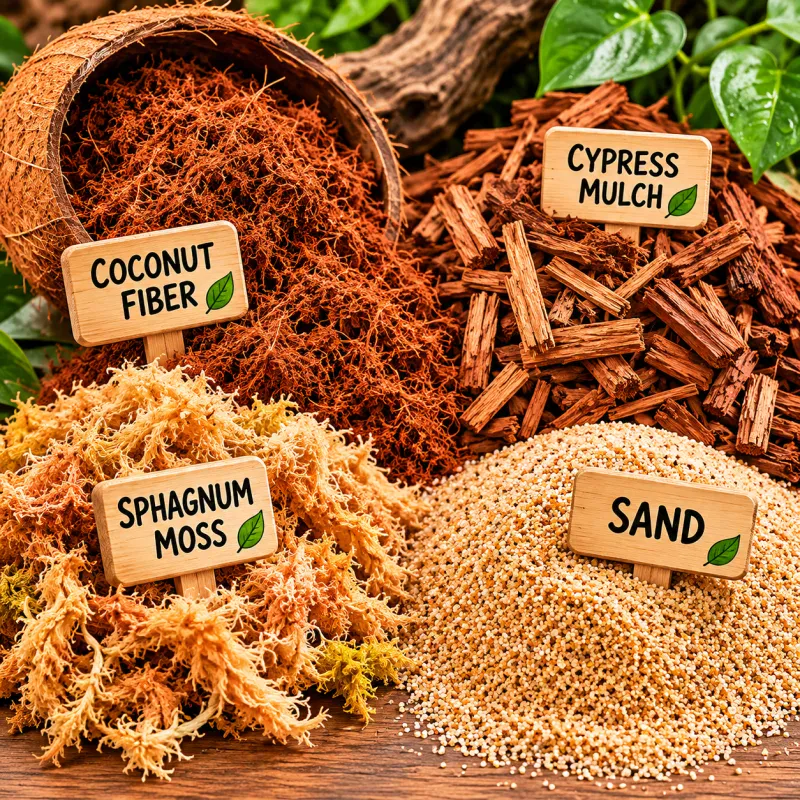
Cypress mulch and coco coir (Eco Earth) are the go-to choices for humidity-loving species. Both resist mold, retain moisture for days, and allow natural burrowing behavior. For ball pythons, a 3-4 inch layer of cypress mulch or ReptiChip with water poured into the corners (not misted on top) maintains 60%+ humidity for a week.
Coco husk (ReptiChip) is chunkier than coir and creates air pockets that prevent the surface from staying perpetually wet — this is crucial for preventing scale rot in snakes.
Sand & Excavator Clay — Arid Specialists
Pure calcium sand is one of the most dangerous substrates sold in pet stores. It's marketed as "digestible" but actually hardens into a cement-like mass in the gut, causing fatal impaction. Never use pure calcium sand.
Washed play sand can be used safely for true desert specialists (Uromastyx, sandfish skinks) when provided at appropriate depth. For leopard geckos, a 70% organic topsoil / 30% play sand mix is the advanced-keeper gold standard — but only for healthy adults.
Excavator clay mixed with sand creates a burrowable, naturalistic surface for arid species. It hardens enough to hold tunnels but remains diggable. Excellent for Uromastyx and desert monitors.
Bioactive Mix (ABG)
ABG (Atlanta Botanical Garden) mix is the foundation of bioactive enclosures. The standard recipe: 2 parts tree fern fiber, 1 part peat moss (or coco coir), 1 part charcoal, 1 part sphagnum moss, and 1 part orchid bark. This mix drains well, resists compaction, supports plant roots, and provides habitat for cleanup crew (springtails and isopods). Works for most tropical and temperate species.
Substrates to Avoid
- Calcium sand: "Digestible" marketing is false — it causes fatal impaction.
- Crushed walnut shell: Sharp edges damage intestinal lining; indigestible.
- Corn cob bedding: Molds rapidly, causes impaction, and harbors bacteria.
- Pine and cedar: Toxic phenols cause respiratory and neurological damage.
- Reptile carpet: Harbors bacteria colonies, snags teeth and claws, impossible to fully sanitize.
- Gravel / aquarium stones: Impaction risk; no enrichment value.
Species Quick-Reference
| Species Group | Recommended Substrate | Avoid |
|---|---|---|
| Leopard Gecko | Tile, paper towels (juv), 70/30 soil-sand (adult) | Pure sand, calcium sand, carpet |
| Bearded Dragon | Tile, shelf liner, arid bioactive | Sand (juveniles), walnut shell |
| Crested Gecko | ABG mix, coco coir | Sand, aspen, pine |
| Ball Python | Cypress mulch, ReptiChip, coco coir | Aspen, pine, sand |
| Corn Snake | Aspen shavings | Pine, cedar, sand |
| Uromastyx | Sand-excavator clay mix, slate | Wood-based, coconut (too humid) |
| Pacman Frog | Coco coir (Eco Earth) | Gravel, moss, bark chips |
The Most Common Problems
- Using sand for a non-desert species: "It looks natural" is not a valid reason. Match substrate to the animal's needs, not your aesthetic.
- Skipping the quarantine period: Every new animal should spend 30-90 days on paper towels. This lets you monitor droppings and check for mites before introducing to a bioactive or loose substrate setup.
- Misting instead of pouring water: For humidity species, pouring water directly into the substrate corners keeps the top layer dry (preventing scale rot) while maintaining deep humidity.
- Not providing enough depth: Burrowing species need 4-6 inches minimum. A thin layer prevents natural behavior and causes stress.
Related Reading
- Bioactive Enclosure Guide — ABG substrate and CUC setup.
- Reptile-Safe Plants Guide — Live plants for terrariums.
- Reptile Enclosure Size Guide — Minimum tank sizes by species.
Check optimal temps, calculate feeding, and find your perfect species match.
References
- ReptiFiles. Substrate Guides by Species. https://reptifiles.com/
- Mader, D.R. (2006). Reptile Medicine and Surgery, 2nd Edition. Saunders Elsevier.
- The Bio Dude. Bioactive Substrate Guide. https://www.thebiodude.com/
🐾 Join the Community
See how other keepers set up their enclosures, ask questions, and share your experience.
🛠️ Apply What You Learned
Check optimal temps, calculate feeding schedules, and get calcium dosage — all personalized for your species.
Comments