Bioactive Cleanup Crew: Isopods & Springtails
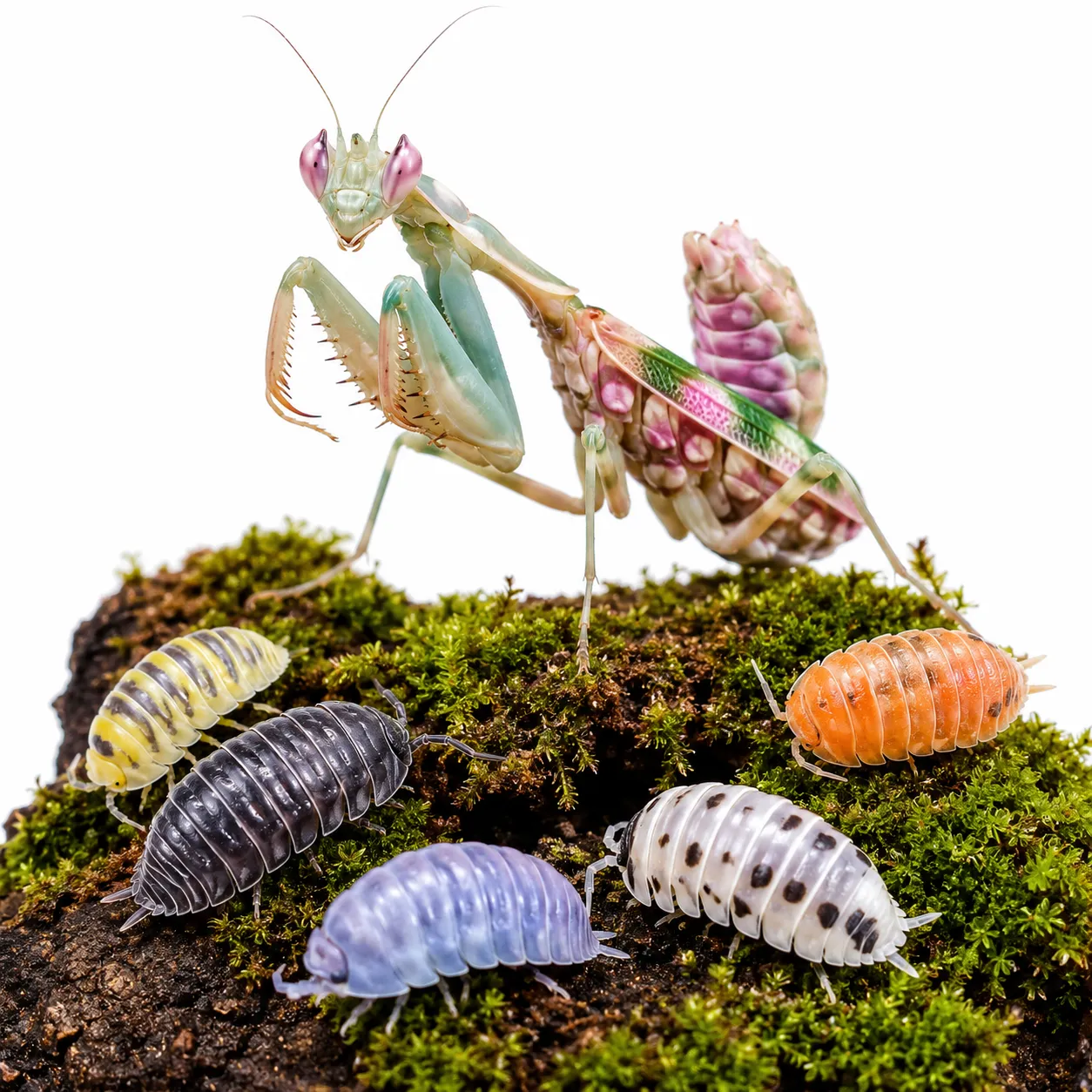
Introduction
Isopods (terrestrial crustaceans) and springtails (Collembola) form the backbone of any successful bioactive vivarium. These tiny custodians break down organic waste—leaf litter, dead plant matter, shed skin, and fecal material—into nutrients that plants and microorganisms can reuse. A well-established cleanup crew (CUC) reduces mold, eliminates odors, and creates a self-sustaining ecosystem. This guide covers everything you need to know: choosing the right species for your vivarium type, culturing methods, substrate requirements, feeding, and troubleshooting common issues.
Why Go Bioactive?
Bioactive setups mimic natural ecosystems. Instead of manual spot-cleaning, you rely on a micro-fauna workforce. Isopods are efficient shredders; springtails control fungal spores and bacteria. Together, they maintain soil health, aerate the substrate, and recycle nutrients. Benefits include less frequent full substrate changes, healthier plants, and a more natural environment for your reptile or amphibian.
Beyond convenience, bioactive enclosures provide enrichment. Reptiles and amphibians exhibit more natural behaviors—digging, foraging, and exploring—when their environment includes living soil and microfauna. The microbial activity in a bioactive substrate also helps break down ammonia from waste, reducing the frequency of deep cleanings and improving air quality.
Best Species for Tropical vs. Arid Vivariums
Not all isopods and springtails tolerate the same humidity and temperature. Choose species adapted to your vivarium’s climate. Below is a comparison table, followed by detailed profiles of the most popular species.
| Vivarium Type | Recommended Isopod Species | Recommended Springtail Species | Key Requirements |
|---|---|---|---|
| Tropical (80–90% humidity, 75–85°F) | Porcellionides pruinosus (Powder Orange/Blue), Armadillidium vulgare (clown isopods), Trichorhina tomentosa (dwarf white) | Folsomia candida (temperate white springtail), Sinella curviseta (tropical springtail) | Moist substrate, high organic matter, constant misting |
| Arid (30–50% humidity, 70–85°F) | Armadillidium maculatum (zebra isopod), Armadillidium nasatum (peach isopod), Porcellio scaber (wild type or “Dairy Cow”) | Folsomia candida (if kept in moist microclimate), Sinella curviseta (hardier) | Dry top layer with a humid hide (moist moss or cork), deeper substrate |
Note: Dwarf white isopods reproduce quickly and stay small—ideal for small vivariums. For arid setups, provide a moisture gradient: a damp corner with sphagnum moss allows springtails to survive.
Detailed Species Profiles
Powder Orange/Blue Isopods (Porcellionides pruinosus)
These are among the most prolific tropical isopods. They tolerate a wide temperature range (65–85°F) but prefer high humidity. Powder blues are slightly more cold-tolerant than oranges. They breed rapidly, making them excellent for establishing a new CUC.
Dwarf White Isopods (Trichorhina tomentosa)
As the name suggests, these stay tiny (under 5 mm). They reproduce faster than most species and are perfect for small enclosures like dart frog vivariums. They require consistently moist substrate and do not need deep burrows.
Zebra Isopods (Armadillidium maculatum)
Recognizable by their black-and-white stripes, these isopods are hardy and tolerate drier conditions. They do well in arid setups with a humid hide. They are slower to reproduce than powder blues, so start with a larger initial colony.
Dairy Cow Isopods (Porcellio laevis)
Despite being listed under Porcellio scaber in some sources, true dairy cows are Porcellio laevis. They are large, active, and excellent for arid-to-moderate humidity. They need a protein source occasionally but can thrive on leaf litter alone.
Springtail Species
Folsomia candida (temperate white springtail) is the most common species in the hobby. It thrives in 65–75°F and high humidity. Sinella curviseta (tropical springtail) tolerates warmer temperatures (75–85°F) and is more drought-resistant. Both are suitable for tropical setups; Sinella is recommended for arid enclosures if a moist microclimate is provided.
Substrate Requirements
A proper substrate is critical for CUC health and reproduction. The substrate must hold moisture, provide aeration, and contain organic matter for food. Here’s how to build the ideal mix.
Base Mix Recipe
- Base mix: 70% organic topsoil (no fertilizers, no perlite) + 30% coconut coir or peat moss. Avoid potting soil with vermiculite or chemical additives.
- Leaf litter: 2–3 inches of dried oak, magnolia, or beech leaves. Leaves provide food and hiding spots. Avoid walnut or eucalyptus (toxic to isopods).
- Moisture: Substrate should be damp but not waterlogged. Squeeze a handful—it should hold shape and release a few drops.
- Calcium source: Add crushed eggshells, cuttlebone powder, or limestone grit. Isopods need calcium for exoskeleton development.
- Depth: At least 2–3 inches for tropical, 3–4 inches for arid (to allow burrowing and moisture retention).
Step-by-Step Substrate Preparation
- Sterilize the soil: Bake organic topsoil at 200°F for 30 minutes to kill pests and pathogens. Let it cool completely before use.
- Mix the base: In a large tub, combine 70% topsoil with 30% coconut coir. Add water gradually, mixing until the substrate is uniformly damp—not dripping.
- Add leaf litter: Layer dried leaves on top and mix some into the substrate. Oak and magnolia are preferred for their slow decomposition.
- Incorporate calcium: Sprinkle cuttlebone powder or crushed eggshells throughout the top 2 inches.
- Let it settle: Place the substrate in the vivarium and mist lightly. Allow it to sit for 24–48 hours before introducing your CUC, so the environment stabilizes.
Moisture Management
The squeeze test is the gold standard: grab a handful of substrate and squeeze. It should hold its shape when released, and only a few drops of water should escape. If water streams out, it’s too wet. If it crumbles, it’s too dry. Adjust by misting or adding dry substrate.
For arid vivariums, create a moisture gradient. Keep one corner damp with sphagnum moss or a water dish. This allows isopods and springtails to choose their preferred humidity. Dry out the top 1 inch between mistings to prevent mold and fungus gnats.
Feeding Your Cleanup Crew
In a bioactive vivarium, isopods and springtails primarily eat decaying organic matter. Supplement if waste is scarce. Here’s a detailed feeding guide.
- Primary food: Leaf litter, rotting wood, reptile shed, dead insects, and feces from your pet.
- Supplements: Offer small amounts of vegetable scraps (carrot, zucchini, sweet potato), fish flakes, or specialized isopod food (e.g., Repashy Bug Burger). Avoid citrus, onions, garlic, and high-protein human foods.
- Springtails: Feed brewer’s yeast, active yeast, or rice flour. A pinch every 2–3 days.
- Frequency: Check weekly. If food disappears within 24 hours, increase. If mold appears, reduce.
How to Feed Properly
- Place food on a dish: Use a shallow dish or a piece of bark to place supplements. This prevents food from rotting into the substrate and makes it easy to remove leftovers.
- Offer variety: Rotate vegetables to provide different nutrients. Isopods especially appreciate sweet potato and zucchini.
- Remove uneaten food: After 48 hours, remove any food that hasn’t been consumed. This prevents mold and mite outbreaks.
- Monitor consumption: If food disappears within 24 hours, increase the amount. If it’s ignored, reduce frequency.
Feeding Springtails
Springtails feed on yeast, fungi, and decomposing matter. In a vivarium, they’ll find plenty of biofilm and mold. However, if populations are low or you’re culturing them separately, provide brewer’s yeast or rice flour. Sprinkle a pinch on a damp piece of charcoal or a leaf. Avoid overfeeding; yeast can sour and attract mites.
Culturing Tips for Self-Sustaining Populations
To maintain a thriving colony without constant restocking, follow these practices. A healthy CUC will reproduce and sustain itself indefinitely.
- Start with 20–50 isopods and 100+ springtails. Populations grow slowly at first, then explode.
- Provide hiding spots: Cork bark, flat stones, or magnolia leaves. Isopods are nocturnal and need dark refuges.
- Mist regularly: Keep one side of the vivarium moist; allow the other to dry slightly. This prevents over-hydration and mite outbreaks.
- Ventilation: Use a mesh top or side vents. Stagnant air promotes mold and fungus gnats.
- Supplement calcium: A small dish of cuttlebone or crushed eggshells ensures healthy molting.
- Harvest excess: If populations explode, remove 20–30 isopods and transfer to a culture bin or another vivarium.
Setting Up a Separate Culture Bin
Many keepers maintain a backup culture bin. This ensures you always have a source to replenish your vivarium. Here’s how:
- Choose a container: A 6-quart plastic bin with a lid works well. Drill small holes for ventilation.
- Add substrate: Use the same base mix as your vivarium, but keep it slightly moister.
- Introduce seed stock: Transfer 10–20 isopods or a handful of springtails from your main setup.
- Feed and mist: Provide leaf litter, vegetable scraps, and springtail food. Mist weekly.
- Harvest monthly: Remove a portion of the population to introduce into your vivarium or to start new cultures.
When to Expect Population Growth
Isopods can take 2–4 months to visibly increase in number. Springtails reproduce faster; you may see a population boom within 3–4 weeks. Patience is key. Avoid adding too many CUC members at once, as this can overwhelm the ecosystem and lead to food shortages.
Common Health Issues and Solutions
| Problem | Cause | Solution |
|---|---|---|
| Isopods dying off | Too dry, too wet, or lack of calcium | Check moisture gradient; add cuttlebone; reduce ventilation if too dry |
| Springtails disappearing | Substrate drying out, predation by isopods (rare) | Maintain a moist microclimate; separate springtail culture if needed |
| Mold explosion | Excess food, poor ventilation, high humidity | Reduce feeding, increase ventilation, remove visible mold |
| Mites (grain mites, predatory mites) | Overfeeding, contaminated substrate | Reduce food; freeze substrate before use; predatory mites can be beneficial |
| Fungus gnats | Overly wet substrate, decaying organic matter | Dry top layer; use sticky traps; introduce beneficial nematodes |
Detailed Troubleshooting
Isopods Dying Off
If you find dead isopods, first check the moisture level. Isopods breathe through gill-like structures and desiccate quickly if too dry. Conversely, waterlogged substrate can drown them. Use the squeeze test. Also, ensure calcium is available—without it, isopods may die during molting. If you see soft, white isopods (fresh molts) that are weak, calcium deficiency is likely.
Springtails Disappearing
Springtails require a thin film of water to move and reproduce. If your substrate dries out completely, they’ll die. Create a moist microclimate—a patch of sphagnum moss that you mist daily. If you have predatory mites, they may feed on springtails. Separate your springtail culture to protect them.
Mold Explosion
Mold is a sign of excess organic matter and poor aeration. Reduce feeding, increase ventilation, and manually remove visible mold. Springtails will eventually consume it, but they need time. If mold persists, replace the top 1 inch of substrate.
Mites
Not all mites are harmful. Predatory mites (e.g., Stratiolaelaps scimitus) actually control fungus gnats and other pests. Grain mites appear when food is overabundant. Freeze any new substrate for 48 hours to kill mite eggs. Reduce feeding and remove uneaten food promptly.
Fungus Gnats
Fungus gnats are a nuisance but not harmful to your CUC. Dry out the top layer of substrate to discourage egg-laying. Use yellow sticky traps for adults. Beneficial nematodes (Steinernema feltiae) can be introduced to the soil to kill larvae.
Common Mistakes to Avoid
- Using chemical-laden soil: Fertilizers and pesticides kill CUC. Always use organic, untreated soil.
- Overfeeding: Uneaten food rots, attracts mites, and spikes ammonia. Offer small amounts and remove leftovers after 48 hours.
- Ignoring moisture gradients: Even in arid vivariums, isopods need a humid hide. Dry conditions cause desiccation.
- Not providing enough leaf litter: Leaves are the primary food and shelter. Without them, isopods may eat live plant roots or starve.
- Introducing CUC too early: Wait until the vivarium has cycled (2–4 weeks after setup) and plants are established. Newly set-up tanks lack the biofilm springtails need.
- Using tap water: Chlorine and chloramines harm microfauna. Use dechlorinated water, distilled water, or rainwater.
Additional Pitfalls
- Mixing incompatible species: Some isopods (like Porcellio species) may outcompete or prey on dwarf whites. Research species compatibility before mixing.
- Keeping CUC in direct sunlight: UV light can dry out and kill springtails. Place the vivarium in indirect light.
- Using cedar or pine wood: These woods release phenols that are toxic to isopods. Stick to oak, magnolia, or beech.
- Forgetting to quarantine new CUC: Always quarantine new isopods or springtails for 2 weeks to prevent introducing pests or diseases.
Integrating CUC into Your Vivarium
Proper introduction is essential for CUC survival. Here’s a step-by-step guide.
- Cycle the vivarium: Set up the enclosure with substrate, plants, and leaf litter. Mist regularly and wait 2–4 weeks for the nitrogen cycle to establish. This allows beneficial bacteria and biofilm to grow.
- Acclimate the CUC: Place the culture container in the vivarium for 30 minutes to equalize temperature.
- Introduce springtails first: Sprinkle springtails onto the substrate surface. They’ll immediately seek moisture and begin feeding on biofilm.
- Add isopods after a few days: Once springtails are established, place isopods near leaf litter or under cork bark. They’ll hide and start exploring at night.
- Monitor for the first week: Check for mortality. A few deaths are normal during acclimation. If many die, reassess moisture and food availability.
Signs of a Healthy CUC
- Visible isopods at night (use a red light to observe)
- Springtails jumping on the substrate surface when disturbed
- No foul odors
- Leaf litter slowly breaking down
- No excessive mold or mites
Species Comparison Table
| Species | Size | Reproduction Rate | Humidity Range | Temperature Range | Best For |
|---|---|---|---|---|---|
| Powder Orange/Blue | 8–10 mm | Fast | 70–90% | 65–85°F | Tropical, large vivariums |
| Dwarf White | 3–5 mm | Very fast | 80–95% | 70–85°F | Small vivariums, dart frogs |
| Zebra | 10–12 mm | Slow | 50–70% | 70–85°F | Arid, moderate humidity |
| Dairy Cow | 15–20 mm | Moderate | 60–80% | 70–85°F | Arid, larger enclosures |
| Springtail (Folsomia candida) | 1–2 mm | Fast | 80–95% | 65–75°F | Moist microclimates |
| Springtail (Sinella curviseta) | 1–2 mm | Fast | 60–90% | 75–85°F | Tropical, arid with humid hide |
Conclusion
A healthy bioactive cleanup crew transforms vivarium maintenance from a chore into a hands-off experience. By selecting species matched to your humidity and temperature, providing a rich substrate with leaf litter and calcium, and avoiding common pitfalls like overfeeding or chemical contamination, you’ll create a resilient ecosystem. Isopods and springtails will thrive, keeping your vivarium clean, mold-free, and naturally balanced. For best results, start with a diverse culture, monitor moisture levels, and enjoy watching your micro-custodians work.
Frequently Asked Questions
How many isopods and springtails should I start with?
Start with 20–50 isopods and at least 100 springtails. This provides a solid genetic base and ensures the population can grow. Dwarf white isopods reproduce faster, so you can start with fewer (20–30). For larger vivariums, consider starting with 50 isopods to accelerate establishment.
Can I use tap water to mist my bioactive vivarium?
No. Tap water contains chlorine and chloramines that are toxic to isopods and springtails. Always use dechlorinated water, distilled water, or rainwater. If you must use tap water, let it sit in an open container for 24–48 hours to allow chlorine to evaporate, but this does not remove chloramines. A dechlorinating product is safer.
Why are my isopods not breeding?
Isopods may not breed if conditions are suboptimal. Check three factors: moisture (should be damp but not wet), temperature (within the species’ preferred range), and food availability (enough leaf litter and calcium). Also, ensure you have both males and females—most species are not sexually dimorphic, so start with a larger group to guarantee both sexes.
How do I prevent mold in my bioactive vivarium?
Mold is controlled by springtails, but you can prevent outbreaks by avoiding overfeeding, providing adequate ventilation, and maintaining a moisture gradient. Remove uneaten food after 48 hours. If mold appears, increase airflow, reduce misting temporarily, and manually remove visible mold. Springtails will consume the rest.
Related Reading
Check optimal temps, calculate feeding, and find your perfect species match.
References
- McMonigle, O. (2013). The Complete Guide to Isopods. Coachwhip Publications.
- Springtail Care Guide. (2021). Terrarium Tribe.
- Bioactive Vivarium Basics. (2020). ReptiFiles.
🐾 Join the Community
See how other keepers set up their enclosures, ask questions, and share your experience.
🛠️ Apply What You Learned
Check optimal temps, calculate feeding schedules, and get calcium dosage — all personalized for your species.
Comments