Leachie Gecko Care: The Giant of New Caledonia
Species Overview
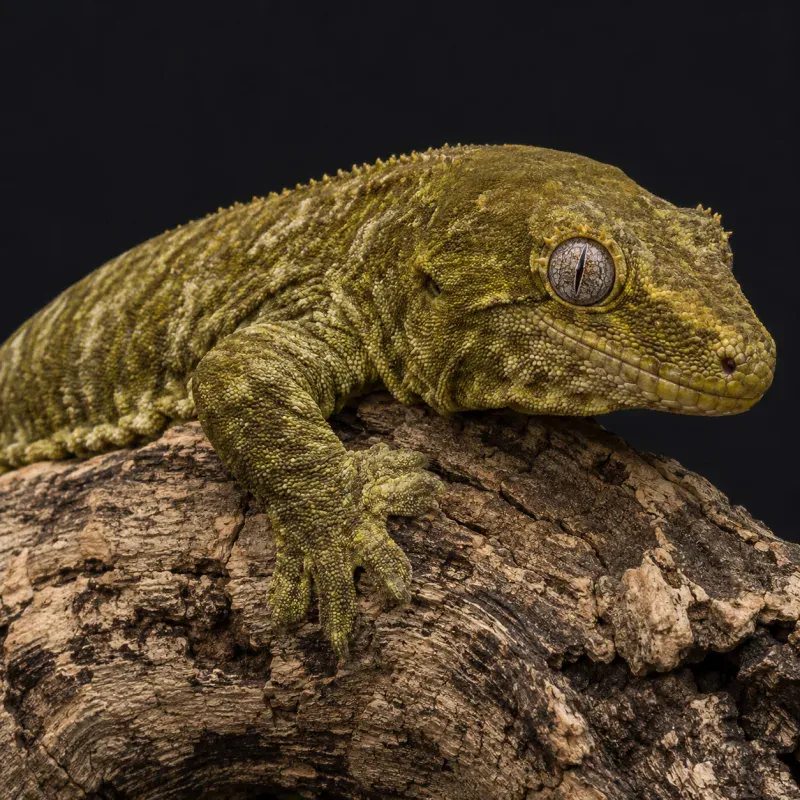
\nThe leachie gecko (Rhacodactylus leachianus) is the world's largest living gecko, reaching up to 17 inches and weighing over 300 grams. Native to the islands of New Caledonia, these giants are the holy grail of Rhacodactylus keeping — expensive, demanding, and utterly magnificent.
\nLeachies are unique among geckos for their pair-bonding behavior — they form long-term monogamous pairs in the wild and can be housed as bonded pairs in captivity (unlike almost all other reptiles). They are also vocal, producing a range of growls, barks, and whistles that are startling the first time you hear them.
\nPrice reality: A captive-bred leachie costs $800–2,000+, with rare locales (GT, Mt. Koghis, Yate) fetching $3,000–8,000. This is not an impulse-buy gecko.\n
Leachies come in several distinct locales, each with unique size and coloration. The 'Grand Terre' (GT) locale is the largest, often exceeding 14 inches, while island locales like 'Pine Island' are smaller and more colorful. Understanding locale differences helps in planning enclosure size and expectations.
\nThese geckos are arboreal and nocturnal, spending most of their lives in tree hollows and branches. Their natural habitat ranges from humid rainforests to drier coastal areas, making them adaptable but still sensitive to temperature extremes.
\n\nEnclosure Setup
\n| Life Stage | Minimum Enclosure |
|---|---|
| Juvenile | 12"×12"×18" |
| Sub-adult | 18"×18"×24" |
| Adult (single) | 24"×18"×36" |
| Adult pair | 36"×18"×36" or larger |
Leachies are heavy-bodied and need sturdy climbing structures. Cork bark rounds at least 4–6 inches in diameter serve as hides and perches. Bamboo poles should be thick (1.5"+ diameter) to support their weight. A feeding ledge at mid-height is essential. Substrate: ABG mix or coco coir with leaf litter.
\nFor a bioactive setup, add a drainage layer of clay balls, a mesh barrier, and 2–3 inches of ABG mix. Live plants like pothos, bromeliads, and ferns thrive in the humid environment and provide additional cover. Ensure all plants are reptile-safe and pesticide-free.
\nStep-by-Step Enclosure Assembly
\n- \n
- Clean the enclosure with a reptile-safe disinfectant and rinse thoroughly. \n
- Install the drainage layer (if bioactive) — 1–2 inches of clay balls or lava rock. \n
- Add the substrate — ABG mix or coco coir, 2–3 inches deep. \n
- Place climbing structures — cork bark rounds, bamboo poles, and sturdy branches. Secure them so they cannot shift or fall. \n
- Add the feeding ledge at mid-height, easily accessible for you and the gecko. \n
- Plant live plants (optional) — ensure they are well-established before adding the gecko. \n
- Set up lighting and heating — low-wattage UVB (if used) and a ceramic heat emitter on a thermostat if needed. \n
- Mist heavily and let the enclosure cycle for 2–3 days before introducing the gecko. \n
Common Enclosure Mistakes
\n- \n
- Using flimsy branches that cannot support the gecko's weight — always test by applying pressure. \n
- Overcrowding with decorations — leachies need clear climbing paths and open space. \n
- Placing the enclosure in direct sunlight — this can cause overheating. \n
- Using substrate that retains too much moisture — this can lead to bacterial growth. \n
Temperature & Humidity
\n| Parameter | Value |
|---|---|
| Daytime | 72–78°F (22–26°C) |
| Night | 65–70°F (18–21°C) |
| Humidity | 60–80% (spike to 80–90% at night) |
Like other New Caledonian geckos, leachies are heat-sensitive. Sustained temperatures above 82°F are dangerous. Most homes need no supplemental heating. If your room drops below 64°F, use a low-wattage ceramic heat emitter on a thermostat. Mist heavily in the evening; allow the enclosure to dry to 55–60% during the day.
\nMonitoring and Adjusting Climate
\nUse a digital thermometer and hygrometer placed at mid-height to track conditions. Avoid analog gauges, which are often inaccurate. For humidity, a hand-mister is fine, but an automatic misting system (e.g., MistKing) can maintain consistent spikes and dry-outs, especially for busy keepers.
\n- \n
- If humidity stays too high (above 80% during the day), increase ventilation by adding more screen mesh or reducing misting frequency. \n
- If humidity drops too low (below 50% during the day), mist more often or add a larger water dish. \n
- If temperatures exceed 82°F, move the enclosure to a cooler room, reduce heat sources, and increase airflow. \n
Seasonal Adjustments
\nIn the wild, leachies experience cooler, drier winters. You can mimic this by reducing temperatures slightly (by 2–3°F) and shortening day length for 2–3 months. This may encourage breeding behavior but is not required for maintenance.
\n\nDiet (CGD)
\nLeachies thrive on the same CGD as cresteds and gargoyles, but they eat substantially more:
\n- \n
- Staple: Pangea Gecko Diet or Repashy — mixed to ketchup consistency. \n
- Quantity: An adult leachie may consume 2–3 tablespoons of prepared CGD per feeding. \n
- Frequency: Replace every 48 hours for adults, every 24 hours for juveniles. \n
- Insects: Optional. Large dubia roaches or hornworms as occasional treats. Dust with calcium if fed. \n
- Fruit: Fresh mango, fig, or papaya as rare treats (1–2×/month). CGD is nutritionally complete. \n
Preparing and Offering CGD
\n- \n
- Mix the powder with water to a ketchup-like consistency — not too runny, not too thick. \n
- Place the prepared CGD in a shallow dish on the feeding ledge. \n
- Offer the dish in the evening, as leachies are nocturnal. \n
- Remove and replace after 24–48 hours to prevent spoilage. \n
Supplementation Guidelines
\nCGD is formulated to be complete, so additional vitamins are unnecessary. However, if you feed insects, dust them with a calcium supplement (without D3) at every feeding, and a multivitamin once a week. Never add extra calcium/D3 to CGD — this can cause overdose and health issues.
\nFeeding Troubleshooting
\n- \n
- If your leachie stops eating — check temperatures and humidity; stress or illness may be the cause. Consult a vet if it lasts more than a week. \n
- If your leachie is overweight — reduce feeding frequency to every 72 hours and cut back on treats. \n
- If your leachie is underweight — offer food more frequently, ensure the dish is accessible, and consider adding more insects. \n
Pair Bonding & Behavior
\nLeachies are one of the few reptiles that form lasting pair bonds. In the wild, males and females share tree hollows and defend territories together. In captivity, a compatible male-female pair can cohabitate peacefully for years — but introductions must be done carefully:
\n- \n
- Quarantine separately for 90 days before introduction. \n
- Introduce in a neutral enclosure — never drop a new gecko into an established one's territory. \n
- Watch for aggression: Tail wagging, charging, and biting are signs the pair is incompatible. Separate immediately. \n
- Two males will fight — often to the death. Never house males together. \n
- Vocalizations: Leachies growl, bark, and whistle. This is normal communication, not distress. \n
Step-by-Step Pair Introduction
\n- \n
- Quarantine both geckos separately for at least 90 days to monitor health. \n
- Set up a neutral enclosure (clean, no scent of either gecko) with ample hides and climbing structures. \n
- Place both geckos in the neutral enclosure simultaneously, preferably in the evening. \n
- Observe closely for the first hour. Some initial hissing is normal. \n
- If aggression occurs (biting, charging, tail wagging), separate immediately and try again after a few weeks. \n
- If they tolerate each other, continue to monitor for the first week. Provide multiple feeding ledges to avoid competition. \n
Signs of a Bonded Pair
\n- \n
- They sleep together in the same hide. \n
- They groom each other. \n
- No aggression during feeding. \n
- They vocalize softly to each other. \n
Common Pairing Mistakes
\n- \n
- Introducing in the male's enclosure — this triggers territorial aggression. \n
- Assuming all pairs will bond — some geckos simply don't get along. \n
- Not having a backup enclosure — always be ready to separate. \n
Handling
\nLeachies can be handled but require a different approach than smaller geckos:
\n- \n
- Let them come to you: Never grab. Place your hand flat and let the gecko walk onto it. \n
- Support their weight: A leachie is heavy. An unsupported body stresses them. \n
- Watch for the "leachie scream": A startled leachie produces a loud, startling growl-bark. This is defensive, not aggressive — back off and try again later. \n
- Sessions: 10–15 minutes, 2–3×/week. Leachies are tolerant but not as handleable as bearded dragons. \n
Building Trust
\n- \n
- Start by placing your hand in the enclosure for a few minutes daily, allowing the gecko to investigate. \n
- Once comfortable, gently coax the gecko onto your hand using a flat palm. \n
- Keep sessions short initially (5 minutes) and gradually increase. \n
- Always handle over a soft surface (like a bed) to prevent injury if the gecko jumps. \n
Handling Mistakes to Avoid
\n- \n
- Grabbing the tail — leachies can drop their tails (though less commonly than other geckos). \n
- Handling when stressed — wait until the gecko is calm and active. \n
- Handling after feeding — wait at least 24 hours to avoid regurgitation. \n
The Most Common Problems
\n- \n
- Heat: Overheating kills leachies faster than any other mistake. No basking lamps. No heat unless the room is actually cold. \n
- Insufficient enclosure size: An 18×18×24 is fine for a juvenile, not an adult. These are BIG geckos. \n
- Rushing pair introductions: Incompatible pairs will fight. Introduce slowly and have a backup enclosure ready. \n
- Over-supplementation: CGD is nutritionally complete. Adding extra calcium/D3 to CGD can cause overdose. \n
- Buying unsexed geckos for pairing: Two males will kill each other. Always confirm sex before attempting cohabitation. \n
- Skipping quarantine: A $2,000 leachie can be killed by pathogens from a new arrival. Quarantine is non-negotiable. \n
Health Issues and Signs
\n- \n
- Metabolic Bone Disease (MBD): Caused by lack of calcium or vitamin D3. Signs include weak limbs, tremors, and deformities. Prevent with proper diet and UVB (if used). \n
- Respiratory infections: Wheezing, mucus, or open-mouth breathing. Caused by cold or damp conditions. Consult a vet. \n
- Parasites: Weight loss, lethargy, and abnormal feces. Fecal exams are recommended annually. \n
- Stuck shed: Ensure humidity is adequate. Soak the gecko in shallow warm water if needed. \n
When to See a Vet
\nIf your leachie shows any signs of illness, consult a reptile-experienced veterinarian immediately. Do not attempt home treatments without professional guidance.
\n\nCost Breakdown: Initial & Ongoing Expenses
\nLeachies are a significant financial commitment, and planning ahead helps avoid surprises. Here's a realistic breakdown of what you'll spend:
\n| Item | Estimated Cost (USD) | Notes |
|---|---|---|
| Leachie gecko (captive-bred) | $800–2,000+ | Rare locales can cost $3,000–8,000. |
| Enclosure (adult size) | $150–400 | Glass or PVC; larger for pairs. |
| Substrate & drainage layer | $30–60 | ABG mix, clay balls, leaf litter. |
| Climbing structures (cork bark, bamboo) | $40–80 | Sturdy pieces to support weight. |
| Feeding ledge & dishes | $15–30 | Magnetic or suction cup ledges. |
| Thermometer & hygrometer (digital) | $15–40 | Essential for monitoring. |
| Misting system (optional) | $50–150 | Automatic misters save time and maintain humidity. |
| Ceramic heat emitter & thermostat (if needed) | $40–100 | Only if room drops below 64°F. |
| CGD (per month) | $10–20 | Pangea or Repashy, depending on consumption. |
| Insects (optional treats) | $5–15 per month | Dubia roaches or hornworms. |
| Vet check-up (annual) | $50–100 | Fecal exam and general health. |
Total first-year cost: Expect to spend $1,200–2,800 (excluding the gecko itself), with ongoing monthly costs of $15–35. Budgeting for emergencies (e.g., unexpected vet visits) is wise.
\n\nTroubleshooting Common Husbandry Issues
\nEven experienced keepers run into issues. Here's a quick reference for solving frequent problems:
\n| Symptom | Likely Cause | Solution |
|---|---|---|
| Lethargy, hiding more than usual | Stress, illness, or incorrect temperatures | Check temps (72–78°F day, 65–70°F night) and humidity (60–80%). Consult a vet if persistent. |
| Not eating | Stress, temperature too high/low, or illness | Verify climate, reduce handling, and offer fresh CGD. If >1 week, see a vet. |
| Skin stuck on toes or tail | Low humidity | Increase misting, provide a humid hide, or soak in shallow warm water. |
| Aggression during handling | Fear or territorial behavior | Back off, give space, and work on trust-building gradually. |
| Weight loss | Parasites, illness, or underfeeding | Schedule a fecal exam and review diet quantity. |
| Weight gain | Overfeeding or too many treats | Extend feeding interval to every 72 hours and reduce insects. |
| Excessive vocalization | Mating behavior, stress, or communication | Normal unless paired with aggression; monitor if new. |
If symptoms persist or worsen, always consult a reptile veterinarian.
\n\nFrequently Asked Questions
\nHow big do leachie geckos get?
\nLeachie geckos are the world's largest living gecko, reaching up to 17 inches in length and weighing over 300 grams. The 'Grand Terre' locale tends to be the largest, while island locales are slightly smaller.
\nCan two male leachies live together?
\nNo, two males will fight, often to the death. Never house males together. Leachies only cohabitate as compatible male-female pairs that have been properly introduced.
\nWhat do leachie geckos eat?
\nLeachies thrive on commercial gecko diet (CGD) like Pangea or Repashy, mixed to ketchup consistency. Adults may consume 2–3 tablespoons per feeding, replaced every 48 hours. Insects like dubia roaches and hornworms are optional treats, and fresh fruit like mango or papaya can be offered 1–2 times per month.
\nDo leachie geckos need a heat lamp?
\nNo, leachies are heat-sensitive and sustained temperatures above 82°F are dangerous. Most homes require no supplemental heating. If your room drops below 64°F, use a low-wattage ceramic heat emitter on a thermostat, never a basking lamp.
\nHow long do leachie geckos live?
\nWhile the article does not specify a lifespan, leachies are long-lived geckos, and with proper care, they can live for 20 years or more in captivity. This makes them a long-term commitment.
\nCan leachies be kept alone?
\nYes, leachies are naturally solitary and can thrive alone. Pair bonding is optional and only recommended for experienced keepers who can manage introductions carefully.
\nWhat is the best substrate for a leachie gecko?
\nABG mix or coco coir with leaf litter are recommended. For bioactive setups, add a drainage layer of clay balls and a mesh barrier.
\nHow often should I clean the enclosure?
\nSpot clean waste daily, replace substrate every 3–6 months (or as needed), and disinfect the enclosure monthly with a reptile-safe cleaner.
\nDo leachies need UVB lighting?
\nUVB is optional but can be beneficial. If used, provide low-wattage UVB and ensure it is not too intense. Always follow the manufacturer's guidelines for distance and duration.
\nAre leachies good for beginners?
\nNo, leachies are expensive, demanding, and require precise climate control. They are best suited for experienced keepers familiar with New Caledonian geckos.
\n\nRelated Reading
\n- \n
- Leachie Gecko Handling Guide — Taming and pair bonding. \n
- Crested Gecko Care Guide — Smaller Rhacodactylus cousin. \n
- Bioactive Enclosure Guide — Large planted vivarium setup. \n
- Leachie gecko morphs — Grande Terre, Isle of Pines, Moro and Nuu Ana locales with photos.
Check optimal temps, calculate feeding, and find your perfect species match.
References
- de Vosjoli, P. (2005). The Herpetoculture of Leachianus Geckos. Advanced Vivarium Systems.
- Repashy, A. (2010). New Caledonian Gecko Care Guide. Repashy Ventures.
- Pangea Reptile (2023). Leachie Gecko Care Sheet. Pangea Reptile LLC.
🐾 Join the Community
See how other keepers set up their enclosures, ask questions, and share your experience.
🛠️ Apply What You Learned
Check optimal temps, calculate feeding schedules, and get calcium dosage — all personalized for your species.
Comments