Heat Mat vs Overhead Heating for Reptiles
Introduction: Why Heating Method Matters for Natural Reptile Behavior
Reptiles are ectothermic, relying on external heat sources to regulate body temperature, digestion, immune function, and activity levels. In captivity, providing the right heating method is crucial not only for survival but for encouraging natural behaviors like basking, burrowing, and thermoregulation. This guide compares four popular heating options—heat mats (UTHs), ceramic heat emitters (CHEs), deep heat projectors (DHPs), and halogen bulbs—to help you choose the best setup for your reptile's species-specific needs.
Understanding Reptile Heating Basics: Basking, Ambient, and Nighttime Heat
Reptiles require a thermal gradient in their enclosure: a warm basking spot (typically 95–110°F for many diurnal species), a cool side (75–85°F), and an ambient temperature gradient in between. Nighttime temperatures can drop 5–10°F, but some species need supplemental heat if the room falls below 65°F. The heating method you choose must provide the right type of heat—radiant (infrared), conductive, or convective—to match your reptile's natural habitat and behavior.
Types of Heat
- Radiant heat: Direct, infrared energy that warms objects and surfaces (e.g., basking rocks). Best for diurnal baskers.
- Conductive heat: Heat transferred through direct contact (e.g., heat mats). Ideal for nocturnal or burrowing species.
- Convective heat: Heat transferred through air movement (e.g., ceramic heat emitters). Good for raising ambient temperatures.
Heat Mat (UTH): How It Works, Pros & Cons
An under-tank heater (UTH) or heat mat is a flat, adhesive pad that attaches to the underside of the enclosure. It produces low-intensity conductive heat that warms the substrate and surfaces directly above it.
Pros
- Low profile and easy to install
- Does not emit light (ideal for nocturnal reptiles)
- Low energy consumption
- Good for creating a localized warm spot for burrowing species
Cons
- Does not provide basking heat (no IR-A or IR-B)
- Can cause burns if not regulated with a thermostat
- May not heat the air effectively in taller enclosures
- Can interfere with natural thermoregulation if placed over the entire floor
Best for: Snakes, geckos, and other ground-dwelling, nocturnal reptiles that need belly heat for digestion.
Ceramic Heat Emitter (CHE): How It Works, Pros & Cons
A ceramic heat emitter is a screw-in bulb that produces infrared heat without visible light. It screws into a ceramic socket and can be used 24/7.
Pros
- No light emission (perfect for nighttime heating)
- Long lifespan (up to 20,000 hours)
- Raises ambient temperature effectively
- Safe with proper thermostat regulation
Cons
- Produces mostly IR-C (deep penetrating heat) but limited IR-A/B for basking
- Can dry out the enclosure (requires humidity management)
- Requires a guard to prevent burns
- Not ideal for species that need bright basking spots
Best for: Nocturnal reptiles, species requiring high ambient temperatures (e.g., ball pythons, crested geckos), and as a supplemental heat source.
Deep Heat Projector (DHP): How It Works, Pros & Cons
A deep heat projector is a specialized bulb that emits primarily IR-A and IR-B infrared waves, mimicking the sun's natural heat profile. It produces no visible light.
Pros
- Produces high-quality basking heat (IR-A/B) without light
- Penetrates deep into muscle tissue, promoting natural basking behavior
- Can be used 24/7
- Longer lifespan than halogen bulbs
Cons
- More expensive than CHEs or heat mats
- Requires a compatible dimming thermostat
- May not heat large enclosures evenly without additional sources
Best for: Diurnal and crepuscular reptiles that need quality basking heat without light disruption (e.g., bearded dragons, leopard geckos, blue-tongue skinks).
Halogen Bulb: How It Works, Pros & Cons
Halogen bulbs are bright, high-intensity bulbs that produce a concentrated beam of light and heat (IR-A and visible light). They are commonly used as basking lamps.
Pros
- Excellent for creating a bright, hot basking spot (up to 120°F)
- Produces IR-A and visible light, stimulating natural basking and UVB absorption
- Widely available and inexpensive
- Can be combined with UVB bulbs
Cons
- Emits bright light (must be turned off at night)
- Short lifespan (2,000–3,000 hours)
- Can overheat enclosures if not regulated
- Not suitable for nocturnal species
Best for: Diurnal basking reptiles like bearded dragons, uromastyx, and tortoises that require high-intensity light and heat.
Comparison Table: UTH vs CHE vs DHP vs Halogen
| Feature | Heat Mat (UTH) | Ceramic Heat Emitter (CHE) | Deep Heat Projector (DHP) | Halogen Bulb |
|---|---|---|---|---|
| Heat Type | Conductive | Radiant (IR-C) | Radiant (IR-A/B) | Radiant (IR-A + visible) |
| Light Emission | None | None | None | Bright white light |
| Best For | Nocturnal, ground-dwellers | Nocturnal, ambient heat | Diurnal/crepuscular baskers | Diurnal baskers |
| Basking Quality | Poor | Fair (IR-C only) | Excellent (IR-A/B) | Excellent |
| Night Use | Yes | Yes | Yes | No |
| Thermostat Required | Yes | Yes | Yes (dimming) | Yes |
| Lifespan | 2–5 years | Up to 20,000 hours | Up to 15,000 hours | 2,000–3,000 hours |
| Cost (Initial) | $15–30 | $20–40 | $40–70 | $10–20 |
How Each Heating Method Affects Natural Reptile Behavior
Natural basking behavior involves a reptile positioning itself under a heat source to absorb infrared radiation. Heat mats do not support this behavior because they heat from below; reptiles cannot 'bask' on a mat. CHEs provide heat but lack the IR-A/B spectrum that triggers deep tissue warming and metabolic responses. DHPs and halogens both produce IR-A/B, but halogens add visible light, which can encourage basking during the day. For species that need 12–14 hours of bright light (e.g., bearded dragons), halogen is ideal. For species that require heat without light (e.g., leopard geckos), DHP is superior.
Heating Setup: What Goes Wrong
- Using a heat mat without a thermostat: This can cause severe burns or overheating.
- Placing heat mats under the entire enclosure: This eliminates the cool side, preventing thermoregulation.
- Using a CHE for basking: CHEs do not provide the right type of heat for basking; they are better for ambient heat.
- Running halogen bulbs 24/7: This disrupts the day/night cycle and can cause stress.
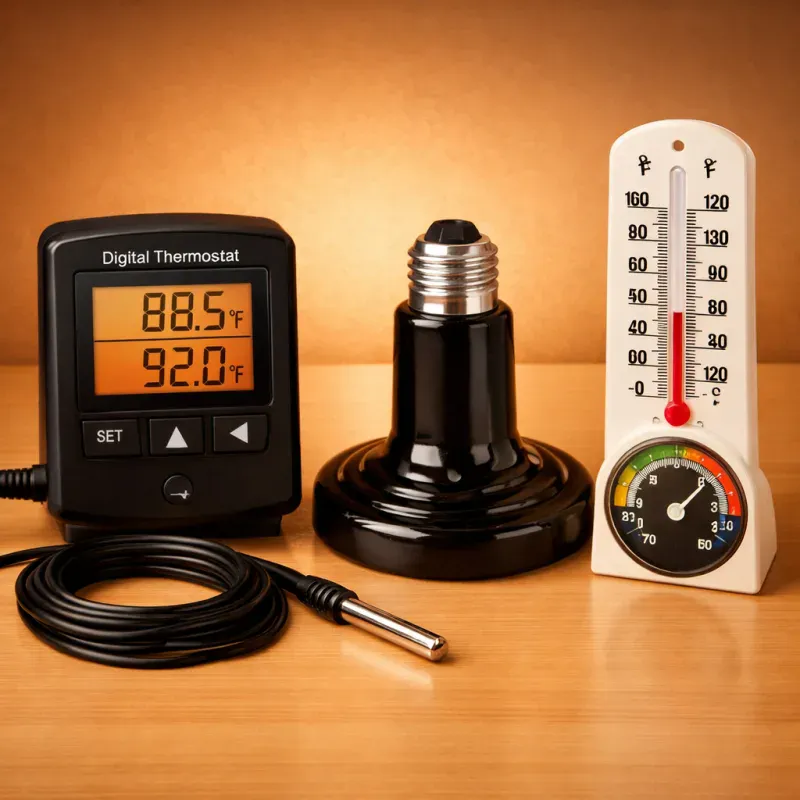
- Not measuring temperatures at the reptile's level: Always use a digital thermometer with a probe at the basking spot.
- Ignoring humidity: Overhead heating can dry out the enclosure; monitor and adjust humidity accordingly.
Final Recommendations: Choosing the Right Heat Source for Your Reptile
For most diurnal reptiles, a combination of a halogen bulb for daytime basking and a DHP or CHE for nighttime heat (if needed) is ideal. For nocturnal species, a DHP or CHE alone, paired with a heat mat for belly heat, works well. Always use a thermostat (dimming for DHPs/halogens, on/off for CHEs/heat mats) to maintain safe temperatures. Remember: the goal is to mimic the natural thermal environment of your reptile's wild habitat, encouraging healthy thermoregulation, digestion, and activity.
Related Reading
- Reptile Heating Guide: Heat Mats, Bulbs, Ceramics & ...
- Best Thermostats for Reptiles 2026: On/Off vs Propor...
- Ceramic Heat Emitter Guide: Complete CHE Setup, Ther...
Check optimal temps, calculate feeding, and find your perfect species match.
References
- Baines, F. M., & Chappell, J. (2020). Infrared heat and its role in reptile thermoregulation. Journal of Herpetological Medicine and Surgery, 30(2), 45–53.
- Gillingham, J. C., & Miller, R. E. (2018). Reptile Care: From Science to Practice. Wiley-Blackwell.
- McArthur, S., & Wilkinson, R. (2019). Essentials of Reptile and Amphibian Care. Elsevier.
- Rossi, J. V. (2016). The Reptile Medicine and Surgery Handbook. CRC Press.
🐾 Join the Community
See how other keepers set up their enclosures, ask questions, and share your experience.
🛠️ Apply What You Learned
Check optimal temps, calculate feeding schedules, and get calcium dosage — all personalized for your species.
Comments