Veiled Chameleon Care: Advanced Setup for the Casque-Head
Species Overview
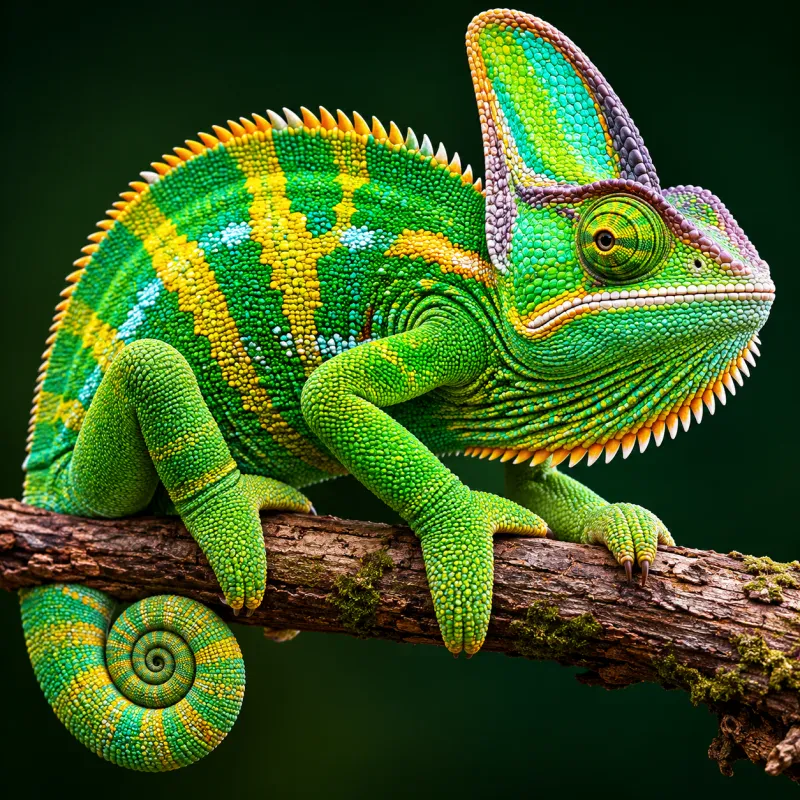
The veiled chameleon (Chamaeleo calyptratus) is the most commonly kept chameleon — but "common" does not mean easy. Native to the coastal mountains of Yemen and Saudi Arabia, they are arboreal, solitary, and exquisitely sensitive to husbandry errors. Their iconic casque (head crest) channels dew toward their mouth, an adaptation to arid mountain habitats. Veiled chameleons are watch-only pets: they do not enjoy handling.
Warning: This is an Advanced species. If you have not successfully kept a bearded dragon or blue-tongue skink for several years, do not attempt a chameleon. Their environmental requirements leave essentially zero margin for error.
In the wild, veiled chameleons experience distinct wet and dry seasons, with temperatures ranging from warm days to cooler nights. They are territorial and solitary, interacting with others only during breeding. In captivity, replicating their natural microclimate is crucial for their physical and psychological well-being. This guide covers every aspect of advanced veiled chameleon care, from enclosure setup to dietary precision.
Screen Cage Setup
Chameleons require screen cages, not glass terrariums. Glass traps stagnant air and causes respiratory infections. Minimum: 24"×24"×48" screen cage for one adult. Larger is always better — these are arboreal animals that use vertical space extensively.
Fill the cage with horizontal branches and vines at multiple heights. Live plants (pothos, ficus, schefflera) are essential — they drink from leaves and need foliage for security. No substrate is needed; bare-bottom or paper towels are safest to prevent impaction from accidental ingestion.
Choosing the Right Cage Size
While 24"×24"×48" is the minimum for an adult, veiled chameleons thrive in larger enclosures. A 36"×24"×48" or even 48"×24"×48" screen cage allows for better temperature gradients and more climbing space. For juveniles, a smaller enclosure (e.g., 16"×16"×30") can help them locate food and water more easily, but they should be moved to a full-size adult enclosure by 6–8 months of age.
Furnishing the Enclosure
- Branches: Use a variety of diameters (1–2 inches) to promote foot health. Secure them firmly to prevent falls.
- Vines: Durable, non-toxic vines provide additional climbing routes and resting spots.
- Live plants: Pothos, ficus, schefflera, and hibiscus are safe choices. They provide hydration (water droplets on leaves) and security. Ensure plants are pesticide-free and washed before placing in the cage.
- Artificial plants: Can supplement live plants, but they do not provide the same hydration benefits. Use only as decoration.
- No substrate: Bare-bottom or paper towels are safest. Substrate like bark or moss can be ingested accidentally and cause impaction.
Ventilation and Airflow
Screen cages are essential because chameleons require excellent airflow to prevent respiratory infections and fungal growth. If you live in a dry climate, you may need to mist more frequently to maintain humidity. Never use a glass terrarium, even with a mesh top, as it traps stagnant air.
Lighting & Temperature
Proper lighting and temperature are the cornerstone of veiled chameleon health. They need a basking spot, a cooler ambient zone, and a distinct nighttime drop.
| Zone | Temperature (°F) |
|---|---|
| Basking spot | 85–95°F (29–35°C) |
| Ambient daytime | 72–80°F (22–27°C) |
| Night | 60–70°F (16–21°C) — drop is essential |
UVB Lighting
- UVB: T5 HO 5.0 or 6% tube (Arcadia 6% Forest). Linear tube only — coil bulbs are inadequate.
- Placement: Position the UVB tube so it overlaps the basking area. The chameleon should be able to bask within 6–8 inches of the bulb (for T5 HO) without being able to touch it (screen top is fine).
- Replacement: Replace UVB bulbs every 6–12 months, even if they still emit visible light, as UVB output diminishes over time.
Basking Bulb
- Type: Incandescent flood (not spotlight — too focused). Place above the screen top; chameleons climb toward heat.
- Wattage: Choose a wattage that achieves the basking temperature without overheating the enclosure. Use a thermostat or dimmer to fine-tune.
- Photoperiod: Provide a 12-hour light/dark cycle. Use a timer for consistency.
Nighttime Temperature Drop
No heat at night unless room drops below 55°F. The 10–15°F drop is essential for thermoregulation and overall health. If your home is too cold, use a low-wattage ceramic heat emitter (CHE) on a thermostat set to 60°F, but avoid visible light at night.
Hydration & Drippers
Chameleons do not drink from standing water. They lap droplets from leaves. Provide:
- Dripper system: A gravity-fed or pump dripper over foliage, running several hours daily.
- Misting: 2–3× daily with a pump sprayer, or use an automatic misting system (MistKing). Veileds need moderate humidity (50–60%).
- Signs of dehydration: Sunken eyes, orange urates (should be white), wrinkled skin.
Setting Up a Dripper
- Place a dripper (e.g., a plastic cup with a tiny hole or a commercial dripper) above a dense cluster of leaves.
- Adjust the drip rate to about 1–2 drops per second, ensuring water does not accumulate in the cage.
- Run the dripper for 2–4 hours daily, ideally in the morning and early afternoon.
- Collect excess water in a shallow dish or drainage tray to avoid stagnant water.
Misting Routines
Misting serves two purposes: providing drinking water and maintaining humidity. Mist for 2–5 minutes each session, allowing leaves to become coated with droplets. An automatic misting system like MistKing can be programmed for 2–3 sessions daily. In drier climates, you may need to mist more often or use a humidifier in the room.
Monitoring Humidity
Use a digital hygrometer to track humidity levels. Veiled chameleons prefer 50–60% during the day, with a slight increase at night. If humidity is too low, increase misting frequency; if too high, improve ventilation.
Diet & Supplementation
Staples: Crickets, dubia roaches, silkworms, hornworms (hydrating). Superworms as occasional treat. Feed juveniles daily, adults every other day. Gut-load feeders 24h before offering with fresh greens and commercial gut-load.
Supplementation is critically precise:
- Calcium (no D3): Lightly dust every feeding.
- Calcium with D3: 2× per month (every other week).
- Multivitamin: 2× per month (alternating weeks with D3).
Over-supplementation with D3 is as dangerous as under-supplementation. Edema (fluid retention) under the chin or neck is a sign of D3 overdose.
Gut-Loading and Feeder Nutrition
Gut-loading is essential to ensure your feeders are nutritious. Offer feeders fresh greens (collard, mustard, dandelion) and commercial gut-load formulas 24–48 hours before feeding. Dust feeders immediately before offering to avoid the dust falling off.
Feeding Schedule by Age
| Age | Frequency | Feeder Size |
|---|---|---|
| Juvenile (1–6 months) | Daily | Small crickets (1/4 inch), small dubias |
| Subadult (6–12 months) | Every other day | Medium crickets, dubias, silkworms |
| Adult (12+ months) | Every other day | Large crickets, dubias, hornworms |
Feeder Variety and Hydration
Hornworms and silkworms are excellent hydrating feeders, especially for chameleons prone to dehydration. Superworms should be offered sparingly due to their high fat content. Always dust calcium (no D3) on every feeding, but avoid over-dusting with D3 and multivitamins.
Signs of Nutritional Issues
- MBD (Metabolic Bone Disease): Weak limbs, jaw deformities, tremors. Caused by calcium deficiency or improper UVB.
- Edema: Swelling under the chin or neck, often from excess D3 or vitamin A.
- Obesity: Overfeeding can lead to fatty liver disease. Monitor body condition.
Handling & Stress
Chameleons are not handling pets. They are solitary, territorial, and handling causes measurable stress (elevated corticosterone, darkened coloration). If you must move them, let them walk onto a stick or branch. Never grab their body — their ribs are fragile and can fracture.
Stress Reduction Techniques
- Provide hiding spots: Dense foliage allows chameleons to retreat and feel secure.
- Minimize visual disturbances: Avoid placing the cage in high-traffic areas or near other pets.
- Use a consistent routine: Feed and mist at the same times daily to reduce anxiety.
- Handle only when necessary: For cleaning or vet visits, guide the chameleon onto a stick with a gentle touch.
Signs of Stress
- Darkened coloration or stress bars (vertical lines on the body).
- Hissing or gaping mouth.
- Reduced appetite or lethargy.
- Frequent hiding.
If you notice these signs, evaluate your husbandry and reduce handling further.
Watch Out For These Issues
- Glass enclosure: Respiratory infections, fungal issues, and overheating are guaranteed. Screen cages only.
- Wrong supplementation schedule: The #1 cause of MBD and edema. Follow the schedule precisely.
- No nighttime temperature drop: Chameleons need a 10–15°F drop at night. Constant heat stresses them.
- Co-habitation: Chameleons are solitary. Housing together causes severe stress and fighting — even juveniles.
- Buying from a pet store: Most pet store chameleons arrive dehydrated and parasite-loaded. Buy from a reputable breeder.
Troubleshooting Common Problems
| Problem | Likely Cause | Solution |
|---|---|---|
| Respiratory infection (wheezing, open-mouth breathing) | Poor ventilation, glass enclosure, low temps | Switch to screen cage, increase airflow, raise ambient temps |
| Dehydration (sunken eyes, orange urates) | Insufficient misting/dripping | Increase misting frequency, add a dripper, offer hornworms |
| MBD (tremors, weak grip) | Calcium deficiency, inadequate UVB | Dust with calcium, replace UVB bulb, ensure basking temps |
| Edema (swollen neck) | Over-supplementation of D3 or vitamin A | Stop D3/multivitamin for 2 weeks, consult vet |
| Stress bars (dark vertical lines) | Handling, cohabitation, visual stress | Reduce handling, separate if cohabited, provide more foliage |
Comments