Milk Snake Care Guide: Complete Husbandry for Lampropeltis
Species Overview
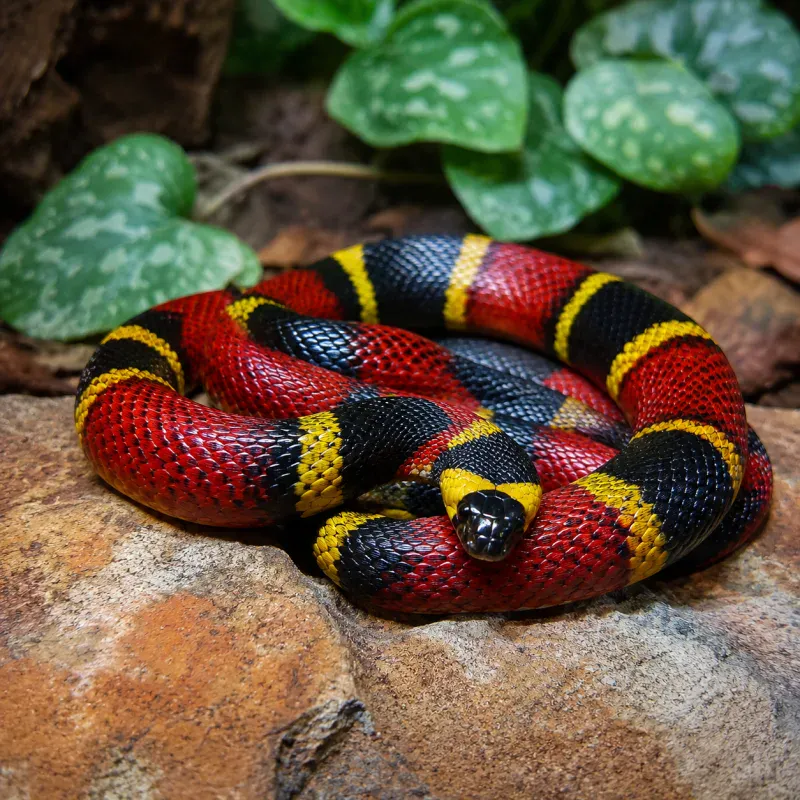
\nMilksnakes (Lampropeltis triangulum complex) are among the most beautifully patterned snakes — vivid red, black, and yellow/white bands mimicking the venomous coral snake. Closely related to king snakes, they share their easy-care nature and enthusiastic feeding response.
\nThese colubrids are found throughout the Americas, from southeastern Canada to northern South America. They inhabit a variety of environments, including grasslands, forests, rocky hillsides, and even suburban areas. Their name comes from the old myth that they suck milk from cows — a false belief that persists today. In reality, they hunt small rodents, lizards, and other snakes.
\nMilk snakes are a complex of subspecies, including the Pueblan (L. t. campbelli), Honduran (L. t. hondurensis), Nelson's (L. t. nelsoni), and the Eastern milk snake (L. t. triangulum). Each has distinct colors and patterns, but all share similar care requirements.
\nTheir docile temperament, moderate size (typically 2–5 feet depending on subspecies), and striking appearance make them excellent pets for both beginners and experienced keepers.
\n\nEnclosure Setup
\nMinimum: 20-gallon long for juveniles, 40-gallon breeder for adults. Secure lid is critical — they're slender escape artists. Substrate: aspen or cypress mulch, 2–3" deep. Two hides, branches, humid hide for shedding.
\nStep-by-Step Enclosure Setup
\n- \n
- Select the enclosure: A glass terrarium with a screen top works well. For juveniles, a 10–20 gallon tank is sufficient; adults need at least a 40-gallon breeder (36" x 18" x 16"). Larger is always better, but avoid excessive space for young snakes as it can cause stress. \n
- Ensure a secure lid: Use a locking screen lid or clips. Milk snakes are escape artists and can push through small gaps. Check the lid for any openings around tubing or wires. \n
- Add substrate: Spread 2–3 inches of aspen shavings, cypress mulch, or a paper-based substrate. Avoid cedar or pine, as their oils are toxic. Provide a slightly deeper layer in one corner to allow burrowing. \n
- Place hides: Provide at least two hides: one on the warm side and one on the cool side. They can be simple cardboard boxes, half-logs, or commercial reptile hides. Ensure each is just large enough for the snake to curl up inside. \n
- Add décor: Include branches for climbing, silk or live plants for cover, and a water dish large enough for soaking but shallow to prevent drowning. A humid hide (a container with damp sphagnum moss) should be placed in the middle or warm end. \n
- Install heating and lighting: Use an under-tank heater (UTH) or ceramic heat emitter (CHE) regulated by a thermostat. A low-wattage UVB bulb is optional but can support vitamin D synthesis. Provide a day/night cycle of 12 hours on, 12 hours off. \n
- Monitor temperature and humidity: Place thermometers on both ends and a hygrometer in the middle. Adjust as needed to maintain the ranges listed below. \n
Substrate Comparison
\n| Substrate | Pros | Cons |
|---|---|---|
| Aspen shavings | Burrowable, absorbent, low dust | Can mold if wet, not ideal for high humidity |
| Cypress mulch | Retains humidity, natural look | May be too moist for some climates |
| Paper towels | Easy to clean, cheap, safe for quarantine | Not aesthetic, no burrowing |
| Coconut husk | Holds humidity, eco-friendly | Can be dusty when dry |
Heating and Temperature
\n| Zone | Temperature |
|---|---|
| Basking | 85–88°F (29–31°C) |
| Warm side | 80–85°F (27–29°C) |
| Cool side | 72–76°F (22–24°C) |
| Night | 68–72°F (20–22°C) |
Humidity: 40–60%. Humid hide with damp moss during shed.
\nHeating Equipment Options
\n- \n
- Under-tank heater (UTH): Placed under one side of the enclosure, controlled by a thermostat. Ensure it covers about 1/3 of the floor. \n
- Ceramic heat emitter (CHE): Screws into a dome lamp, emits heat without light. Use with a thermostat and guard to prevent burns. \n
- Heat tape: Similar to UTH but more flexible; often used for rack systems. \n
- Basking bulb: Provides visible light and heat, but can dry out the enclosure. Use with a dimmer or thermostat. \n
Temperature Troubleshooting
\n- \n
- Too hot: If the warm side exceeds 88°F, reduce the thermostat setting or move the heat source further away. Ensure there is always a cool retreat. \n
- Too cold: If the cool side drops below 70°F, increase the ambient room temperature or add a low-wattage heat source. \n
- Night drop: Allow a drop to 68–72°F at night, but never below 65°F. Use a CHE without light for nighttime heating if needed. \n
Lighting and Photoperiod
\nMilk snakes are primarily crepuscular (active at dawn and dusk), but they benefit from a consistent day/night cycle. Provide 12–14 hours of light during summer and 10–12 hours in winter to mimic natural seasons. A low-wattage UVB bulb (5%) can be used to support calcium metabolism, though it is not strictly necessary if a calcium supplement is provided. Avoid bright lights that stress the snake.
\n\nHumidity and Shedding
\nMaintain ambient humidity between 40–60%. During shedding, increase humidity by misting the enclosure and providing a humid hide filled with damp sphagnum moss. Monitor humidity with a hygrometer. If the snake has difficulty shedding, soak it in shallow warm water for 10–15 minutes.
\n\nFeeding and Nutrition
\nFrozen-thawed mice: pinkies for hatchlings every 5–6 days, adult mice for adults every 7–10 days. Fast metabolism means they shouldn't go as long between meals as ball pythons.
\nFeeding Schedule by Age
\n| Age | Prey Size | Frequency |
|---|---|---|
| Hatchling (0–6 months) | Pinkie mouse | Every 5–6 days |
| Juvenile (6–18 months) | Fuzzy or hopper mouse | Every 7 days |
| Sub-adult (18–30 months) | Adult mouse | Every 7–10 days |
| Adult (30+ months) | Large adult mouse | Every 10–14 days |
How to Feed Frozen-Thawed
\n- \n
- Thaw the mouse in a sealed bag in warm water (not boiling) for 20–30 minutes until it reaches body temperature. \n
- Use tongs to present the mouse to the snake, wiggling it to simulate live prey. \n
- Allow the snake to strike and constrict. Then release the mouse and let the snake swallow. \n
- Do not handle the snake for at least 24–48 hours after feeding to avoid regurgitation. \n
Common Feeding Issues
\n- \n
- Refusal to eat: Check temperatures; too cool can reduce appetite. Try a different prey size or scenting the mouse with a lizard (rarely needed). \n
- Regurgitation: Usually due to handling too soon or temperatures too low. Wait 2 weeks before offering food again. \n
- Overfeeding: Obesity is common in captive milk snakes. Stick to the schedule and monitor body condition. \n
Handling and Temperament
\nMilk snakes are generally docile, but hatchlings may be defensive. Regular, short handling sessions (5–10 minutes, 1–2 times per week) help build trust. Support the snake's body with both hands, avoiding sudden movements. Never grab or restrain the head. If the snake musks (releases a foul-smelling secretion), wash your hands and gently rinse the snake with lukewarm water.
\nSigns of Stress
\n- \n
- Hissing or striking \n
- Musking \n
- Refusing food \n
- Excessive hiding \n
If any of these occur, reduce handling frequency and ensure the enclosure is not too exposed.
\n\nHealth and Common Issues
\nRespiratory Infections
\nSymptoms include wheezing, open-mouth breathing, and excess mucus. Causes: low temperatures or high humidity. Treatment: veterinary care, raise temperature to 85°F, and clean enclosure.
\nMites and Parasites
\nLook for tiny black dots moving on the snake or in water. Treat with reptile-safe mite spray and thoroughly clean the enclosure. Quarantine new snakes for 30 days.
\nDysecdysis (Bad Shed)
\nIncomplete sheds due to low humidity. Provide a humid hide and soak if needed.
\nRegurgitation
\nAs mentioned, often from stress or temperature issues. Withhold food for 2 weeks, then offer a smaller meal.
\n\nBreeding and Reproduction
\nBreeding milk snakes requires a brumation period (cooling) of 60–90 days at 50–60°F. After brumation, gradually raise temperatures and introduce a male. Females lay 4–15 eggs, which incubate at 82–85°F for 55–70 days. Hatchlings are independent and should be housed separately.
\n\nWhat Not to Do
\n- \n
- Escape: They can squeeze through impossibly small gaps. Lock the lid. \n
- Over-handling juveniles: Hatchlings are nervous and may musk. Brief, regular sessions build confidence. \n
- Feeding multiple small items: One appropriately-sized mouse beats several small ones. \n
- Using loose substrate that can be ingested: Avoid sand or gravel; use aspen or paper. \n
- Neglecting temperature gradients: Without a proper gradient, milk snakes cannot regulate their body temperature, leading to health issues. \n
- Handling after feeding: This can cause regurgitation. \n
Morphs and Subspecies
\nCommon subspecies include Pueblan, Honduran, Nelson's, and Eastern. Popular morphs include albino, anerythristic, and hypomelanistic. Each has unique colors and patterns, but care is identical. See milk snake morphs for photos and typical prices.
\n\nFrequently Asked Questions
\nWhat size tank does a milk snake need?
\nA 20-gallon long tank is the minimum for juveniles, while adults require at least a 40-gallon breeder. A secure lid is essential because milk snakes are skilled escape artists.
\nHow often should I feed my milk snake?
\nHatchlings should be fed pinkie mice every 5–6 days, while adults can be fed adult mice every 7–10 days. Because they have a fast metabolism, they should not go as long between meals as ball pythons.
\nWhat temperature should a milk snake's enclosure be?
\nThe basking area should be 85–88°F, the warm side 80–85°F, the cool side 72–76°F, and at night 68–72°F. Use a thermostat to maintain these ranges.
\nWhy is my milk snake not eating?
\nCheck that temperatures are within the correct ranges, as a cool enclosure can reduce appetite. Try offering a different prey size or scenting the mouse. If regurgitation occurs, wait 2 weeks before offering food again.
\n\nRelated Reading
\n- \n
- Milk Snake Morph Guide — Pueblan, Honduran, Nelson varieties. \n
- King Snake Care Guide — Similar Lampropeltis care comparison. \n
- Corn Snake Care Guide — Best beginner colubrid. \n
Check optimal temps, calculate feeding, and find your perfect species match.
References
- Bartlett, R. D., & Bartlett, P. (2006). Milk Snakes. Barron's Educational Series.
- Markel, R. (1990). The King Snake and Milk Snake. TFH Publications.
- Rossi, J. V., & Rossi, R. (2000). The Complete Milk Snake. ECO Herpetological Publishing.
🐾 Join the Community
See how other keepers set up their enclosures, ask questions, and share your experience.
🛠️ Apply What You Learned
Check optimal temps, calculate feeding schedules, and get calcium dosage — all personalized for your species.
Comments