Axolotl Water Parameters: Temp, pH, GH & KH

Introduction
Axolotls are the only common pet where the water itself is the enclosure. Get the parameters right and the animal is nearly bulletproof — it regenerates, eats greedily and lives 10–15 years. Get them wrong and you get gill shrinkage, fungus, curled gills, floating and the slow decline that keepers mistake for "just how it looks". This guide puts every number in one place, with the fix for each value and the order to fix them in.
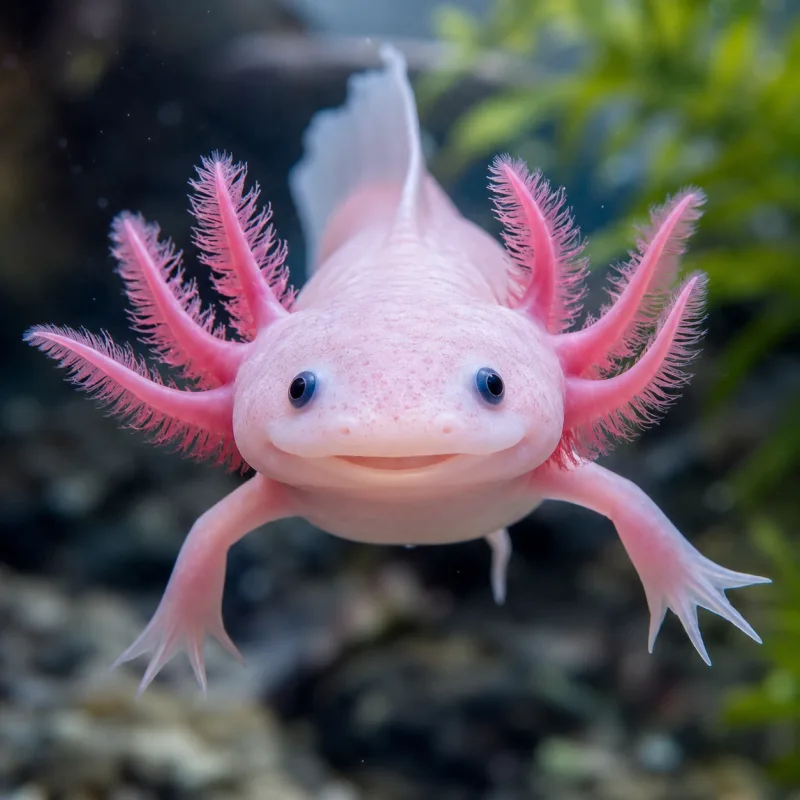
The Parameter Table
| Parameter | Target | Danger zone | Why it matters |
|---|---|---|---|
| Temperature | 60–64°F (16–18°C) | Above 72°F (22°C) | Warm water breeds fungus and bacterial infection; axolotls are cold-adapted |
| pH | 6.5–8.0 (7.4–7.6 ideal) | Below 6.0 or above 8.5 | Extremes burn gills and block ammonia processing |
| General hardness (GH) | 7–14 dGH (125–250 ppm) | Below 5 dGH | Soft water starves them of calcium and magnesium |
| Carbonate hardness (KH) | 3–8 dKH | Under 2 dKH | Low KH lets pH crash overnight |
| Ammonia (NH₃) | 0 ppm | Any readable amount | Burns gills; the most common killer in new tanks |
| Nitrite (NO₂⁻) | 0 ppm | Any readable amount | Blocks oxygen transport in blood |
| Nitrate (NO₃⁻) | Under 20 ppm, 40 ppm maximum | Above 40 ppm | Chronic stress, appetite loss, algae |
| Chlorine / chloramine | 0 ppm | Any | Destroys gill tissue within hours |
Test with a liquid kit, not strips. Strips are inaccurate enough to hide the ammonia spike that kills a juvenile.
Temperature: The Parameter That Decides Everything
Axolotls have no way to cool themselves, and warm water is the root cause behind most fungal and bacterial infections. In a typical centrally heated room, an uncovered tank will sit at 72–76°F — too warm.
- Clip-on fan blowing across the water surface: drops 3–6°F through evaporation. Top up with dechlorinated water daily.
- Aquarium chiller: the reliable answer in hot climates; expensive, but it removes the daily worry.
- Position: lowest floor of the house, away from windows, radiators and appliances.
- Do not: add ice cubes or frozen bottles directly — the swings stress the animal and the temperature yo-yos within hours.
A steady 62°F is far better than a tank that swings between 58 and 70°F. Monitor with a digital thermometer, not the stick-on dial.
pH, GH and KH: The Water Chemistry Trio
Axolotls want moderately hard, neutral-to-slightly-alkaline water. Two mistakes dominate:
- Using distilled or RO water because it is "pure". It has no minerals, so GH and KH read near zero, pH crashes, and the axolotl loses electrolytes through its skin. If your tap water is very soft, remineralise with a GH/KH buffer rather than switching to pure water.
- Chasing a specific pH with chemicals. Stability matters more than the exact number: a tank that holds 7.8 steadily is healthier than one bouncing between 6.8 and 7.6.
Crushed coral or a small bag of aragonite in the filter raises KH and buffers pH naturally if your supply is soft.
Ammonia, Nitrite, Nitrate: The Cycling Order
A new tank is not ready for an axolotl until ammonia and nitrite both read zero and nitrate is climbing — normally 4–6 weeks. If you are still cycling, see the tank cycling guide for the daily routine; adding the animal early is the single most common cause of gill loss in new keepers.
| Reading | Meaning | Action |
|---|---|---|
| Ammonia > 0 | Cycle incomplete or overfeeding | 50% water change with dechlorinated water, siphon waste, feed less |
| Nitrite > 0 | Second bacteria stage catching up | 50% changes daily until it clears |
| Nitrate 20–40 ppm | Normal end product | Weekly 25–30% water change |
| Nitrate > 40 ppm | Maintenance overdue | Two 30% changes 48 hours apart, then weekly routine |
The Weekly Water Routine
- Daily: check temperature; remove uneaten food and visible waste with a turkey baster.
- Weekly: 25–30% water change with dechlorinated, temperature-matched water; test ammonia, nitrite, nitrate and pH.
- Monthly: rinse filter media in tank water (never tap water), check GH and KH, clean glass without soap.
- Always: use a dechlorinator that also binds chloramine, and dose for the full tank volume.
Never use aquarium salt, iodine-based medications, or "general tonic" products. Axolotls are amphibians, not fish, and many fish remedies are lethal to them.
What Bad Water Looks Like on the Animal
| Sign | Likely parameter | Fix |
|---|---|---|
| Gills shrunken, gill filaments lost | Warm water, ammonia, low oxygen | Cool to 62–64°F, water changes, increase surface movement |
| White cottony tufts on gills | Fungus from warm water or injury | Cool the tank, 50% changes, treat per vet advice (never salt baths) |
| Curled gill tips forward | Stress — often temperature or current | Check temp, reduce filter flow |
| Floating, unable to settle | Gas, constipation or nitrate spike | Test nitrate, cool water, withhold food 2–3 days |
| Refusing food | Warm water, ammonia, stress | Test everything before assuming illness |
For a full symptom breakdown and when to see an exotics vet, see the axolotl health guide.
Common Mistakes
- Adding an axolotl to an uncycled tank — almost always ends in gill damage.
- Using distilled or RO water without remineralising.
- Trusting test strips, or a thermometer glued to the glass.
- Ice-cube cooling that swings the temperature by 10°F twice a day.
- Adding fish tank mates ("cleaners") that nip gills or carry disease.
- Treating with fish medications or salt, which amphibians do not tolerate.
Frequently Asked Questions
What temperature should axolotl water be?
60–64°F (16–18°C) year-round. Above 72°F, fungus and bacterial infections become likely; a clip-on fan over the surface or an aquarium chiller keeps the tank in range without daily ice-bottle swings.
What pH do axolotls need?
Between 6.5 and 8.0, ideally 7.4–7.6, and stable. Chasing an exact number with pH-down products causes more harm than a slightly high but steady reading; raise KH with crushed coral if your water is soft.
Can I use distilled water for my axolotl tank?
No. Distilled and reverse-osmosis water lack the calcium and magnesium axolotls need, and the pH crashes without carbonate hardness. Use dechlorinated tap water, or remineralise RO water before use.
How often should I change axolotl water?
Roughly 25–30% weekly once the tank is cycled, with daily removal of uneaten food and waste. If ammonia or nitrite reads above zero, change 50% daily until both return to zero.
Is aquarium salt safe for axolotls?
No. Salt and most fish medications are harmful to amphibians. Cool, clean, well-oxygenated water and a proper dechlorinator are the treatment tools you should rely on, with a vet for infections.
Related Reading
- Axolotl Tank Setup Guide — size, filter, substrate and cycling basics.
- Axolotl Tank Cycling — the 4–6 week process, step by step.
- Axolotl Health Guide — fungus, gill damage and warning signs.
- Axolotl Diet and Feeding Guide — worms, pellets and schedule.
- Axolotl Care Guide — complete husbandry reference.
Check optimal temps, calculate feeding, and find your perfect species match.
🐾 Join the Community
See how other keepers set up their enclosures, ask questions, and share your experience.
🛠️ Apply What You Learned
Check optimal temps, calculate feeding schedules, and get calcium dosage — all personalized for your species.
Comments
No account needed — corrections, updates and questions are all welcome. For a full question with photos, the community Q&A is the better place.